
Mini Review 
 Creative Commons, CC-BY
Thought Chain and Problematic Representation on “Grammar Q&A”
*Corresponding author:Mengyuan Hou, Beijing Normal University, China.
Received:October 19, 2026; Published:October 26, 2026
DOI: 10.34297/AJBSR.2026.32.004193
Abstract
“Grammar Q&A” employed a question-and-answer format between host and guest, utilizing structuralist linguistic theory for grammatical analysis. The related researcher conducted a detailed exploration from seven aspects: characteristics of Chinese grammar, word classes, subjects and objects, attributive phrases, adverbials, complements, coordinate and transitive constructions, central word analysis and hierarchical analysis, the Chinese grammatical system, and form and meaning. He particularly emphasized syntactic components, proposed a phrase-based grammatical system, advocated avoiding the constraints of “preconceived notions,” breaking free from Indo-European language interference, integrating form and meaning, and distinguishing three distinct levels—structure, semantics, and expression—while viewing Chinese with a simple perspective. The book contains many original insights, though some questions, reflections, and limitations also exist within its own structuralist linguistic framework.
Keywords:“Grammar Questions and Answers”, Linguistic Theory, Insights and Limitations,commensurability
Introduction and Theory Line
Content and Exploration: On “Grammar Q&A”
The “Grammar Q&A” continues discussions on language grammar, including classic issues such as “nominalization” and verb object handling in both Chinese and Western thought. Mr. Zhu Dexi analyzed and commented on the controversial issues in Chinese grammar research for a long time in his book “Grammar Q&A, and put forward his own views on the phenomenon of “preconceived notions” of Chinese grammar influenced by Indo European traditional concepts. He emphasized the conciseness and rigor of the language system, and the theoretical color of structural linguistics throughout the book is strong, which is reflected in the exploration of many issues such as word class transformation, subject object disputes, and sentence structure types. His achievements and limitations are also based on this.
The discussion of linguistic grammar is not confined to specific texts and language usage examples; it also manifests at the level of thought and literary theory. Meyerhold, for instance, demonstrated his own reflections in the context of relevant linguistic schools and their applications in daily life, “Discourse should be articulated with taste”[1] (P20). This experiential perception of meaning and the practical principles of referential creation are grounded in the application of sensibility. From Fauvet to Benveniste, such an ontological thread concerning language becomes even clearer.
Language Grammar Theory Travel: The point of Benveniste and Zhu Dexi
The exploration of rules, regulations, and order in Western linguistics and Chinese linguistics is situated within a knowledge framework that flows in both directions. Pure symbolic expression can be used to present the fundamental carrier elements of a sentence segment. In the process of language dissemination, the continuation of theory often helps to constrain the systematic and regular parts of language rule implementation. As Henri Berr once said, “Living language expresses all the inner activities caused by external influences on individual and collective life, although fleeting, they can be recorded in words.”[2] (P.Pre2) Speaking and writing are distributed in different dimensions of language and arranged relatively naturally at the perceptual level. In game consoles and spelling games, rules and grammar become invisible clues and tools that can be used, constantly expanding with the dynamic changes of heterogeneous interlingual communication. The habit of handwriting or eye catching may mix up or blur the relationships between words or the things they refer to, but the intervention of grammar rules will perceivable the direct impressions of the senses.
In Fang DeLiyes’ view, the processing of assimilation or ectopia in language itself varies due to changes in the regional form of language, and through the connection of physical and conceptual mapping relationships, the image of thought is established. And the process of identification reinforces this blend of irrationality and rationality, just as “attempting to establish coordination between names and things follows the same ancient psychological habits as humans”[2] (P220). The confirmation and tracing of cultural psychology integrate the compilation of words, the examination of their origins, and the extension of annotations into the ideological framework formed by language grammar. Meanwhile, the compilation and aggregation of categories solidify this form of system construction, which promote the interweave of theories. In addition, the annotation of classical literature provides a certain explanation and clarification of the treatment of classics. For the bidirectional interlingual communication between China and the West at the linguistic level during the classical period, the annotation of classical literature is based on their respective contextual appearances.
Language Theory and the Establishment and Ambiguity of Grammar Boundaries
Before we have a concrete understanding, we must see that there are many controversies in the academic community regarding the evaluation of this book, which is mainly related to the development of linguistics in the era. Firstly, regarding Mr. Zhu Dexi’s summary of the characteristics of Indo-European language [3] (P85-91), as he mentioned, “In Indo European language, there is a simple one-to-one correspondence between word classes and syntactic components”[4] (P4), it does not quite conform to reality. In English, many examples can be found of infinitives as subjects and objects, present participles and past participles as “attributives and adverbial modifiers”[5] (P6). Next is the issue of nominalization, In his book, he mentioned that “true nominalization in Chinese has formal markers” [4] (P22-23). The statement is also somewhat absolute, and there is a significant difference in understanding “true nominalization” here. He believes that the transformed components of true nouns are already complete nouns, losing the grammatical features they originally had as predicates, which seems to “ blur the boundaries of nominalization in vocabulary and grammar “[6] (P63). Next is the criticism of the phrase-based grammar system. Due to the rich connotations of sentences, simply analyzing phrases can easily conceal the overall meaning behind the sentence, and there are also some exceptions such as “transposition sentences”[ 4] (P78). Phrases and sentences cannot be fully transformed and compared to each other. Finally, there are many doubts about Mr. Zhu Dexi’s exploration and research on specific issues within the framework of structuralist linguistics, such as his determination of whether to use the verb or preposition of the word “give” when analyzing “give to him”.
Doubting and Pondering from “Grammar Q&A”
So, what does’ Grammar Q&A ‘specificall talk about, and how are its inspirations and limitations expressed?
In terms of the characteristics of Chinese grammar, Mr. Zhu Dexi pays special attention to the issue of comparative reference frames. In comparison with Indo European languages, he found that the most fundamental feature of Chinese grammar is still the lack of morphological changes. Generally speaking, due to the lack of form in Chinese, word order and function words are very important. However, when it comes to the issue of Chinese parts of speech, we cannot simply say that Chinese word order is particularly important. Specific problems need to be analyzed. For example, the word order of Latin is more flexible than that of Chinese. In Chinese, different word orders often represent different structures. However, the importance of Chinese word order is not based on this perspective.
At the same time, when comparing other languages as a reference frame, attention should be paid to emphasizing the duality of emphasis. If it can be used as a point of comparison, there must be no implicit ambiguity, otherwise there will be omissions in such comparisons. For example, as Mr. Zhu Dexi pointed out, we believe that Chinese function words are particularly important, while Indo European function words are not important. Is that okay? In practical language use, we can find many counterexamples to prove that function words cannot be omitted in Indo European languages, while function words in Chinese sentences can often be omitted. Mr. Zhu Dexi believes that the true characteristics of Chinese grammar are mainly related to two important aspects of the overall situation. Firstly, there is no simple one-to-one correspondence between Chinese word classes and syntactic components (commonly known as sentence components). Secondly, the construction principles of Chinese sentences and phrases are basically the same. These two understandings are both connected in thought with the phrase based grammar system proposed later in the text. In Indo European language, taking English as an example, verbs or adjectives can only appear in the subject object position after being transformed into nominal components through word formation or syntactic means.
On the issue of word classes, Mr. Zhu Dexi also attaches great importance to structural considerations, and there are significant differences in opinions with Mr. Lv Shuxiang and Mr. Li Jinxi. Mr. Zhu Dexi believes that dividing parts of speech based on meaning is not feasible. The basis for dividing parts of speech can only be the grammatical function of words, because the purpose of dividing parts of speech is to group words with the same or similar grammatical properties together.
Behind “Grammar Q&A”: Debate and Adjustment of Language Logic
The debate over guest language has been ongoing since the 1950s. Mr. Zhu Dexi opposes the involvement of semantic concepts such as agent and receiver in this issue, and particularly emphasizes the role of formal features. Regarding the analysis of “the presidium sitting on the stage”, the word order school believes that all nouns before the verb are subjects, and all nouns after the verb are objects, so the subject is “on the stage”. The meaning school advocates distinguishing the subject and object based on the relationship of giving and receiving, so the subject is the “presidium” of the agent.
Mr. Zhu Dexi still emphasizes hierarchy, structure, and syntax in the issues of attributive, adverbial, complement, linking, and compound forms. He believes that syntactic components are only components of syntactic structure, and discussing syntactic components cannot be separated from syntactic structure. The concept of “eight major word classes, six major components” actually simplifies complex problems. Generally speaking, when determining the components of a syntactic structure (ab), assuming the function of (a) in this structure as an example, one must not only consider its own properties (a) and the properties of its corresponding component (b), but also consider the entire structure (ab) When determining whether a modifier in a positive structure is an attributive or adverbial, the nature of the modifier itself, the nature of the central language, and the nature of the entire positive structure should be considered.
On the other hand, the “Grammar Answer” also points out that when an adverb is added before a quasi predicate positive structure, it is no longer a quasi predicate positive structure, but a true predicate positive structure, because it is no longer modified by an adjective. For example, if the handwriting is clear, an adjective “that” can be added before it. In this sense, “clear” is an adjective. If the number is unquestionable, an adjective cannot be added before it. At this time, “clear” is an adverb. This inference is very different from our usual view, and Mr. Zhu Dexi mentioned earlier that “de” can be seen as a nominalized mark. Question “[4] (P22). However, here he has abandoned the marking function of” de “, Returning to the distribution environment of phrases to explain the problem seems to make the application transformation of quasi predicate positive structures more complex.
Furthermore, there is also a great debate in the academic community regarding the discussion of linking and compound language, with some denying their existence and others advocating for their cancellation. Mr. Zhu Dexi’s viewpoint is to classify compound language as linking. Firstly, the serial verb cannot be eliminated because it is an independent syntactic structure, and the relationship between the preceding and following parts is neither subject verb nor predicate object, predicate complement, or partial positive, and cannot be attributed to any existing syntactic structure type. The form of the compound verb is “V1+N+V2”, and its difference from the serial verb lies in the relationship between N and V2. It is generally believed that N and V2 in the compound verb are subject verb relationships, but Mr. Zhu Dexi analyzed through examples and found that N and V2 are both semantic relationships. It is inappropriate to say that N is the subject or object of V2. Structurally speaking, the hierarchical structure of V1+N+V2 is (V1+N)+V2, and N and V2 are not directly corresponding to each other. Therefore, it is inappropriate to regard the conjunction as a structure opposite to the linkage. The conjunction is only one type of linkage, that is, N is the agent of V2. This treatment is in line with practical applications and is not too biased, so it may be easier for people to accept it.
Next, Mr. Zhu Dexi’s views on the analysis of central words and analytic hierarchy process are presented. He believes that hierarchy is one of the essential attributes of language, and it is an indispensable procedure for grammar analysis rather than a method that is arbitrarily abandoned. The central word analysis method is based on the foundation of analytic hierarchy process, but its internal hierarchical concept is vague and incomplete. The fundamental opposition between the two methods lies not in the central word, but in whether to recognize phrases as sentence components. The most obvious difference is that when analyzing orthonormal structures, works that use the central word analysis method mostly divide the attributive words in complex orthonormal structures into three categories: joint addition, transitive addition, and separate addition.
Conclusion and Commensurability
In the word based grammar system, subject verb object, definite verb complement, etc. are all regarded as components of phrases, so they serve as syntactic components and are internally consistent. At the same time, because there is no concept of sentence components, some direct contradictions on certain issues are naturally resolved. In this grammar system, when analyzing the structure of sentences, the hierarchical and structural relationships are clear and distinct. But as Mr. Zhu Dexi himself said in his book, sentences and phrases are ultimately two different things and cannot be confused. Not all phrases can be independent into sentences, nor can all sentences be reduced to encompassed phrases. So, can we still include them in the phrase based grammar system just because the composition of special cases conforms to the principles of phrase construction? In fact, it is difficult to say because the actual use cases of language are endless, while the framework of language rules is limited. It is difficult to achieve perfection by taking the finite from the infinite.
Overall, Mr. Zhu Dexi has indeed made his own efforts in innovating linguistic theories. We should dialectically view the inspirations and limitations of “Grammar Answers” from a historical perspective, in order to deepen our understanding and recognition in future studies (Figure 1).
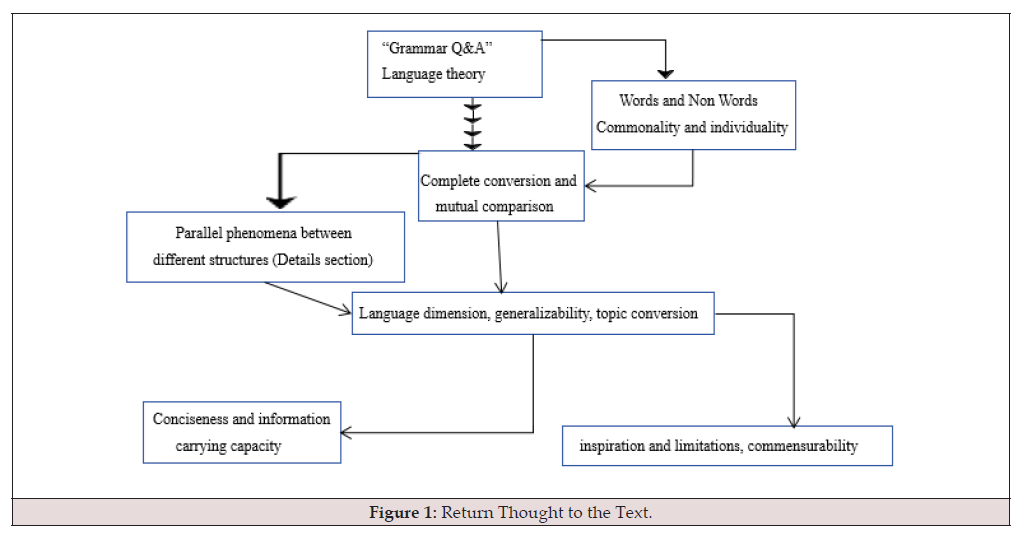
Figure 1:Return Thought to the Text.
Acknowledgements
None.
Conflict of Interest
None.
References
- A Gratkov (1986) Compiled by translated by Tong Daoming. Meyerhold's Collected Talks. Beijing: China Theatre Publishing House 20.
- Joseph Vendeliers (2012) translated by Cen Qixiang and Ye Feishen. On "Language". Beijing: Business Press 220 (Preface)2.
- Wang Li (2015) Appealing and praising should be kept away from academia - from the criticism of Mr. Zhu Dexi's "Grammar Answer" to the current chaos in the academic community. Anhui: Academic Community 85-91.
- Zhu Dexi (1985) Grammar Q&A. Beijing: Commercial Press.
- (2007) Compiled by the Folklore Classic Text Research Center of Beijing Normal University. Research on Folk Classics and Texts (Volume 4). Beijing: Commercial Press 6.
- Tandong (2009) Viewing the problem of nominalization in Chinese from the perspective of category transformation: starting from Zhu Dexi's "Grammar Answer". Shanxi: Journal of Xinzhou Normal University 63.




 We use cookies to ensure you get the best experience on our website.