
Research Article 
 Creative Commons, CC-BY
Role of Transgenic Plants & Innovative Mushroom Technology (IMT) To Control & Diagnose Ageing Diseases Caused Due To Oncological, Immunological, Autoimmune & Cardiological Disorders
*Corresponding author:Dr. Virendra Goswami and Varidhi Mohan Goswami, Indian Institute of Technology (IIT), Environment and peace foundation, Formerly University of Wisconsin and University of Illinois, USA.
Received:February 23, 2026; Published:March 05, 2026
DOI: 10.34297/AJBSR.2026.30.003925
Abstract
All living organisms on this planet belong to one of five kingdoms. Mushrooms belong to the Kingdom Fungi. Fungi include organisms such as moulds and yeasts. Fungi cannot photosynthesis, i.e., use light energy to produce food, therefore they need to obtain material for growth by some other means. Fungi are saprotrophic organisms (recyclers) that break down dead organic material to obtain nutrients. Mushrooms are the fruiting bodies of macro fungi. They include both edible/medicinal and poisonous species. Mushrooms are a good source of B vitamins, including riboflavin, niacin, and pantothenic acid, which help to provide energy by breaking down proteins, fats and carbohydrates2. B vitamins also play an important role in the nervous system.
Mushrooms are also a Source of Important Minerals: Selenium is a mineral that works as an antioxidant to protect body cells from damage that might lead to heart disease, some cancers and other diseases of ageing. It also has been found to be important for the immune system and fertility in men. Microscopic, planktonic plants, or phytoplankton, occupy the lit zone of all water bodies. These plants act as the single largest CO2 sink on earth and hence the concentrations of phytoplankton in water will be measured to estimate chlorophyll by using NMR.
Absorption: CO2 / toxic gases / responsible for Global Worming are to be studied by Absorption Spectra, Gas Chromatography, Emission Spectra & Small angle scattering for structure analysis of materials, including biological materials.
Chemisorption’s: CO2, over the solid leaf of Azedarach indica, Ocimum sanctum and mushroom (agaricus biparous) at different temperature & atmospheric pressure would be done by using BET method. Next, to use photosynthetic micro-organism. to develop the medicine responsible to nullify the toxic gases to save the human beings, plants and animal kingdom from the diseases caused by global warming e.g., breathlessness, cancer and neurological disorders. through Modified Molecular Machines (MMM) using Dynamics of RNA-protein complexes by NMR, SAS and EM Analysis. Keeping this in view efforts are being made to develop innovative technology for mushroom cultivation and evolve preventive medicines for oncological, immunological, autoimmune and cardio logical disorders. Also, the efforts are on to develop diagnostic tools through Innovative Mushroom Technology (IMT) to diagnose the symptoms of above stated Ageing diseases & other deadly diseases by studying the; Correlation of chemical characteristics absorption/desorption) of nutrient & mineral contents of Agaricus bisporus (Mushrooms) & chlorophyll enriched transgenic plants. Next, keen to develop and modify medical devices used in Sleep-apnea (e.g. Continuous Positive Airway Pressure-CPAP). Sjogren syndrome, immunoassay & other diagnostics tools for autoimmune diseases. Further, the efforts are on to develop diagnostic tools through Innovative Mushroom Technology (IMT) to diagnose the symptoms of above stated Ageing diseases & other deadly diseases by studying the; Correlation of Chemical Characteristics absorption/desorption) of nutrient & mineral contents of Agaricus bisporus (Mushrooms) & chlorophyll enriched transgenic plants. Finally, efforts would be made to investigate whether Piriformospora Indica (PFSI), acronyms such as rootonic i.e. mycorrhizal would enhance the yield of mushrooms, transgenic plants and do the value addition to other medicinal plants as well acting as plant-catalysts.
Keywords: Innovative Mushroom Technology (IMT), Mushrooms (Kingdom Fungi), Agaricus bisporus (Mushrooms), Chlorophyll Enriched Transgenic Plants, Sleep-Apnea, Continuous Positive Airway Pressure-CPAP), Sjogren Syndrome, Immunoassay, Other Diagnostics Tools for Autoimmune Diseases
Introduction
All living organisms on this planet belong to one of five kingdoms. Mushrooms belong to the Kingdom Fungi. Fungi include organisms such as moulds and yeasts. Fungi cannot photosynthesis, i.e. use light energy to produce food, therefore they need to obtain material for growth by some other means. Fungi are saprotrophic organisms (recyclers) that break down dead organic material to obtain nutrients. Mushrooms are the fruiting bodies of macro fungi. They include both edible/medicinal and poisonous species. However, originally, the word “mushroom” was used for the edible members of macro fungi, and “toadstools” for poisonous ones of the “gill” macro fungi. Scientifically the term “toadstool” has no meaning at all and it has been proposed that the term is dropped altogether in order to avoid confusion and the terms edible, medicinal and poisonous mushrooms are used [1-6].
In India only three types, namely, the white mushroom (Agaricus bisporus), the paddy-straw mushroom (Volvariella vovvacea) and the oyster mushroom (Pleurotus sajor-caju). Of these, A. bisporus is the most popular and economically sound to grow and is extensively cultivated throughout the world. Transgenic plants are being engineered with a variety of useful traits that do not always fall within the typical categories of higher yield, insect or herbicide resistance, longer shelf-life, and the like. The key technological driver behind transgenic plants is genomics. Genomics arose as part of the effort to sequence the entire human genome. Genomics will certainly influence new drug discovery to treat human diseases, but through its application to agricultural biotechnology, a proportion of our needs for fuel, fibre, food, and some medicines will one day be obtained from genetically modified plants i.e. Transgenic Plants. The examples are. Herbicide-resistant soybeans and insectresistant corn and cotton, corn, soybean, cotton, and canola, vaccines, non-plant enzymes & Flavr-Savr transgenic tomato* (introduced by *Celgene’s (Davis, CA). Numerous developments over a century or more have contributed to the current progress of agricultural biotechnology and transgenic plants. One focus of current plant-genetic engineering is the use of plant viruses, such as Tobacco Mosaic Virus (TMV), to carry foreign genes and ensure their expression in the plant.iovista.com).
Also, the first Monoclonal Antibodies (MABs) were produced in transgenic plants, paving the way for a low cost, high-yield alternative for Mab production, and confirming the potential of plants as carriers for the production of novel materials. A particularly interesting application of transgenic plants to look out for is their use for bioremediations, specifically the reclaiming of metal-contaminated soils. The future will see continued efforts to use transgenic plants for vaccine production, including even immune contraceptive vaccines, something that is extremely important in the context of eradicating disease from the developing world while also providing food. Piriformospora Indica (PFSI), acronym as rootonic i.e. mycorrhizal is a multifunctional fungus and was first discovered by Dr. Ajit Verma et.al from Thar Deserts of Western India in 1992 from the root system of several xerophytic plants Subsequently, a new family of Sebacinaceae and new order Sebacinales were erected during 1998-200, followed by another species. P. williamsii in 2011. Test plants were members of Bryophytes, Pferidophytes, Gymnosperms and Angiosperms (both mono dicots). This is a unique symbiotic fungus which not only promotes plant growth but, also multifunctional activities such as: Antioxidant & Drug Enhances, Promotes Anti-cancer Drugs, Enhance Anti-ageing Agent, Immune modulator, Biocontrol against insects and pathogens, Biofertilizer, Plant promoter, Simulator with PGPRs etc.
Objective: The present Investigation Runs into Seven Phases Viz
First, to develop an Innovative Mushroom Technology (IMT) comprising the most economical and high yield, high quality Mushroom Crop; applicable all over the country using artificially created environment of controlled temperature & humidity.
Second, to make use of Innovative Mushroom Technology (IMT) to develop the new field of immunology medicines amalgamated with drug discovery to control the ageing diseases caused due to Cardio logical (hypertension, heart attacks), oncological (cancer), & immunological disorders by using the nutrient& mineral content of the Agaricus bisporus (Mushrooms).
Third, the secondary studies would be made through transgenic plants to develop new drugs, to treat chronic ageing diseases e.g., Diabetics, arthritis, portal vein thrombosis, dementia, hyponatremia, bi-polar disorders, sleep-eupnea & sjogren syndrome in order to prevent these deadly diseases.
Fourth, The efforts would also be made to develop diagnostic tools by using Innovative Mushroom Technology (IMT) & Transgenic Plant Technology (TPT) to diagnose the above stated ageing diseases & other deadly diseases by studying the correlation of chemical characteristics (absorption/desorption) of nutrient & mineral contents of Agaricus bisporus (Mushrooms) & other transgenic plants consisting Azedarach indica, Ocimum sanctum etc to study the symptoms & develop medicines for the said ageing diseases. Also, to modify medical devices used in sleep-apnea (e.g. Continuous Positive Airway Pressure-CPAP), sjogren syndrome, immunoassay & other diagnostics tools for autoimmune diseases.
Fifth, The Chemisorptions of CO2 & other toxic gases over the solid leaf of Azedarach indica, Ocimum sanctum and Agaricus bisporus (Mushrooms) at different temperature & atmospheric pressure would be done by using BET method in order to find out those chemical elements / constituents in these Chlorophyll enriched transgenic plants responsible for either absorbing the CO2 & toxic gases or converting into O2 & non-toxic gases by developing the absorption & chemisorptions beds & catalytic / Bio Medico Catalyst Converters (BMCC.).
Sixth, to use photosynthetic micro-organism. to develop the medicine responsible to nullify the toxic gases to save the human beings, plants and animal kingdom from the diseases caused; by global warming e.g. Breathlessness, cancer and neurological disorders. through Modified Molecular Machines (MMM) using dynamics of RNA-protein complexes by NMR, SAS and EM Analysis.
Finally, the efforts would be made to investigate whether Piriformospora Indica (PFSI), acronym as rootonic i.e. mycorrhizal would enhance the yield of mushroom, transgenic plants and do the value addition to other medicinal plants as well acting as plant catalysts.
Research-Methodology
Agaricus Bisporus (Mushroom)
The white button mushroom (Agaricus bisporus) is very popular throughout the world and is the most important mushroom of commercial significance in India. It can be successfully cultivated in places where the environmental conditions are favourable but it is cultivated in North India in winter seasons due to the favourable conditions. The optimum temperature for mycelial growth is 22℃-25℃ and that for fruit body formation 14℃-18℃and a high percentage of relative humidity. The substrate for cultivation is specially prepared compost. The mushroom cultivation rooms should have facilities for temperature control and pasteurization processes. Inside the house, shelf or tray system is usually adopted for increase the area of cultivation. Buildings are constructed of wood or bamboos or hollow cement bricks or double walls. Mushroom production has some key raw materials to get good yields. Spawn, Compost and Casing Soil are three raw materials that are used in it.
Innovative Mushroom Technology (IMT)
IMT incorporates the experimental use of Piriformospora Indica (PFSI), acronyms as rootonic i.e. mycorrhizal to enhance the yield of mushroom, mushroom-transgenic plants and do the value addition to these plants by reacting as plant catalysts by way of acting as Biofertilizer, Plant promoter & biocontrol against insects and pathogens, Piriformospora Indica (PFSI), acronym as rootonic i.e. mycorrhizal is a multifunctional fungus is unique symbiotic fungus which not only promotes plant growth but, also multifunctional activities such as antioxidant & drug enhances, promotes anticancer drugs, enhance anti-ageing agent, immune modulator & simulator with PGPRs etc. The conventional process & methodology steps are used to cultivate mushrooms and mushrooms-transgenic plants.
Conventional Process Consists of the Following Steps
Compost Preparation: Agricultural by products like cereal straw (wheat, barley, paddy, oat and rice), maize stalks, hay, sugarcane bagasse or any other cellulose wastes can be used for compost preparation. Wheat straw should be freshly harvested, shining yellow in colour and should not have been exposed to rain. The straw should be in about 5-8cm long pieces, otherwise heap prepared by long straw would be less compact which may lead to improper fermentation. Conversely; too short straw makes heap too compact to allow enough oxygen to enter the centre of the heap and lead to anaerobic fermentation. Wheat straw or any of the above materials provide cellulose, hemicellulose and lignin, which are utilized by the mushroom mycelium as the carbon source. These materials also provide physical structure to the substrate needed to ensure proper aeration during composting for the buildup of microflora, which is essential for the fermentation. Since the byproducts used in composting do not have adequate nitrogen and other components required for the fermentation process, compounding mixture is supplemented with the nitrogen and carbohydrates, to start this process.
Spawning: Spawning is mixing spawn in for optimum and timely yields. Optimum dose for spawn ranges between 0.5 and 0.75% of fresh weight of compost. The optimum temperature for growth of A. bisporus is 20 degrees Celsius. Relative humidity in growing room should range from 85-90% during spawn-run.
Harvesting: Usually, 3 to 4 days after opening the bags, mushroom primordia begin to form. Mature mushrooms become ready for harvesting in another 2 to 3 days. An average biological efficiency (fresh weight of mushrooms harvested divided by airdry substrate weight x 100) can range between 80 to 150% and sometimes even more. To harvest the mushrooms, they are grasped by the stalk and gently twisted and pulled. A knife should not be used. The mushrooms remain fresh for up to 3 to 6 days in a refrigerator/cool-place.
Mushroom house / Rooms: Cube Preparation Room: An ideal room should have an R.C.C. (Reinforced Cement Concrete) floor, well-ventilated and dried.
Incubation Room: A room for spawn running. This room can be either an R.C.C. building or an Assam type room (i.e., any separate room in the house) and should be installed with shelves made of clean whole bamboo in three tiers for keeping the block. The first tier should be 100cms above the ground and the other tiers should be at least 60cms apart.
Cropping Room: An ideal house/room would be an R.C.C. building installed with proper installation and provisions for heating and cooling the rooms. However, an in order to provide a crude insulation system, a second wall is made all around the house keeping about 15cms space between the first wall and the second. Mud plastering should be done on the outside of the outside wall. The air space in between the two walls will act as an insulator, since air is a bad conductor of heat. A cropping room of 3.0X2.5X2.0m will accommodate about 35 to 40 cubes.
Method
Chop the straw either manually or mechanically into bits of 3-5cms in length and pack in gunny bags. Boil water in a drum. When the water start boiling, place the gunny bag along with the straw in the boiling water and boil as such for 15 to 20minutes. Then remove the gunny bag from the drum and leave for 8 to 10hrs. to drain the excess water and allow the straw to cool.
Another Method of Pasteurization of the Straw is by Steaming
a) Fill approximately 5cms of boiled straw and compress it with
the help of a wooden lid and sprinkle spawn over the whole
surface.
b) After the first layer of spawning, put another 5cms of straw
and again sprinkle spawn over the surface, compress it as in
the first layer.
c) Punch holes (2mm diameter) on all sides of the block for
aeration.
d) The temperature of the block should be maintained at 250C.
This can be noted by inserting a thermometer into the holes
of the block.
e) Within a week to 10 days, tiny pinheads will be seen on
the surface of the block and these will grow into full-size
mushrooms within a day or two.
f) When fruits bodies start forming, the requirement of air is
increased. Therefore, once fruit bodies start forming, it is
essential that there is an exchange of fresh air every 6 to 12hrs,
by opening the ventilator.
g) The fruits bodies (mushrooms) are ready for picking just when
the periphery of the caps starts turning upward. To harvest the
mushrooms, take hold of the stripe (stalk) at the base with
thumb and forefinger and with a gentle anti-clockwise twist,
detach the mushroom from the straw without disturbing the
straw or any small mushroom growing alongside. Do not use
knife or scissors for harvesting. The block will again come to
fruiting after about a week.
Yield
Mushrooms appear in flushes. About 2 to 3 flushes may be harvested from a single cube. The yield of the first flush is more and then gradually decreases, giving a total yield of 1.5kg to 2kg of fresh mushroom from one cube. Then the cube is discarded and dump in a pit situated far from the cropping room or can be used as manure in a garden or field.
Preservation
Mushroom can be consumed fresh or dried. Since they are highly perishable in nature, it is necessary to preserve the product for further use or for distant marketing. Hot air drying is effectively used, whereby mushrooms are dried in the equipment called “Dehydrator” After drying the mushroom, it can be stored in airtight containers or sealed in poly bags for 6 to 8 months. After complete drying, the mushroom is reduced to about 1/13th of their fresh weight which may vary depending upon the variety. The dried mushroom can be easily re-hydrated when soaked in warm water.
Precautions from Mushroom Diseases and Pests
A number of diseases and pests may attack the mushroom crop if left un-cared.
A. Disease (i): Green Mound (Trichoderma Viridine): It is
the most common disease in oyster mushroom where greencoloured
patches are observed on cubes.
B. Control: Dip a cotton swab in formalin solution (4%) and scrap
off the affected area. If the fungus attacks more than half of the
cube then the entire cube should be discarded. Care should be
taken that the contaminated cube is burnt or buried in a place
far from the cropping room to avoid re-infection.
C. Insects: Flies: Scared flies, Phorid flies, Cecid flies are found
to be attracted to mushroom and odor of spawn. They lay eggs
on the straw or mushrooms, and the larva emerging from them
damages the crop. Larva feed on the mycelium, mushroom
and penetrate inside the fruiting bodies making it unfit for
consumption.
D. Control: To check entry of adult flies during the cropping
period, screen the doors, windows or ventilators, if any
with 30mesh nylon or wire net. Use flytraps or repellent in
mushroom house.
E. Mites: These are very thin, small crawling insects that appear
on the mushroom body. They are not damaging but annoy the
grower when present in large numbers.
F. Control: Maintain the hygienic condition of the house as well
as its surroundings.
G. Slugs, Snails: These pests chew up portion of the mushroom
which may later get infected with bacteria and affect the
quality of the crop.
H. Control: Remove the pests from the cubes and kill them.
Maintain hygienic conditions.
I. Other Pests: Rodents: The attack by rodents is found mostly
in low-cost mushroom house (mud house). They eat the grain
spawn and make holes inside the cubes.
J. Control: Use rat poison bait in the mushroom house. Burrow
of rats should be close with glass pieces and plaster.
K. Ink caps (Coprinus spp.): It is a weed of mushroom
that develops on the cubes before cropping begins. They
subsequently disintegrate into a black slimming mass at
maturity.
L. Control: Physical removal of Coprinus from the cube is the
only control measure recommended.
M. Precautions: “Prevention is better than cure” is the
fundamental motto of mushroom growing since it is a very
delicate crop and curative measures are often difficult. The
mushroom itself being a fungus, when fungal diseases appear,
it is often very difficult to control as the chemicals used against
the disease may affect the mushroom itself. Thus, infinite
care has to be exercised from the very start to discourage the
entry of any foreign “germs” or contamination. The following
precautions should not be over-looked: The very first
requirement in mushroom growing is sanitation and hygienic
conditions. Most of the problems in mushroom growing arise
due to improper hygiene.
Diagrammatic Representation: (Figure 1)
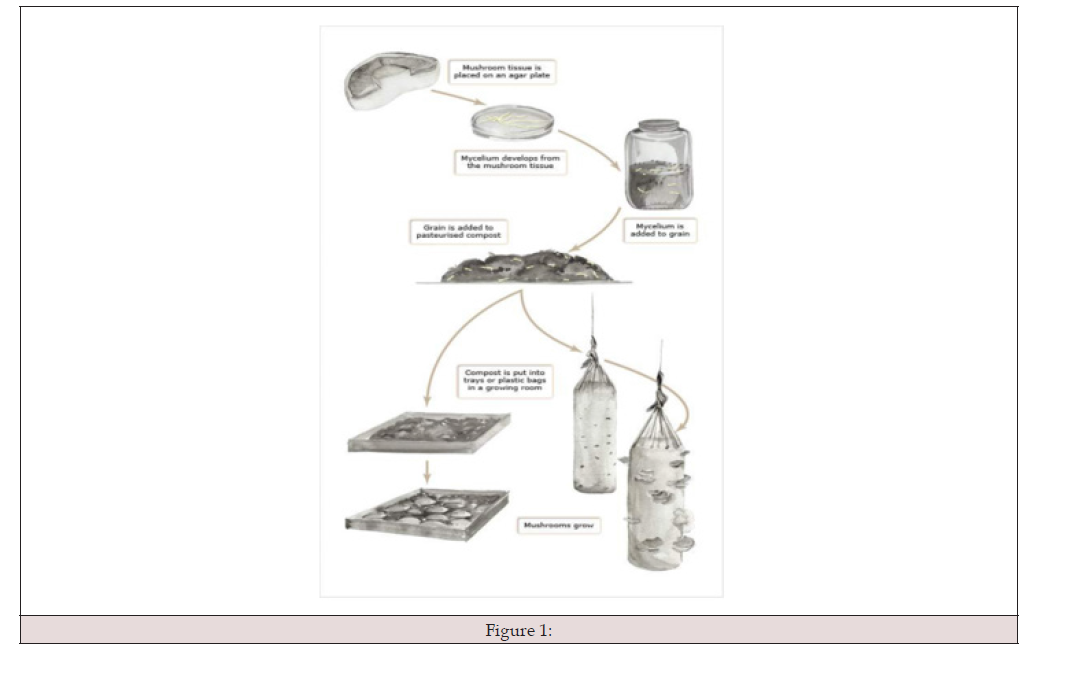
Figure 1:
Mushrooms in Control of Ageing Diseases Caused Due To Oncological, Immunological & Cardiological Disorders
Mushroom’s Nutrient Composition
Mushrooms are a good source of B vitamins, including riboflavin, niacin, and pantothenic acid, which help to provide energy by breaking down proteins, fats and carbohydrates 2. B vitamins also play an important role in the nervous system.
Pantothenic acid helps with the production of hormones and also plays an important role in the nervous system.
Riboflavin helps maintain healthy red blood cells.
Niacin promotes healthy skin and makes sure the digestive and nervous systems function properly.
Mushrooms are also a source of important minerals
Selenium is a mineral that works as an antioxidant to protect body cells from damage that might lead to heart disease, some cancers and other diseases of ageing. It also has been found to be important for the immune system and fertility in men3. Many foods of animal origin and grains are good sources of selenium, but mushrooms are among the richest sources of selenium in the produce aisle and provide 8-22mcg per serving4. This is good news for vegetarians, whose sources of selenium are limited.
Ergothioneine is a naturally occurring antioxidant that also may help protect the body’s cells. Mushrooms provide 2.8-4.9mg of ergothioneine per serving of white mushrooms.
Copper helps make red blood cells, which carry oxygen throughout the body. Copper also helps keep bones and nerves healthy.
Potassium is an important mineral many people do not get enough of. It aids in the maintenance of normal fluid and mineral balance, which helps control blood pressure. It also plays a role in making sure nerves and muscles, including the heart, function properly. Mushrooms have 98-376mg of potassium per 84 gram serving, which is 3-11 percent of the Daily Value.
Beta-glucans, found in numerous mushroom species, have shown marked immunity-stimulating effects, contribute to resistance against allergies and may also participate in physiological processes related to the metabolism of fats and sugars in the human body.
The standard Qualitative and Quantitative Pharmaceutical Method with permutation techniques of other medicinal plants (e.g. Azadirachta indica, Ocimum sanctum) will be employed to develop medicines for ageing diseases caused due to Oncological, Immunological and Cardio logical disorders.
Transgenic Plant Technology (TPT): Research Methodology for Transgenic Plants Properties
a) Chemisorptions
Chemisorptions of CO2, over the solid leaf of Azadirachta indica, Ocimum sanctum and mixture of the two in 3:1 ratio at different temperature & atmospheric pressure would be done by using BET method.
b) Absorption
Absorption of CO2 / toxic gases / responsible for Global Worming are to be studied by Absorption Spectra, Gas Chromatography, Emission Spectra & Small-angle scattering for structure analysis of materials, including biological materials.
c) Fluorescence
Fluorescence is the phenomena to absorb specific wavelengths of light by a compound and almost instantaneously emit longer wavelengths of light. A fluorescent compound e.g. Chlorophyll absorbs blue light and emits, red light. Fluorometers detect chlorophyll by transmitting an excitation beam of light in the blue range (440nm for extracted analysis and 460nm for in vivo analysis) and by detecting the light fluoresced by cells or chlorophyll in a sample at 685nm (red). Generally, this fluorescence is directly proportional to the concentration of the material in question. Fluorescence: to be measured by means of fluorometer using the two methods viz. acidification method & Non-acidification Method.
d) Chlorophyll Analysis
Chlorophyll- Fluorescence is the Most Versatile Sensitive and easy way to measure the concentrations of phytoplankton in water. Phytoplankton is present in all aquatic environments. Since, chlorophyll-containing organisms are the first step in most food chains, the health and /or abundance of these primary producers will have cascading effects to all higher organisms. Therefore, the determination of chlorophyll concentration is one of the key indices in monitoring the health of any natural system. Microscopic, planktonic plants, or phytoplankton, occupy the lit zone of all water bodies. These plants act as the single largest CO2 sink on earth and hence the concentrations of phytoplankton in water will be measured to estimate chlorophyll by using the above-mentioned NMR Techniques.
e) Also, photosynthetic Microorganism
E.g. green microalgae, cyanobacteria and purple bacteria are enriched with chlorophyll, hence, are the good source of harnessing solar energy for the production of clean fuel.
Scope
The Single particle Electron Microscopy (EM) techniques will be employed to extract biologically relevant information about proteins and macromolecular complexes. A large amount of randomly oriented images of the specimen under study (so-called particles) are collected from micrographs taken with an electron microscope. These particles are then computationally aligned and combined to yield the three-dimensional structure, which is subsequently subjected to visualization and interpretation. Since ,Mushrooms cultivated by the above innovative method has got comparatively higher Nutrient Composition ( viz. Vitamin B, Pantothenic acid ,Riboflavin & Niacin) & enriched source of important minerals( e.g. Selenium ,Copper, Potassium & Ergothioneine) would definitely help to develop the new field of immunology medicine amalgamated with drug discovery to control not only ageing diseases caused due to Cardio logical (hypertension, heart attacks),oncological (cancer),& immunological disorders but, would also lead to invent drugs as bi-product, to treat chronic ageing diseases e.g. Diabetics, arthritis, portal vein thrombosis, dementia, hyponatremia, bi-polar disorders, sleep-eupnoea & sjogren syndrome etc., and thus saving millions of life.
Also, the NMR, EM, SAS studies would reveal the Dynamics of RNA-protein & help to understand further RNA metabolism & photosynthetic micro-organism through Modified Molecular Machines. The study may open the scope of development of new field of plant catalysts.
Conflict of Interest
None.
Acknowledgement
None.
References
- VK Goswami (2010) Awaji Island, Japan: 12-16.
- VK Goswami (2007) Magnetic and Thermodynamic properties of Co 0-I, Co 0-II, Co O-I, II. J Hydrogen Mater Sci Chem Car Nanomater: 563-564.
- VK Goswami (2022) Catalytic Organic Synthesis; an eco-friendly approach. Tanuja Srivastava, DC Saxena, Dr VK Goswami. Seminar on recent advances of science and Technology, Proc Natl. SLIE T Longawal Punjab. India.
- VKGoswami (1995) Correlation of physical characteristics and catalytic activity of solid catalysts: XXth International Symposium on Macrocyclic Chemistry, Jerusalem.
- Archer David (2005) Fate of fossil fuel CO2 in geologic time. J Geophys Res 110 (C9): C09S05.1-C09S05.
- Ajit Verma, P Fraklen (1998) the properties of the fungus, Periformospora indica 97121440: 8-2015.




 We use cookies to ensure you get the best experience on our website.