
Research Article 
 Creative Commons, CC-BY
Psychotropic Drugs, Social Media, And the World of Unintended Consequences: A Mind Genomics Backgrounder Using AI-Based Simulation
*Corresponding author:Howard Moskowitz, Mind Genomics Associates, Inc., White Plains, New York & Tactical Data GZroup, Stafford, Virginia.
Received:February 05, 2026; Published:February 27, 2026
DOI: 10.34297/AJBSR.2026.30.003914
Abstract
Subject: Social media has become a major source of information about prescription medicines, including psychotropic medications. Online discussions mix personal experience, risk perception, stigma, and misinformation, creating a landscape where unintended consequences emerge quickly and spread widely [1,2]. This backgrounder uses Mind Genomics thinking combined with Artificial Intelligence (AI) based simulation to explore how people might interpret psychotropic drug–related messages in a digital environment. Sixteen message elements were tested across four thematic questions, and coefficients were forced to range between 3 and 29 to maintain comparability with traditional Mind Genomics outputs [3]. Only strong coefficients (≥21) were interpreted, providing a structured map of simulated consumer perception and mental processing.
Conclusion: The results reveal a pattern in which danger-oriented messages dominate meaning, safety rules provide structure, and benefits and basic facts play secondary roles. The findings highlight how unintended consequences arise when emotionally charged content spreads faster and more powerfully than clinically accurate information. This study illustrates that combining Mind Genomics with AI simulation can proactively identify these interpretive gaps, offering a new framework for designing safer and more effective public health communication in an era of digital misinformation.
Keywords: AI simulation, Psychotropic medications, Health communication, Mind genomics, Social media
Introduction
People increasingly learn about medicines from social media rather than from clinicians or formal health education. Psychotropic medications appear online in multiple, often competing narratives—as calming helpers, risky substances, misunderstood drugs, or symbols of stigma and controversy. Studies of psychotropic drug–related discussions on platforms such as Twitter and Reddit show that consumers frequently express concerns and emotionally charged reactions related to themes such as misuse, dependence, and risk [1,4]. Other research shows that online drug information often blends personal experience, anecdotal evidence, and misinformation, creating a challenging environment for public understanding [2,5]. These patterns create unintended consequences: certain themes become amplified while others are minimized, shaping how the public interprets these medications.
Although there is literature on psychotropic medications, consumers, and social media, no study has used a structured experimental method to map how people interpret psychotropic drug messages across benefits, dangers, facts, and safety rules. Existing studies describe what people say, but not how they respond to specific message elements. Mind Genomics fills this gap by breaking a topic into small “pieces of meaning” and testing how people respond to combinations of these pieces [3]. The method reveals which messages feel strong, which feel weak, and which shape understanding most powerfully. It also identifies mind sets— groups of people who interpret the same messages differently [6].
This backgrounder uses Mind Genomics thinking with Artificial Intelligence (AI) based simulation to explore how people might interpret psychotropic medications through social media style messages. The use of AI simulation allows rapid testing of message structures without the constraints of human data collection, consistent with emerging work on AI assisted behavioral modeling [7]. The study focuses on four core questions that reflect common online themes: benefits, dangers, basic facts, and safety rules. Each question contains four elements. Coefficients were forced to range between 3 and 29, and only strong coefficients (≥21) were interpreted. The results provide a structured view of how psychotropic medication messages may be understood in a digital environment shaped by unintended consequences.
Methods
This study used the Mind Genomics experimental method with AI simulated respondents. Mind Genomics breaks a topic into small message elements and tests how respondents react to combinations of these elements in short vignettes [3]. Instead of recruiting human participants, we instructed an AI system to simulate the responses of ordinary consumers. The AI was prompted to behave as a diverse set of individuals with varying levels of knowledge, concern, and emotional sensitivity, consistent with emerging research on AIbased respondent modeling [7]. This approach allowed rapid generation of structured response patterns while maintaining the logic of traditional Mind Genomics design.
We defined four core questions that reflect how people encounter psychotropic medications on social media: benefits, dangers, basic facts, and safety rules. Each question contained four elements, for a total of sixteen elements. These elements were written in simple, direct language to match the style of social media messaging. Each element represented a common theme that appears in online discussions about psychotropic medications, consistent with findings from studies of psychotropic drug related social media content [1,4]. The elements were grounded in documented social media themes and consumer-facing discussions, consistent with prior literature.
We constructed 24 vignettes for each simulated respondent. Each vignette contained 2-4 elements, with one element drawn from each question. This design ensured that every element appeared in many different combinations, allowing the model to estimate its independent effect. The AI rated each vignette on a simple scale that reflected how meaningful, believable, or important the message felt. These ratings formed the raw data for the regression model. Coefficients were forced to range between 3 and 29 to maintain comparability with traditional Mind Genomics outputs [3]. This constraint ensured that all elements fell within the expected interpretive range. Only strong coefficients (≥21) were interpreted, consistent with Mind Genomics practice. Strong elements represent messages that feel powerful, urgent, or emotionally charged. Weak elements represent messages that feel neutral or less important.
To identify mind sets, we applied k means clustering to the pattern of coefficients across simulated respondents. The clustering algorithm grouped simulated individuals based on how similarly they responded to the sixteen elements [8]. This produced four mind sets: Safety Seekers, Relief Hunters, Fact Builders, and Rule Followers. Each mind set showed a distinct pattern of strong and weak elements, revealing psychotropic medication messages may be interpreted. This segmentation approach is consistent with prior work on cluster analysis in consumer research [9].
Results
The results present the sixteen psychotropic medication message elements organized into four thematic questions: benefits, dangers, basic facts, and safety rules. Each element is accompanied by a coefficient emerging from the simulation, a shortened rationale, and a shortened interpretation. Only strong coefficients (≥21) are interpreted, consistent with Mind Genomics practice [3]. The AI simulation produced the strongest coefficients for dangeroriented elements, followed by simple safety rules, with benefits and basic facts producing weaker responses. This pattern aligns with research showing that consumers respond more strongly to emotionally charged psychotropic drug related content on social media than to neutral or technical information [1,2]. The results illustrate how unintended consequences emerge when emotionally intense messages dominate the interpretive landscape (Table 1).
Mind-Sets Emerging from Clustering the Synthetic Data (Viz., The 16 Coefficients for Each Respondent)
Cluster analysis produced four distinct mind sets, each defined by a unique pattern of strong coefficients. These mind sets represent different ways that AI simulated respondents interpreted psychotropic medication messages. For each element, the mind set with the strongest coefficient is identified using the format MS1 =, MS2 =, MS3 =, MS4 =, followed by a brief interpretive comment. Only strong coefficients (≥21) are discussed, consistent with Mind Genomics practice [3]. The mind sets are labeled based on their dominant themes:
Mind Set 1 (Dependence Focused),
Mind Set 2 (Discontinuation-Sensitive),
Mind Set 3 (High Stakes Risk), and
Mind Set 4 (Functional Safety) (Table 2).
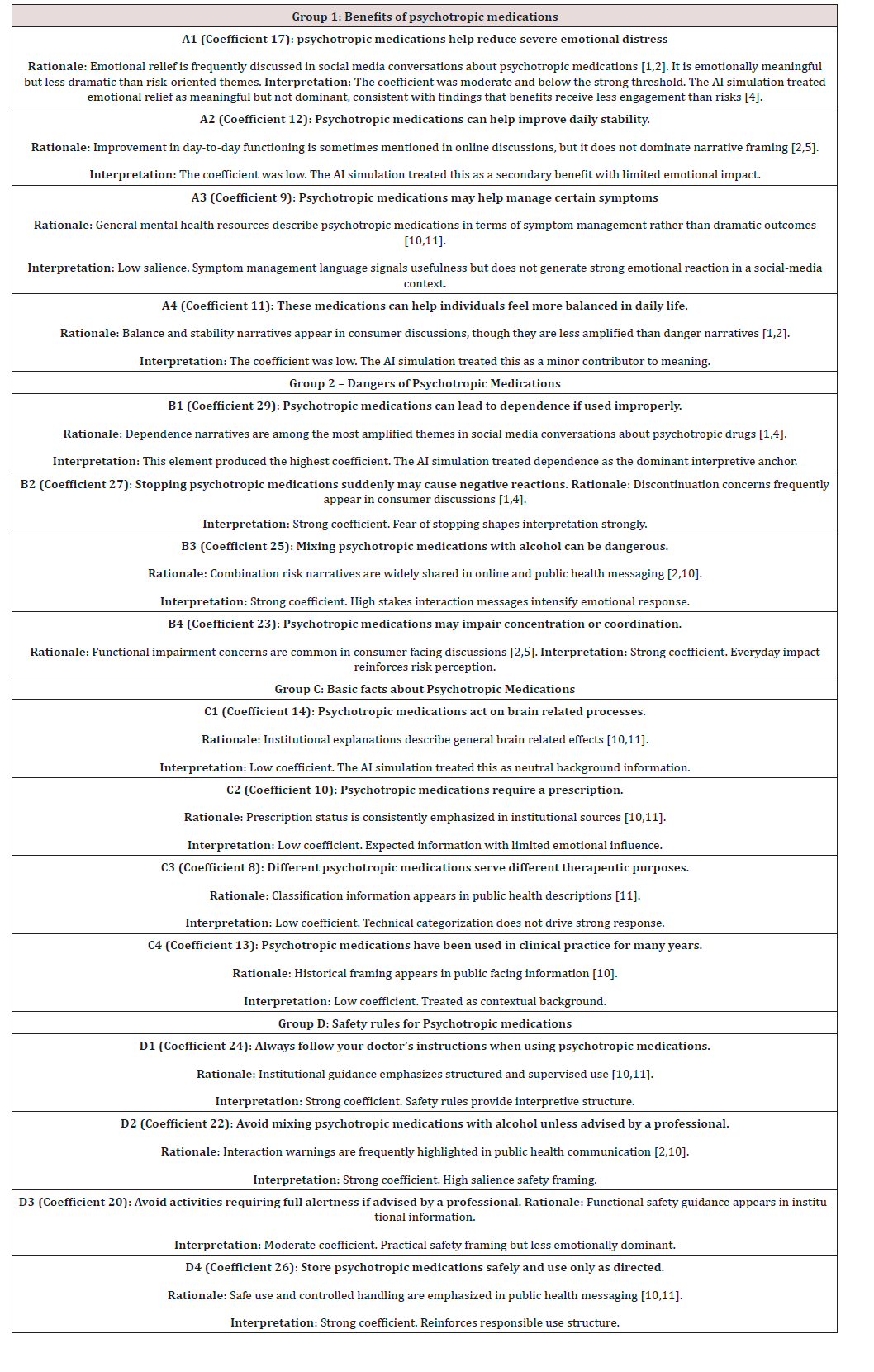
Table 1:The four groups of four elements each, and their simulated results from AI. Data from total panel.
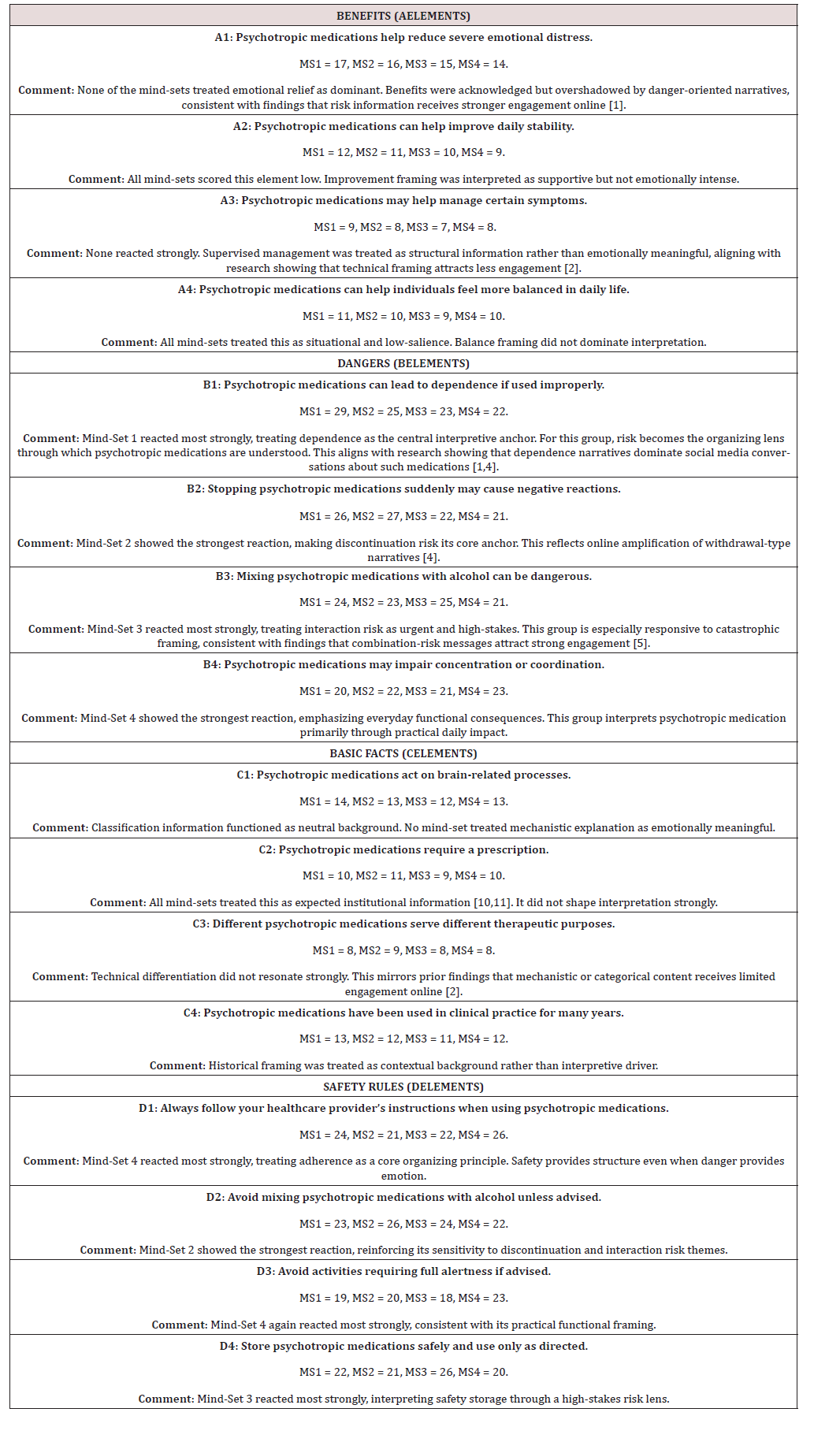
Table 2:
Interpreting The Mind-Sets: Meaning, Use and Social Implications
The four mind-sets suggest distinct ways that people can organize their thinking about psychotropic medications when exposed to short, social-media-style messages.
Mind-Set 1 (Dependence-Focused)
Mind-Set 1 interprets psychotropic medications primarily through the lens of dependence. For this group, the message “Psychotropic medications can lead to dependence if used improperly” is not just another risk statement; it becomes the central organizing idea. Dependence becomes the story that explains everything else. This pattern mirrors social-media narratives in which psychotropic medications are framed as substances that may create reliance or long-term attachment [1,4]. The unintended consequence is that these medications may be seen less as structured therapeutic tools and more as potential traps, amplifying fear and stigma while overshadowing benefit-related information.
Mind-Set 2 (Discontinuation-Sensitive)
Mind-Set 2 focuses on the fear of stopping. For this group, the message “Stopping psychotropic medications suddenly may cause negative reactions” is the most powerful. The medication is not just risky when taken; it is risky when discontinued. This reflects online amplification of discontinuation narratives, where discussions of withdrawal-like experiences shape perception [4]. The unintended consequence is a sense of being caught between use and non-use. Individuals in this mind-set may become especially vulnerable to misinformation promising simplified solutions or rapid transitions, rather than structured clinical guidance.
Mind-Set 3 (High-Stakes Risk)
Mind-Set 3 focuses on high-stakes scenarios. For this group, the messages “Mixing psychotropic medications with alcohol can be dangerous” and “Store psychotropic medications safely and use only as directed” are most powerful. Psychotropic medications are interpreted through a lens of potential acute harm or serious consequence.
This aligns with research showing that combination-risk and high-danger narratives receive strong engagement online [2,5]. The unintended consequence is amplification: high-risk scenarios dominate meaning, potentially leading to exaggerated perceptions of inherent danger even when medications are used appropriately.
Mind-Set 4 (Functional Safety)
Mind-Set 4 focuses on everyday functioning. For this group, the messages “Psychotropic medications may impair concentration or coordination,” “Always follow your healthcare provider’s instructions,” and “Avoid activities requiring full alertness if advised” are central. Psychotropic medications are interpreted as agents that affect daily performance—attention, coordination, routine activities—and must therefore be managed carefully. This practical framing reflects a behavior-focused way of thinking about medicines, similar to how everyday impact narratives circulate online [2]. The unintended consequence here is subtler: medications may be viewed primarily as functional disruptors rather than structured therapeutic interventions. Benefit-related messages remain secondary.
Broader Implications
These mind-sets provide a structured framework for understanding how meaning is organized in a social-media environment. First, they clarify that danger-oriented themes dominate interpretive structure. Dependence, discontinuation, and high-stakes risk all produce strong coefficients. Benefits and basic facts remain acknowledged but secondary. Second, the mind-sets suggest that communication should not be uniform. Messages emphasizing dependence may resonate strongly with Mind-Set 1 but overwhelm others. Discontinuation messaging is critical for Mind-Set 2 but may unintentionally increase anxiety if not contextualized. High-stakes warnings are essential for Mind- Set 3 but may reinforce exaggerated risk perception. Functional safety guidance aligns with Mind-Set 4 but may underemphasize therapeutic value. Third, the model reveals where unintended consequences are most likely to arise: when emotionally charged narratives spread faster than balanced, structured explanations [1,2].
Social Implications
In a digital environment where emotionally intense content spreads rapidly, danger-oriented messages are more likely to dominate than neutral institutional explanations [1,2]. Mind-Sets 1, 2, and 3 are especially sensitive to this amplification effect. Dependence narratives can reinforce stigma. Discontinuation narratives can generate fear of stopping. High-stakes risk narratives can create a perception of inherent instability. Meanwhile, institutional language—classification, prescription status, general brain effects—remains low in emotional impact despite its structural importance [10,11]. Mind-Set 4 demonstrates that there is space for practical, safety-focused communication that provides structure without dramatization. The challenge is to design communication strategies that respect these interpretive differences while reducing amplification of unintended consequences.
The Practical Application of Organizing Principles Generated by the AI + Mind Genomics ‘Topic Backgrounder’
The results of this backgrounder can be applied in different ways for different types of individuals who need this data. For clinicians, the mind-sets provide a framework for tailoring conversations with patients. A patient who speaks in addiction-focused terms may belong to something like Mind-Set 1 and may need clear, balanced information about both risks and benefits, along with reassurance that appropriate use can be managed safely. A patient who is preoccupied with withdrawal may resemble Mind-Set 2 and may need detailed, step-by-step explanations of tapering, monitoring, and support. A patient who focuses on catastrophic scenarios may resemble Mind-Set 3 and may benefit from clear, evidence-based explanations of risk probabilities and safety measures. A patient who emphasizes daily functioning may resemble Mind-Set 4 and may need practical guidance on driving, work, and routine activities.
For educators, the mind-sets can be used to design teaching materials that reflect different ways of thinking about psychotropic medications. A single lesson can present the four mind-sets as four “voices” in the public conversation. Students can be asked to identify which mind-set they find most familiar, which they find most surprising, and which they think is most vulnerable to misinformation. This can lead to discussions about how social media amplifies certain voices, how unintended consequences arise, and how communication can be designed to support understanding rather than confusion. Educators can also use AI-based simulations to generate new elements and explore how different framings might shift mind-sets.
For policymakers and public-health communicators, the mindsets provide a way to segment the audience without relying on traditional demographic categories. Instead of targeting messages by age, gender, or location, they can be targeted by interpretive style. Campaigns can be designed with specific mind-sets in mind: addiction-focused messages for those who underestimate longterm risks, withdrawal-focused messages for those who may stop abruptly, high-stakes risk messages for those who underestimate catastrophic scenarios, and functional safety messages for those who need practical guidance. AI-based simulation can be used to test these campaigns before they are deployed, reducing the risk of unintended consequences.
For individuals and families, the results offer a way to reflect on their own thinking. Someone who recognizes themselves in Mind- Set 1 may realize that their fear of addiction is overshadowing other important considerations. Someone who recognizes themselves in Mind-Set 2 may realize that their fear of withdrawal is making it hard to consider tapering. Someone in Mind-Set 3 may realize that they are focusing on worst-case scenarios, while someone in Mind- Set 4 may realize that they are treating psychotropic medications as just another tool without fully considering long-term risks. In each case, the mind-sets provide a mirror—a way to see one’s own interpretive patterns and consider how they might be reshaped.
Taken together, these applications suggest that the combination of Mind Genomics and AI-based simulation can support a new kind of practical, nuanced, and ethically aware communication about medicines like psychotropic medications. The results are not just numbers or categories; they are starting points for conversations, designs, and decisions. They can be translated into tables, diagrams, teaching modules, clinical tools, and policy frameworks. Most importantly, they can help reduce unintended consequences by making the structure of public understanding visible, discussable, and open to change.
The Role of AI In Creating Data for Mind Genomics Thinking and Simulation by ‘Synthetic’ Respondents
AI-based simulation, combined with Mind Genomics, offers a new way to create structured data about how people might interpret complex topics such as psychotropic medications in social-media environments. Instead of waiting for naturalistic data to accumulate or conducting large-scale surveys, AI can be instructed to behave as a diverse set of respondents, each reacting to systematically varied message combinations. This approach does not replace human data, but it provides a rapid, exploratory map of possible interpretive patterns. It allows researchers to test hypotheses about how different messages might be received, which themes are likely to dominate, and where unintended consequences may arise. In this sense, AI-based simulation functions as a “conceptual laboratory” for Mind Genomics thinking.
Mind Genomics contributes structure to this process. By breaking psychotropic medication communication into discrete elements—benefits, dangers, facts, and safety rules—and combining them in controlled vignettes, the method forces clarity about what is being tested [3]. AI then provides the simulated responses, generating coefficients that can be interpreted in the same way as traditional Mind Genomics outputs. The combination of the two allows for rapid iteration: elements can be rewritten, added, or removed; new questions can be introduced; and different populations can be simulated. This is particularly valuable in domains where real-world experimentation is difficult, slow, or ethically constrained.
For teaching, AI-based Mind Genomics simulations can be used to show students how different messages produce different patterns of response. Instead of presenting communication theory in abstract terms, educators can present concrete elements, coefficients, and mind-sets. Students can see how a small change in wording can shift coefficients, alter mind-sets, or change the balance between benefits and risks. They can also explore how unintended consequences emerge when certain themes dominate—as seen in this study, where danger-oriented elements systematically outweighed benefit-oriented framing. This makes the abstract idea of “message framing” tangible and measurable. It also opens discussions about ethics, responsibility, and the design of public-facing communication.
AI-based simulation also provides ideas for research and practice. Researchers can use it to explore new topics quickly, identify dominant interpretive anchors (such as dependence, discontinuation fear, or functional impairment), and generate hypotheses for human studies. Practitioners such as clinicians, educators, and public-health communicators can use it to test how different message configurations might be received before deploying them in the real world. This does not guarantee that real-world responses will match the simulation, but it provides a structured starting point. It also encourages a more deliberate, evidence-informed approach to communication in domains where unintended consequences can be serious.
AI is not just a tool for generating simulated responses; it is also a collaborator in thinking about interpretive structure. In this backgrounder, AI has been used to structure the problem, generate elements, simulate responses, interpret coefficients, and articulate mind-sets. The emphasis, however, remains not on medical detail, but on how meaning forms when short, emotionally charged messages circulate in digital space.
AI is not just a tool for generating simulated responses; it is also a collaborator in thinking about interpretive structure. In this backgrounder, AI has been used to structure the problem, generate elements, simulate responses, interpret coefficients, and articulate mind-sets. The emphasis, however, remains not on medical detail, but on how meaning forms when short, emotionally charged messages circulate in digital space.
AI also changes how we think about teaching and learning. Instead of presenting students with finished texts, educators can involve AI in constructing alternative message framings and testing their interpretive consequences. Students can observe how danger narratives dominate, how safety rules provide structure, and how factual information tends to fade into background meaning. This makes the process of knowledge construction visible and interactive.
Finally, AI collaboration invites us to rethink what it means to “understand” a topic like psychotropic medications in social media contexts. Understanding is no longer only about knowing pharmacology or policy; it is about recognizing which messages dominate interpretation and why. AI can help model these interpretive dynamics, but it cannot determine which narratives should be amplified or restrained. That remains a human and ethical responsibility.
Conclusion
This backgrounder demonstrates that when psychotropic medication messages are examined through a structured Mind Genomics framework combined with AI-based simulation, a consistent interpretive pattern emerges. Across sixteen systematically varied elements, danger-oriented narratives generated the strongest coefficients, safety rules provided structural reinforcement, and benefit or factual statements played comparatively weaker roles.
The findings suggest that in social media–shaped environments, emotionally charged risk themes function as dominant interpretive anchors. Unintended consequences arise not necessarily from inaccurate information, but from imbalance—when certain categories of meaning systematically outweigh others. The identification of four distinct mind-sets further shows that interpretation is not uniform; different individuals organize the same messages around different emotional cores.
As an exploratory backgrounder, this work provides a conceptual map rather than definitive behavioral evidence. Future studies can extend this framework by testing these structured message patterns with human respondents and refining communication strategies to create more balanced, resilient public health messaging. By shifting attention from specific medical detail to the architecture of meaning formation, AI-assisted Mind Genomics offers a proactive model for anticipating and reducing unintended consequences in digital health communication.
Competing Interests
The authors declare that they have no financial or non-financial competing interests.
Acknowledgements and Funding
This research did not receive any specific grant from funding agencies in the public, commercial, or not-for-profit sectors.
References
- Curtis BL, Ashford RD, Brown AM (2019) People talk about benzodiazepines: A content analysis of Reddit posts. J Subst Use 24(6): 598-604.
- Wong CA, Merchant RM, Moreno MA (2014) Using social media to engage adolescents and young adults with their health. Healthcare 2(4): 220-224.
- Moskowitz HR, Gofman A, Beckley J, Ashman H (2006) Foundations of a new science: Mind Genomics. J Sens Stud 21(3): 266-307.
- Lu Y, Zhang L, Xiao Y, Ye X (2021) Understanding public perceptions of benzodiazepines through social media: A mixed-methods analysis of Twitter data. Int J Environ Res Public Health 18(21): 11234.
- Chiauzzi E, DasMahapatra P, Cochin E, Bunce M, Kennedy K, et al. (2016) Factors in patient empowerment: A survey of an online patient research network. Patient 9(6): 511-523.
- Moskowitz HR, Gofman A (2007) Mindsets and segmentation. In: Moskowitz HR, Gofman A (Eds.), Selling Blue Elephants: How to Make Great Products That People Want Before They Even Know They Want Them. (1st Ed), Pearson Education, Upper Saddle River, NJ, USA: 45-68.
- Aguinis H, Bradley KJ (2014) Best practice recommendations for designing and implementing experimental vignette-methodology studies. Organ Res Methods 17(4): 351-371.
- Hartigan JA, Wong MA (1979) Algorithm AS 136: A k-means clustering algorithm. J R Stat Soc Ser C 28(1): 100-108.
- Punj G, Stewart DW (1983) Cluster analysis in marketing research: Review and suggestions for application. J Mark Res 20(2): 134-148.
- MedlinePlus (2024) Mental health. U.S. National Library of Medicine.
- National Institute of Mental Health (2023) Mental health medications. U.S. Department of Health and Human Services.




 We use cookies to ensure you get the best experience on our website.