
Case Report 
 Creative Commons, CC-BY
Primary Herpes Genitalis Due to Autoinoculation
*Corresponding author:Gilbert GG Donders, Department of Gynecology Regional Hospital Hart Tienen, Femicare vzw, Clinical Research for Women, Tienen, Belgium.
Received:April 03, 2026; Published:April 13, 2026
DOI: 10.34297/AJBSR.2026.30.003976
Case
A 16-year-old girl was admitted in the hospital due to severe primary genital herpes (Figure 1). She had progressive lesions since 4 days, but has now consulted because urinating had become so painful that she refrained from drinking in order to prevent micturation. A bladder catheter was placed, perineum was rinsed with aqueous Isobetadine® 3 times a day, and 500 mg acyclovir was given intravenously 3 times a day. Culture on Hela cells were unequivocally positive for HSV-1.
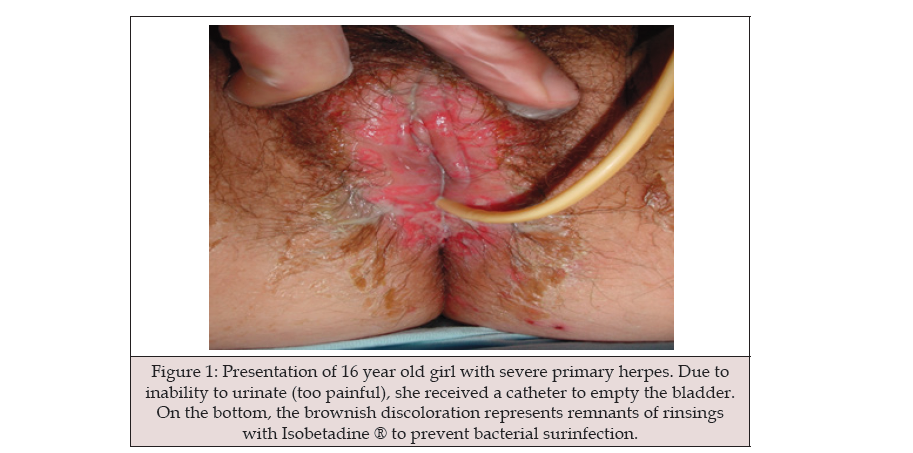
Figure 1:Presentation of 16 year old girl with severe primary herpes. Due to inability to urinate (too painful), she received a catheter to empty the bladder. On the bottom, the brownish discoloration represents remnants of rinsings with Isobetadine ® to prevent bacterial surinfection.
Her first and single boyfriend of 16 had never experienced any genital pain or lesions, and he also was a virgin before engaging into sexual contact with her. His clinical exam was negative and his serum tested negative for HSV antibodies.
During her stay in the hospital, she also showed her right index finger, which was painful, swollen and red and showed two blisters with thick skin on top, one of which had ruptured (Figure 2). She also had been suffering since a week from painful lesions on the right side of her lower lip (Figure 3). During that period she had been biting on the nail bed of her right index finger, which some days later started to become painful and red. Patient and her parent provided written consent to share this information through publication with health care workers.
The clinical picture of the lesions reminded us to a previous case where recurrent herpes on the hand had been diagnosed in a women with accidental occupational infection of HSV that had occurred during patient care (Figure 4).
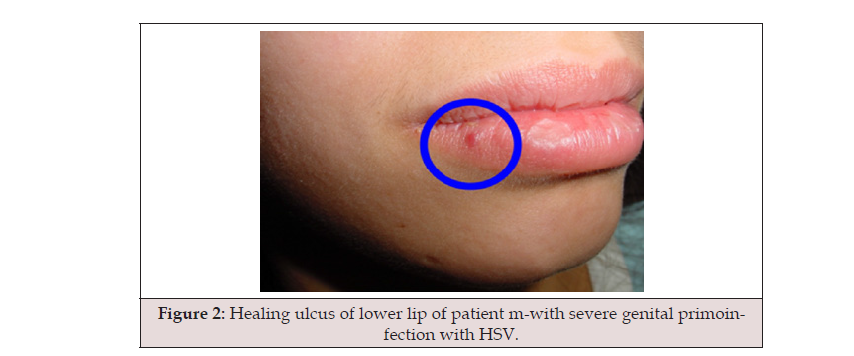
Figure 2:Healing ulcus of lower lip of patient m-with severe genital primoinfection with HSV.
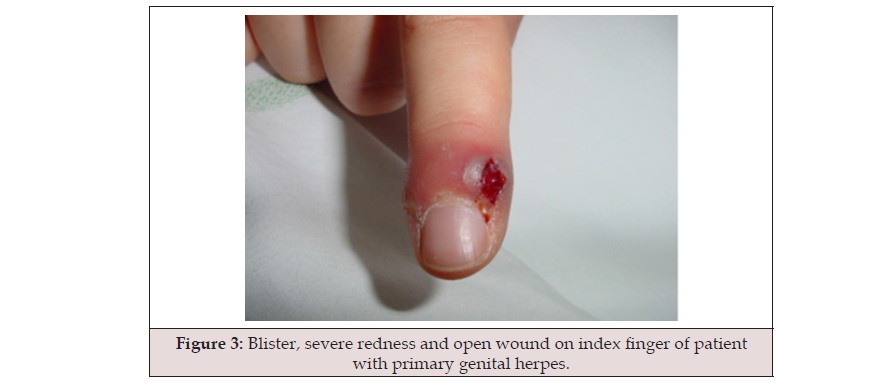
Figure 3:Blister, severe redness and open wound on index finger of patient with primary genital herpes.
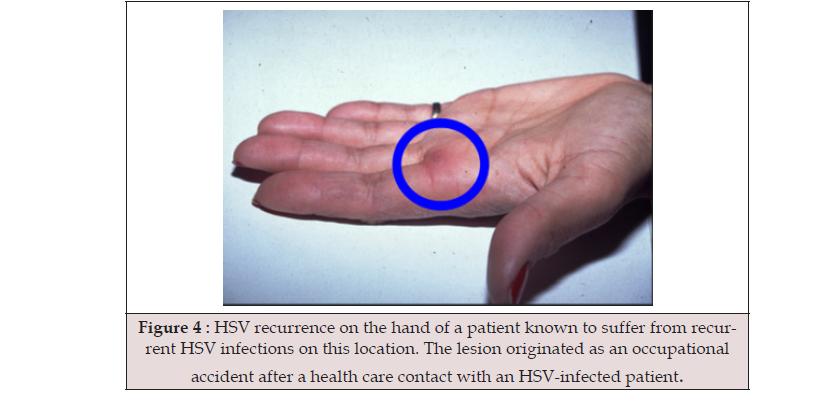
Figure 4:HSV recurrence on the hand of a patient known to suffer from recurrent HSV infections on this location. The lesion originated as an occupational accident after a health care contact with an HSV-infected patient.
Discussion
As a sexually transmitted disease, the mode of transmission of HSV herpes genitalis is generally considered to occur through genital skin-to-skin contact. However, other modes of transmission, such as accidental occupational infection (like in Figure 4) and auto-inoculation are known alternative ways to acquire the disease, both amongst adults [1] as in neonates infected by adults with labial herpes [2]. Exact knowledge of the mode of transmission is an important issue in the management and counselling of our patients, as an erroneous allegation of sexual transmissibility can cause permanent harm to the couple as well to both individuals. Due to the unremarkable clinical situation and the sero-negative status of the boyfriend in our case, from the medical history the first sexual contact on both sides, the likelihood of sexual transmission of HSV became extremely unlikely.
Furthermore, isolation of HSV type I from the genital lesions and the sequential appearance of primary herpes labialis and subsequently on the index finger of the same side, makes it very likely that the severe primary herpes genitalis was caused by autoinoculation. Our search of the literature could not demonstrate data of proven autoinoculation of herpes genitalis form herpes labialis, a mechanism however widely accepted by most authors [3]. Therefore, this seems to be the first proven case of genital herpes caused by autoinoculation of herpes labialis through an infected finger.
We therefore suggest to be cautious when discussion the mode of transmission of herpes in young patients, as auto-inoculation is clearly possible.
Acknowledgement
None.
Conflict of Interest
None.
References
- Graudal C, Jensen O, Poulsen A, Graudal N (1983) The Autoinoculation Test. False-Positive Reactions Caused by Herpes Simplex Virus. Hautarzt 34(3):130-131.
- van der WH, Weiland HT, van Doornum GJ, van der Straaten PJ, Berger HM (1985) Disseminated Neonatal Herpes Simplex Virus Infection Acquired from the father. Eur J Pediatr 144(1): 56-57.
- Malkin JE (2002) Natural history of HSV1 and HSV2 transmission modes and epidemiology consequences of HSV infection on HIV infection. Prevention]. Ann Dermatol Venereol 129(4): 571-576.




 We use cookies to ensure you get the best experience on our website.