
Review Article 
 Creative Commons, CC-BY
Harnessing AI to Revolutionize Drug Discovery
*Corresponding author:Jonathan RT Lakey, Departments of Surgery and Biomedical Engineering, University of California Irvine, Department of Cardiovascular and Thoracic Research, West Virginia University, Charlestown, West Virginia, 92605, USA.
Received:April 11, 2026; Published:April 20, 2026
DOI: 10.34297/AJBSR.2026.30.003983
Abstract
The pharmaceutical industry faces significant challenges in therapeutic development, including high failure rates, extended timelines, and substantial costs. Artificial intelligence represents a powerful solution to these challenges, offering transformative capabilities across the drug development pipeline. By harnessing AI to analyze complex biological datasets, researchers can now identify disease-relevant targets with greater precision and speed, enhancing the likelihood of clinical success and enabling tailored therapeutic approaches. While implementation challenges exist-including concerns about data quality and the complexity of biological system modeling-AI is dramatically reshaping preclinical testing landscapes. Advanced computational platforms driven by AI can now predict drug behavior and simulate human biological responses, achieving results at speeds up to 1,000 times faster than animal testing, a transition supported by regulatory agencies, including the US FDA. Practical applications of AI have already yielded impressive results, including expedited COVID-19 treatment identification and record-speed advancement of novel compounds to clinical trials. By facilitating early candidate validation and optimizing trial design, AI democratizes drug development, allowing smaller organizations to compete in a previously restricted marketplace. The ongoing integration of AI with comprehensive biological data analysis is establishing new standards in therapeutic innovation, promising more accessible, effective, and affordable treatments while reducing reliance on traditional animal testing methods.
Introduction
The development of new therapeutics is a daunting, resourceintensive endeavor marked by high failure rates, prolonged timelines, and soaring costs [1]. Each phase from target identification and preclinical studies to clinical trials and post-marketing surveillance requires navigating complex scientific, ethical, and regulatory landscapes. Traditional drug development methodologies, though responsible for remarkable medical breakthroughs, are increasingly seen as inefficient, inaccessible, and outdated. In response to these challenges, the integration of Artificial Intelligence (AI) and datadriven technologies is emerging as a transformative force, offering the potential to accelerate discovery, reduce attrition, and decrease reliance on animal testing.
The path from discovery to regulatory approval is often measured in decades and billions of dollars. The early stages, including the identification of drug targets, are particularly costly as they rely on laborious lab work and fragmented datasets, costing $50 to $100 million [2]. The subsequent preclinical phase, traditionally involving Pharmacokinetic/Pharmacodynamic (PK/ PD) modelling and toxicity testing in animals, adds another $100 to $200 million. These substantial investments rarely reach the patient’s bedside as 90% of clinical trials fail, leading to substantial financial losses and delayed access to potentially life-saving therapies emphasizing the urgent need for more predictive, costeffective methods [3].
Selecting Proper Drug Target
Identifying the right therapeutic target is arguably the most important decision in the drug development process [4,5]. The shortfalls in traditional methods have been well-documented with incomplete data and limited biological context as key components. In contrast, AI has the power to integrate and analyze massive datasets including genomic, transcriptomic, and proteomic information from humans, i.e. multi-omic datasets, to uncover patterns and causal relationships allowing for faster, more accurate identification of biologically relevant and disease-specific targets, and importantly, improving the probability of clinical success and enabling the development of personalized therapies. Notwithstanding, AI-driven discovery, while rapidly advancing, continues to face challenges. The algorithms that drive the process are only as reliable as the data they are trained on, therefore, biases, inconsistencies, and a lack of standardized formats across biomedical datasets can reduce predictive accuracy. Additionally, modeling complex biological interactions, most notably immune response(s) or multi-organ/ pathway crosstalk remains a substantial barrier, to date. The collective challenges have promulgated the struggle of regulatory agencies to evaluate AI-derived candidates, especially when generated through black-box methodologies. Nevertheless, the FDA is having ongoing discussions on how to best adapt and evaluate drug targets found through AI [6]..
Better Methods for Preclinical Testing
Animal models have long been the foundation of preclinical testing. However, high costs, ethical concerns, and poor translation to human outcomes have fueled a push toward non-animal alternatives for over a decade. Since the late 20th century, in vitro assays and molecular techniques have begun to replace animal testing in certain contexts. AI is now accelerating this shift by simulating human biology with remarkable accuracy. AIpowered platforms can predict ADMET (Absorption, Distribution, Metabolism, Excretion, and Toxicity) and PK/PD profiles to use human data for faster drug development. Furthermore, with poor translatability of animal models to human physiology, animals needlessly suffer despite minimal scientific knowledge being gained [7]. Even if AI can generate drug candidates, animal models may still be used for safety and efficacy data, posing ethical challenges while negatively impacting speed and costs of the trial. Generative AI and digital twin technologies can test thousands of compounds in silico, achieving results up to 1,000 times faster than traditional methods. The FDA’s 2025 roadmap for phasing out animal testing in biologics development by using AI marks a regulatory endorsement of these innovations.
Existing AI Solutions
Several companies have already demonstrated the disruptive potential of AI in identifying drug targets and streamlining preclinical testing (Table 1) [8-15]. These include the use of natural language processing and knowledge graphs to identify baricitinib, an FDA-approved drug for rheumatoid arthritis and alopecia areata, could be repurposed as a COVID-19 treatment. Deep learning and patient stratification have also been utilized for the development of the first AI-designed molecule to enter human trials for obsessivecompulsive disorder. In addition, the first generative adversarial networks to develop a drug for idiopathic pulmonary fibrosis allowed for reaching Phase I trials in just 18 months. Leveraging neural networks and machine learning can help identify diagnostic and prognostic biomarkers, simulate novel compound libraries, and predict pharmacological profiles. These examples highlight how AI is reducing discovery timelines, lowering costs, and improving the quality of candidate molecules.
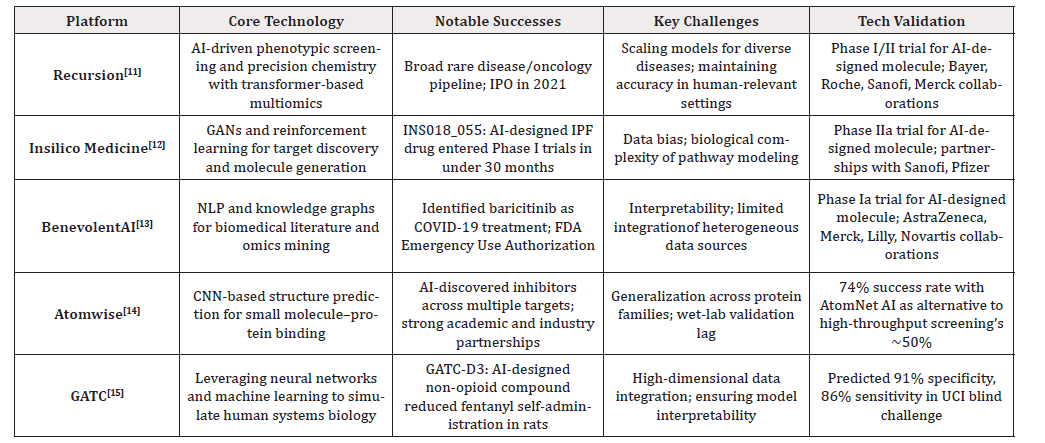
Table 1:Overview of AI-Driven Drug Discovery Platforms.
Data Source Disclaimer: The data presented in this table were compiled from publicly available information on the official websites of the companies listed.
Importance of Validation
The significance of validation for AI platforms prior to substantial investment in drug development cannot be overstated. Early-stage validation-encompassing target identification, in silico modeling, and preclinical testing-serves as a critical safeguard against the high attrition rates observed in clinical trials. Implementing robust validation processes enables researchers to identify and eliminate unpromising candidates early, thereby conserving resources and focusing efforts on more viable therapeutic avenues. This proactive approach not only enhances the probability of clinical success but also aligns with regulatory expectations, as agencies like the FDA increasingly emphasize the need for comprehensive preclinical data before advancing to human trials. Furthermore, by analyzing historical trial data, genetic profiles, and clinical outcomes, ML algorithms can transform clinical trial design through the development of more effective trial structures, identify suitable patient populations, and even personalize dosing regimens. Consequently, investing in validated platforms and ML-enabled clinical trial design is not merely a prudent strategy but a necessary step toward more efficient and effective drug development.
Levelling the Playing Field
Capital efficiency, i.e., maximizing output per dollar spent, has emerged as a necessity in the pharmaceutical industry. As the cost and risk of drug development continue to escalate, only the largest pharmaceutical firms or heavily capitalized biotech companies can afford to sustain traditional pipelines. This dynamic marginalizes smaller innovators, particularly those focused on rare or niche diseases. In this context, AI and Machine Learning (ML) offer an opportunity to accelerate the go/no-go decision-making process, reduce attrition, and support smarter portfolio management. In doing so, they empower a capital efficient strategic imperative in drug development, enabling startups and public-sector entities to compete more effectively.
Conclusion
The convergence of AI, big data, and systems biology is revolutionizing drug discovery and development. By improving precision and translational efficiency as well as reducing time and cost, revolutionary platforms once thought of only as science fiction are setting new benchmarks for how we identify, develop, and validate therapeutic candidates, all while paving the way to a post-animal-testing era. This transformation holds promise not just for pharmaceutical companies but for patients worldwide, offering hope for faster, safer, and more cost-effective treatments. As technology continues to advance and regulatory agencies adapt, AI-driven platforms will redefine what is possible in biomedical research and therapeutics, ushering in a smarter, more compassionate future for drug development.
Author Contribution
DG and JTL assisted with ideation and writing the manuscript. IJ and LM provided edits to further improve the manuscript.
Conflict of Interest Statement
Ian Jenkins is an employee of GATC Health, a biotechnology company involved in AI-driven drug discovery. The views expressed in this manuscript are those of the authors and do not necessarily reflect the views of GATC Health. All other authors declare no competing interests.
Description (1-2 Sentences)
Drug discovery is a time- and resource-intensive process that often results in unsuccessful clinical trials. But with greater advances in artificial intelligence, we can expedite the development of novel therapeutics to provide more life-changing treatments..
References
- Sertkaya A, Beleche T, Jessup A and Sommers BD (2024) Costs of drug development and research and development intensity in the US, 2000-2018 JAMA Netw Open 7(6): e2415445.
- Strokach A, Becerra D, Corbi Verge C, Perez Riba A and Kim PM (2020) Fast and flexible protein design using deep graph neural networks. Cell Syst 11(4): 402-411.e4.
- Sun D, Gao W, Hu H and Zhou S (2022) Why 90% of clinical drug development fails and how to improve it? Acta Pharm Sin B 12(7): 3049-3062.
- Lakey JRT, Casazza K, Lernhardt W, Mathur EJ and Jenkins I (2025) Machine learning and augmented intelligence enables prognosis of type 2 diabetes prior to clinical manifestation Curr Diabetes Rev 21(8): e010224226610.
- Jenkins I, Uffens J, Lernhardt W, Casazza K and Lakey J (2024) Future of Precision Medicine: Artificial Intelligence Guided Polypharmacology and Rational Polypharmacy Interventions. Am J Biomed Sci Res 21.
- https://www.fda.gov/media/167973/download?attachment
- Singer M and Akhtar A (2024) With What Should We Replace Nonhuman Animals in Biomedical Research Protocols?.
- Diwan R, Bhatt H., Beaven E and Nurunnabi M (2024) Emerging delivery approaches for targeted pulmonary fibrosis treatment. Adv Drug Deliv Rev 204: 115147.
- Miller MI, Shih LC and Kolachalama VB (2023) Machine learning in clinical trials: A primer with applications to neurology. Neurotherapeutics 20(4): 1066-1080.
- Yang Z, Zeng X, Zhao Y and Chen R (2023) AlphaFold2 and its applications in the fields of biology and medicine. Signal Transduct Target Ther 8(1): 115.
- https://www.recursion.com/
- https://insilico.com/
- https://www.benevolent.com/
- https://www.cas.org/solutions/biofinder
- https://www.gatchealth.com/




 We use cookies to ensure you get the best experience on our website.