
Review Article 
 Creative Commons, CC-BY
Anomalous Phenomena of the Glacier Zone of the Fedchenko Glacier (Continued, Part Two)
*Corresponding author:Davlyatov Rashid Rakhimovich, Member of five expeditions on the Fedchenko glacier. National expert of the “HEIGE” project (UNESCO)./p>
Received:February 16, 2026; Published:March 04, 2026
DOI: 10.34297/AJBSR.2026.30.003922
Abstract
A pulsating glacier is one of the unsolved phenomena that occurs in Nature. In this article I would like to continue to talk about the glacier basin of the Fedchenko glacier, we will talk about the Medvezhy glacier. Now it is difficult to find his historical name, and when it stuck with him. In my opinion, the unnamed glacier was nicknamed for its peculiar behavior, which it possesses and resembles a waking bear after a winter sleep. The time periods of its pulsations are 10-12-15 years, and historical notes about the “movement of the glacier” are very scarce, but plausible.
Keywords: Global Warming, Glacier Pulsation, Glacier Degradation, Average Air Temperature, Precipitation Amount, Excessive Humidity, Glacier Zone
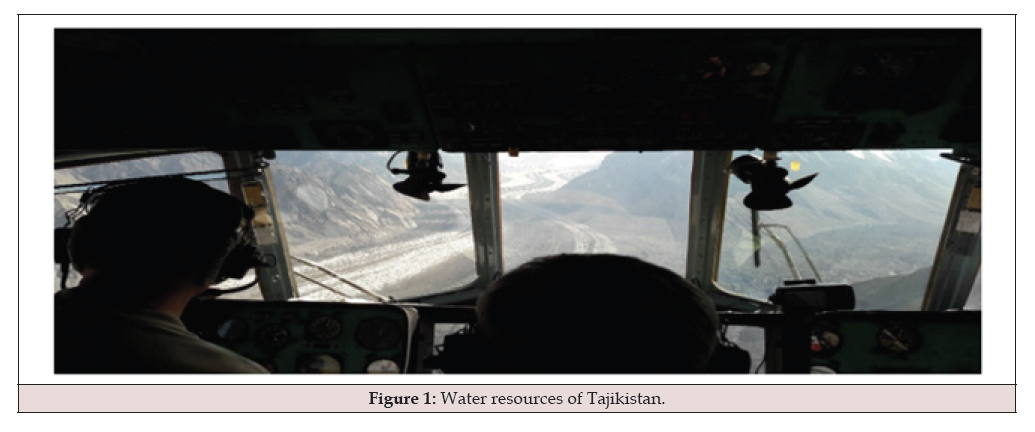
Figure 1:Water resources of Tajikistan.
The Third National Communication of the Republic of Tajikistan to the UN Framework Convention on Climate Change stated: The general forecast until 2050 in Tajikistan is that several thousand small glaciers will completely disappear! The area of glaciation in the country will decrease by 20%, and the volume of ice will decrease by 25%. However, the largest, most important glaciers will remain, although they will become somewhat shorter, and their “tongues” will be located higher (Figure 1).
I do not consider it rewarding to make “long-term forecasts”. Moreover, the hard-to-reach area of glaciation in Tajikistan, the Fedchenko glacier basin, is practically not fully explored at this time. As an exception, we can say about the “Third International Geophysical Pamir Expedition” (HEIGE-UNESCO), which took place in 2015-2016. The latest meteorological data obtained by the Agency for Hydrometeorology from the Fedchenko Glacier weather station (altitude 4169 meters above sea level) dates back to 1994. This year the last expedition since the times of the USSR completed its work. At present, it is impossible to resume the operation of a high-mountain scientific object due to the lack of specialists and the inaccessible remoteness. An important factor can be called the delivery of food products, fuels and lubricants, coal - at present this is a very expensive project. And the building of the meteorological station itself fell into a dilapidated state and now it is not suitable for the work of new scientific expeditions [1].
This article continues the story about the glaciation zone of the Fedchenko glacier basin and its many glaciers, which at times for some unknown reason begin to pulsate. Imagine a “huge mass” of ice crumbles, turning into an “icy stream”, which makes a dash from the steep mountains, rushing down the mountain gorge down to the foothills of the mountains. A large number of such small pulsating glaciers are practically not studied, and there is practically no information about the mysterious phenomenon occurring in nature.
Medvezhy Glacier (38°39’00”N, 72°11’00”E)
In the upper reaches of the source of the Abdukagor River, which is a tributary of the Vanj River and belongs to the basin of the Pyanj River, there is the Medvezhy Glacier. It is a valley glacier with only one small tributary to the left. It originates on the western slope of the Academy of Sciences ridge - the highest in Tajikistan. The glacier is 15.8 km long and has an area of 25.3 km2. It begins in a large circus at an altitude of 4.5 thousand meters above sea level, and its “tongue” is located at an altitude of 3000 meters. Between the accumulation area and the ablation area, there is a steep icefall 900 meters high.
Information from a small local population has reached our days that the glacier tends to move from time to time and block the local river - this was noted in 1916, 1937 and 1951. However, the study of the Medvezhy glacier began only in the early sixties of the last century. As an author, I wanted to conduct a study on the periods of accumulation of the snow-ice mass of this glacier, based on meteorological data on temperature and precipitation - monitoring deserves attention. Based on the database of the Agency for Hydrometeorology, we will trace several phases of the glacier pulsation [2].
The Period From 1937-1950 Year
Monitoring historical observational data can be a very interesting job at times. For example, a short period of time, the Second World War, which left its mark on the meteorological data of meteorologists who worked at the Fedchenko Glacier at the meteorological station, is clearly recorded. The relatively warm season, one might say, was celebrated in 1940-1942 and 1947. The trend “cold winter - hot summer” has been preserved here, and the annual average data on temperature have shown this to us. The amount of precipitation in these time intervals also shows us their minimum amount. Summing up this period of time, we note that the indirect influence of military operations on Earth influenced the period of accumulation of the snow-ice mass in the high-mountainous zone of the Pamirs. The period between pulsations of the Bear Glacier was 15 years. At the same time, the total average annual temperature was minus -7.1оС cold, and the general trend showed a decrease in temperature. The total amount of precipitation for the period under consideration was 12945.9 mm. The number of days with precipitation of varying intensity, on average, was 3300 days, and the general trend showed an increase in the mass of precipitation in the form of snow (Figure 2).
The Period From 1951-1963 Year
Another movement of the Medvezhy glacier took place in the spring of 1963. It was described by geologists who worked and lived in the village of Dalny: “… the speed of the glacier suddenly increased a hundred times. He began to move at a speed of up to fifty meters per day, that is, a little over 2 meters per hour. Ice movement did not stop even at night. The surface of the glacier looked like a cracked ice mass slowly sliding down the gorge ...”. In the upper reaches, the glacier subsided greatly, and in its lower part the ice mass rose as a round hillock. It took the form of a giant “raindrop” that stretched out on the ground. And this “drop”, with its frightening appearance, began to accelerate its movement. On its way, this “snow-ice mass” crushed several dwelling houses of geologists, and at the lower point of the mountain gorge it reached the Abdukagor River. Having rested against a mountain rock, this mass of snow and ice began to accumulate and began to turn into a snow-ice dam, which blocked the river. As a result, a spontaneous lake with a volume of about twenty million cubic meters began to form. In the afternoon, June 18, 1963, a spontaneously formed lake made its way through the ice barrier, and the water formed a mudflow with a flow rate of up to 2 thousand m3 per second. For comparison, let’s say that the average discharge of the Vanj River is 50 m3 per second, and in spring up to 300 m3 per second. The mudflow of water passed through the entire Vancha valley. Thanks to measures taken in advance, casualties and destruction were avoided. However, soon the ice tunnel closed, and water again began to accumulate in the spontaneously formed lake. By the end of June 1963, when 15 million cubic meters of water had accumulated, the second breakthrough of the lake occurred, which turned out to be slightly weaker than the first. Here it is necessary to make an amendment that the amount of water in the formed lake is not accurate, but in a conditionally assumed volume. In total, in 1963, Medvezhiy increased its length by 1,700 meters, and its area increased by 1.1 km2. The volume of the removed ice was 140 million m3. By autumn, the Medvezhiy glacier stopped, and the “ice drop” took the form of a frozen “felt boot”, with its features similar to the Apennine peninsula, but very small in size. The Abdukagor River carried its waters through a tunnel washed in an ice dam (Figure 3)
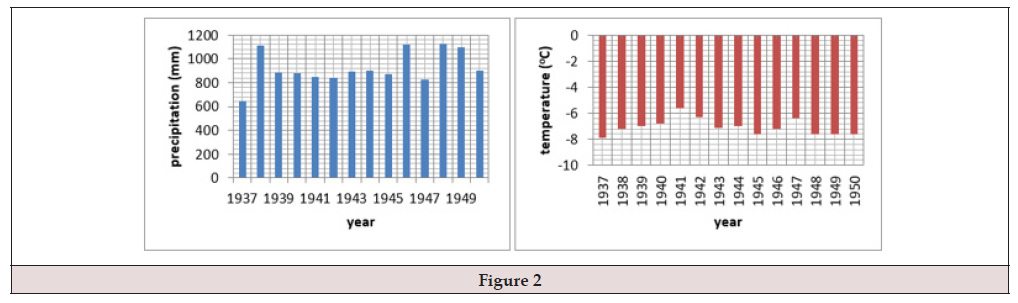
Figure 2:
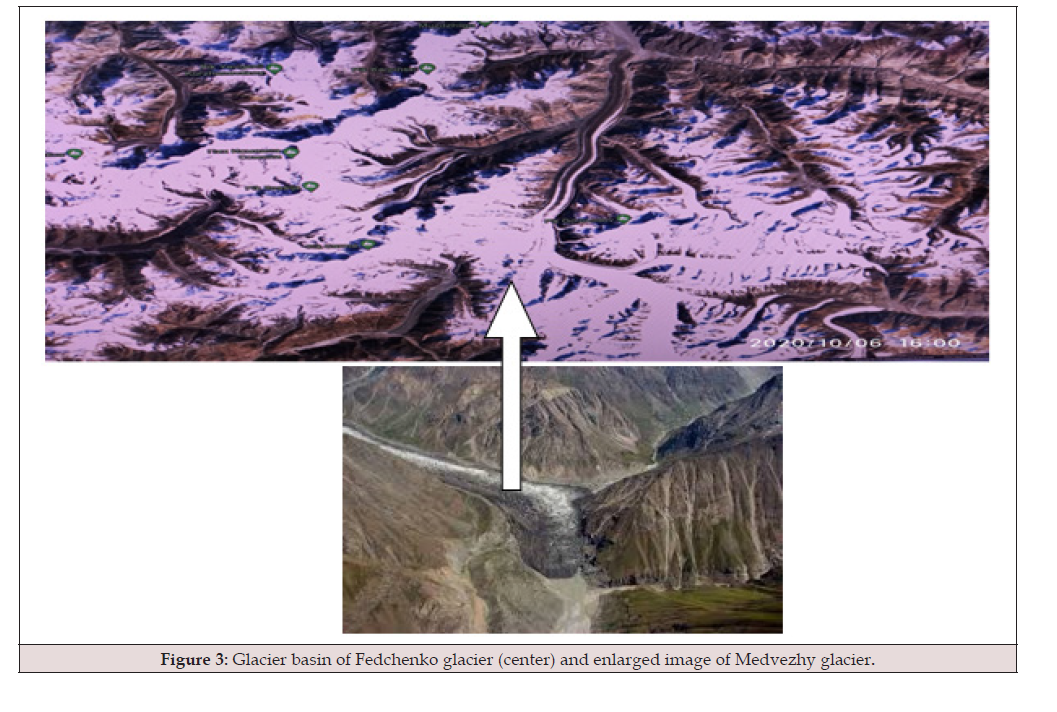
Figure 3:Glacier basin of Fedchenko glacier (center) and enlarged image of Medvezhy glacier.
Let’s trace the dependence of temperature and precipitation in the period from 1951-63 [3] (Figure 4).
A new movement of the glacier passed thirteen years later, and the new period gave us completely new data, that is, against the background of a slight increase in temperature relative to the previous pulsation of the glacier, the average annual value showed minus -6.9°C of frost, which recorded an increase in the total temperature by + 0.2°C of heat. At the same time, the amount of precipitation decreased in direct proportion. Their total number was 16688.7 mm. The total number of days with precipitation of varying intensity was 2660 days.
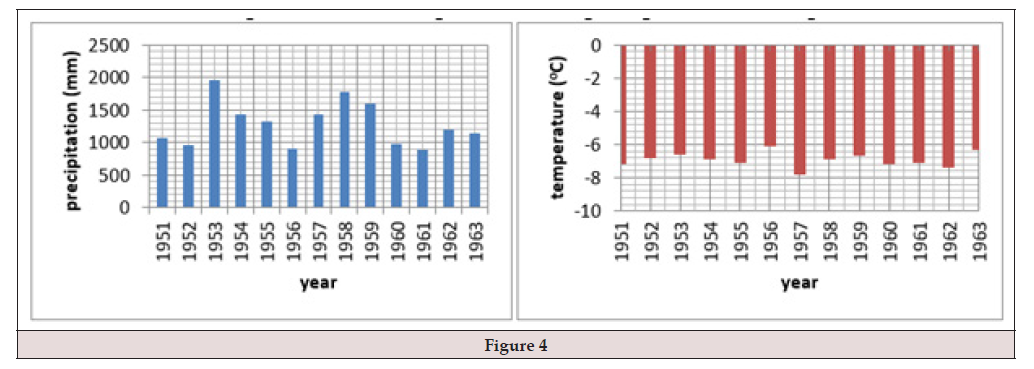
Figure 4:
The Period From 1964-1973 Year
Over the past ten years, the melted mass of ice has melted and only stone accumulations of rock remained from the movement of the Medvezhy glacier. Another advance occurred in the spring of 1973. A new mass of ice was moving in the old beaten track into the gorge. The moving “Ice Drop” reached the valley of the Abdukagor River and blocked it. A dam, half a kilometer wide and one hundred and fifty meters high, was formed. According to eyewitnesses, the depth of the formed lake reached 110 meters. On June 19, 1973, when 27 million m3 of water accumulated in the lake, a breakthrough occurred [4]. A giant wave, the maximum flow rate of which reached thousands of cubic meters per second, rushed downstream of the river. As the Wave moved, a rise in the water level in the Vanj River was recorded. So, in the regional center of the city of Vanj, 90 km from the glacier, there was a rise in water by 3 meters. Further downstream in the city of Kalai-Khumb, 180 km from the Medvezhy glacier, a rise of 1.5 meters was noted. And already on the territory of the Republic of Uzbekistan, in the city of Termez, the rise in the water level was 0.5 meters. When the lake has 3 million cubic meters. meters of water, the washed-out tunnel in the glacier collapsed. The congestion formed again and the lake began to fill up again. History repeated itself, and on July 3 there was a second breakthrough, which no longer posed a threat to the population. The measures taken in advance made it possible to avoid casualties and destruction. Based on the meteorological data of the N.P.Gorbunov weather station. (Fedchenko glacier) 1964- 1973 compiled tables on temperature and precipitation for this period of accumulation of snow and ice mass (Figure 5).
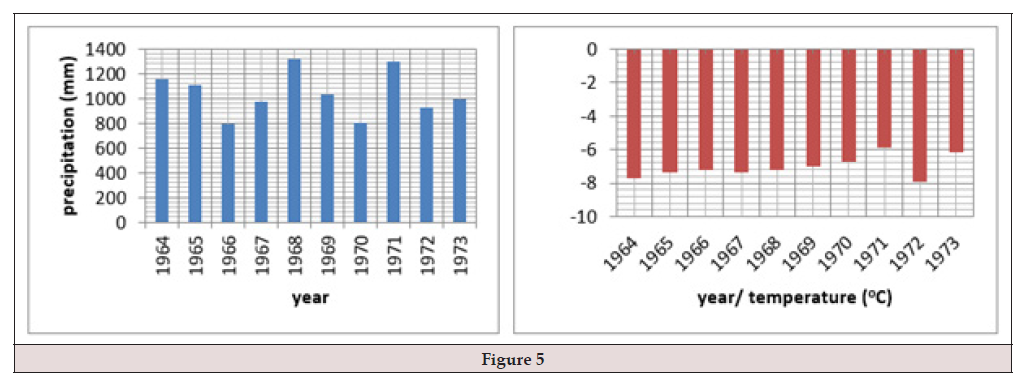
Figure 5:
The next movement of the glacier took place ten years later, and the new period turned out to be shorter than the previous ones. The average annual air temperature showed minus -7.1°C. Two relatively cold periods of 1964 and 1972 can be distinguished here, the average annual temperature of which was minus -7.7°C and -7.9°C of frost, respectively [5]. This time, a decrease in the overall temperature was recorded by -0.2°C below zero. At the same time, the total amount of precipitation over ten years was 10525.4 mm. The total number of days with precipitation of varying intensity was 2200 days. Two years with relatively little precipitation in 1966 and 1970 can be distinguished here. However, according to the results of the monitoring carried out, it is difficult to say that the Medvezhy Glacier gained a critical snow-ice mass, which affected its pulsation [6].
Analyzing the data, it can be noted that the coldest calendar month is January, and the warmest month was August. With the onset of the Arctic summer, the thermometer mark firmly marks a positive average daily temperature, and precipitation is practically close to zero. Only starting from the second decade of September, the snow cover begins to steadily cover the ice surface of Fedchenko. The Arctic winter begins, in which the temperature goes to minus marks, and the amount of precipitation begins to gradually increase. The snowiest period can be noted for the period of six months, from December to May, when the amount of precipitation exceeds 100 mm every month.
Period From 1974-1988 Year
A new movement of the Medvezhy glacier was expected in 1985, but the glacier behaved calmly and showed no signs of its pulsation until the fall of 1988, when its speed increased from 0.4 to 4.0 meters per day. This was a harbinger of progress. In 1989, the Medvezhiy glacier continued its movement and lengthened by 1.2 km, its area increased by 0.8 km2, the volume of ice removed was about 80 million cubic meters. The glacier again reached the Abdukagor River, but the height and width of the ice dam this time turned out to be less than during the previous movements. The resulting dammed lake was not very large, and due to the small dam, its breakthroughs occurred many times, while they were relatively small. The filling of the lake began on June 16, 1989, and on the night of June 26, the first breakthrough occurred, although the lake had accumulated only 4 million m3. The water consumption during the breakthrough was only 60 m3/sec. The second breakthrough with a flow rate of more than 120 m3/s occurred on the night of June 28. Such settlements passed through Vanch without causing any harm. The lake reached its maximum volume (6.1 million m3) on June 5, but with a breakthrough, the discharge did not exceed 50 - 60 m3/sec. The next movement of the Medvezhiy glacier ended in mid-July. Its movement almost stopped, and a permanent tunnel formed in the ice dam [7].
Based on the meteorological data of the N.P. Gobunov meteorological station (Fedchenko glacier) monitored data on temperature and precipitation for the period 1974-1988. I note that the temperature increased by + 0.6°C degrees Сelsius both in winter - the relatively cold month of January, and in summer - the relatively warm month of August. At the same time, the average annual temperature increase during this period (1974-1988) was noted with a positive value of only + 0.3°C degrees of heat.
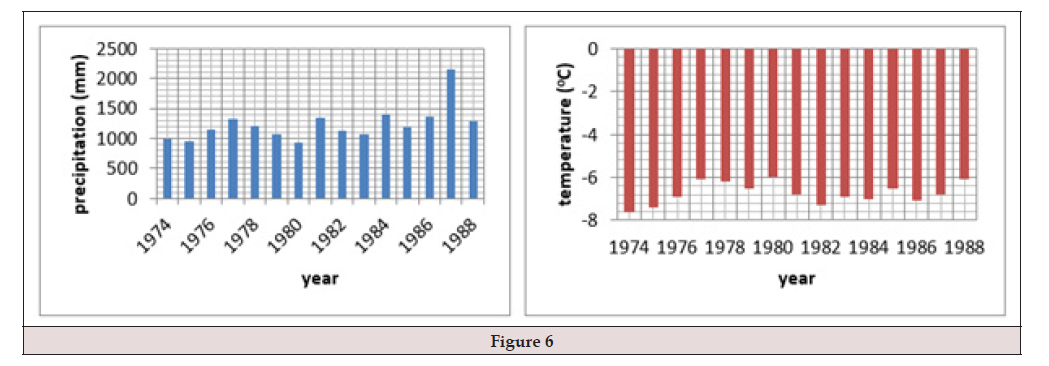
Figure 6:
An increase in temperature in summer and winter led to an increase in precipitation in the high-mountainous zone of the Fedchenko Glacier. For the period under consideration, it can be said that no hydrological anomalies were noted, and the amount of precipitation for the year was within the normal range. However, one can single out 1987, when their total for the year was 2158.8 mm, which is practically equal to the two-year norm. It should be said that the intensity of snowfall, without interruption, was 42 days. During my wintering, I had a chance to experience such a feeling, “14 days of weightlessness”, at the Fedchenko glacier station. This is an incomprehensible state, when a strong wind blows, it snows continuously, and there is 100% humidity - fog, as well as zero visibility day and night. On the fifteenth day you wake up from the loud voice of the head of the meteorological station: “The blizzard is over! All for clearing snow drifts and preparing the helipad.” A large mass of snow and a slight increase in temperature became another impetus for a new pulsation of the Bear Glacier (Figure 6).
While monitoring meteorological data, I mentally recalled my youth, where from 1984 to 1987, I worked and conducted my first scientific observations of weather changes in the alpine zone of the Fedchenko glacier. Track the meteorological data of the N.P. Gorbunov weather station. (Fedchenko glacier) in subsequent years is not possible, since the meteorological station was closed in 1994 for an indefinite period. And at present this unique object for scientific research remains unclaimed, and information on the weather in the high-mountainous part of the mountainous Pamirs, which is necessary to predict the reserves of snow cover and water flow in Tajikistan, remains inadequate.
Subsequent pulsations of the Medvezhy Glacier were noted in 2001 and 2011. During these periods of pulsation, the Medvezhy Glacier did not show its strength, and its activity was much weaker. The descent of “snow-ice masses” was not very large, and during its movement it did not manage to reach the Abdukagor River, therefore no lake was formed. The periods of hibernation of the glacier and its new pulsations, this time were thirteen and ten years. These were the first pulsations in the new millennium.
Another ripple of the Medvezhy Glacier occurred nine years later, in 2020. This time, hardly anyone could predict it. It can also be noted that this time the “snow-ice mass” reached the Abdukagor River. A dam was formed, but the mountain river seeped through the ice jam and formed a tunnel. The water was discharged as usual. Here it can be assumed that a rather short period of accumulation of snow-ice mass is associated with pulsations of small glaciers in the glacier zone of the Fedchenko glacier.
Conclusion
Summing up, according to the monitoring carried out, let’s look at the monthly long-term meteorological data on temperature and precipitation, which were observed in the period from 1937-1988 (Figure 7).
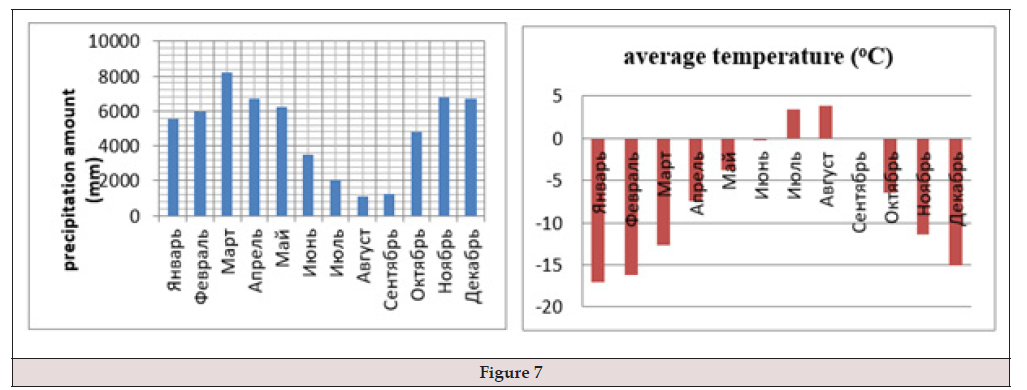
Figure 7:
As can be seen from the obtained graphs, the maximum amount of precipitation came out in March, and with its minimum amount, August remained. Temperature readings show that the coldest month of the year is January, and in contrast, the warmest month is August. Speaking about global warming and its influence on the glaciers of Central Asia, we can say that the Fedchenko glacier “holds the blow”, which is now observed in Nature. The monitoring of the data revealed the following: the total amount of precipitation for the period under consideration was 58727.5 mm, and the average temperature value showed a mark of minus -7.0°C frost. The metropolis of the Fedchenko Glacier is an unsolved mystery in Nature, which is the “Pearl of Tajikistan”. Future scientific researchers may be able to unravel the state of the “climate model”, which is hidden in the ice of the Pamir Mountains.
Acknowledgement
None.
Conflict of Interest
None.
References
- Catalog of glaciers of the USSR. Central Asia, Amu Darya for 1960-1988 L: Gidrometeoizdat, T.14.-B3.
- Archive of the Agency for Hydrometeorology for 2000-2016.
- Davlyatov RR (2015-2016) Chronological diary of observations 1984-1987.
- "Third National Communication" of the Republic Tajikistan.
- VB Aizen (2015-2016) Technical report of the 3rd International Pamir Geophysical Expedition.
- Osipova GB, Tsvetkov DG (2003) Nature. 4: P. 3-12.
- VM Kotlyakov, LV Desinov, VA Rudakov (2015) Ice and Snow. 2 (130).




 We use cookies to ensure you get the best experience on our website.