
Case Report 
 Creative Commons, CC-BY
Pulmonary Thromboembolism Despite of Thrombocytopenia in a Known Case of Immune Thrombocytopenic Purpura (ITP) Postpartum; A Case Report
*Corresponding author:Marjan Razi Khosroshahi Resident of Obstetrics & Gynecology Department of Obstetrics and Gynecology, Taleghani Hospital, Shahid Beheshti University of Medical Sciences, Tehran, Iran & Mehdi Sheibani, Assistant Professor of cardiology, Cardiovascular Research Center, Shahid Beheshti University of Medical Science, Tehran, Iran.
Received:September 19, 2025; Published:September 29, 2025
DOI: 10.34297/AJBSR.2025.28.003714
Abstract
Background: Immune Thrombocytopenic Purpura (ITP) is a rare but potentially severe disorder that affects blood clotting. When combined with
pregnancy or post-partum circumstances, it may pose some risks to patients, leading to adverse events such as Pulmonary Emboli (PE).
Case: In this case report, we present a known case of ITP who developed a pulmonary embolus after delivery. This insightful examination sheds light
on the complexities surrounding ITP and the heightened vulnerability to pulmonary emboli post-delivery.
Conclusion: Exemplifying the delicate interplay between these conditions, this case report offers valuable insights for medical professionals and
researchers alike. By understanding the intersection of ITP and postpartum pulmonary emboli, we can enhance patient care, refine treatment practices,
and ultimately improve outcomes for mothers dealing with these intersecting health challenges.
List of Abbreviations:Ltp: Immune Thrombocytopenic Purpura; Pte: Pulmonary Thrombo-Emboli; Vte: Venous Thromboembolism; At: Antithrombin (At); Ivc: Inferior Vena Cava; Ac: Anticoagulants; Ivig: Intravenous Immunoglobulin; Avf: Arteriovenous Fistula; Fda: Food And Drug Administration; Aptt: Partial Thromboplastin Time; Act: Activated Clotting Time; Lmw: Low Molecular Weight; Hit: Heparin-Induced Thrombocytopenia; Ufh: Unfractionated Heparin; Noacs: Non‐Vitamin K Antagonist Oral Anticoagulants.
Introduction
Immune Thrombocytopenic Purpura (ITP) is an uncommon blood disorder marked by a low platelet count without abnormalities in red or white blood cells. Platelet destruction leads to isolated thrombocytopenia. The incidence is between 1.6 to 3.9 per 100,000 patient-years, with higher rates in older people [1]. It is reported that the risk of thrombotic events is increased among people with ITP and more commonly among those who had a history of coagulopathy or recent surgery [2]. In this report, we described the management of a post-partum patient, a known case of ITP, who developed pulmonary emboli in the setting of severe thrombocytopenia 5 days post-partum.
Case Presentation
A 38-year-old pregnant female known case of ITP from 13 years ago; during pregnancy at 34 weeks gestational age, she was referred to our hospital due to a sudden onset petechia and purpura on her lips and lower limb and the platelet count was 10000/μl. She had a history of uneventful pregnancy and delivery 7 years ago and bone marrow biopsy showed normal results at that time. The patient was admitted, and a hematology consult was performed. She received IVIG 2.5 gr/kg for 5 days, and prednisolone 1mg/kg orally in three divided doses. The platelet count increased gradually. Eventually, she was discharged with a platelet count of 160000/μl after a week with oral prednisolone.
At the gestational age of 37 weeks, she presented to us with epi gastric pain, a rise in blood pressure to 145/90, and 1+ proteinuria, and a platelet count of 30000/μl. Due to the diagnosis of pre-eclampsia and previous cesarean section, an emergent cesarean was considered. A week before admission she received a single dose of Romiplostim 250. The peripheral blood smear was unremarkable. She received one unit of single donor platelet during the procedure, and blood loss estimation was about 500 ml. The patient was in good and stable condition post-operation, but the platelet count was 31000/μl. She was on oral prednisolone 100 mg in divided doses and IVIg 2.5 gr/kg for 5 days according to the hematologist’s consultation.
On day 6 post-operation, she suddenly complained of acute dyspnea and palpitation. On examination, the patient was conscious and oriented. Her Blood Pressure was 129/89 mmHg, heart rate was 120 beats/minute, respiratory rate was 25 breaths/minute, and O2 saturation was 85%. There were no signs of lower extremity edema or DVT, and color Doppler sonography of lower limbs was normal. Chest CT-angiography revealed pulmonary emboli at the distal portion of the left main pulmonary artery with extension to lobar arteries and another one at the right interlobar artery extending to distal branches. Figure 1 Because of hemodynamic stability, treatment with anticoagulation was planned. After consultation with cardiology and vascular surgery services, a retrievable Inferior Vena Cava (IVC) filter was deployed for the patient due to severe thrombocytopenia (19000/μl) and contraindication to anticoagulation. She was transferred to the cardiac intensive care unit.
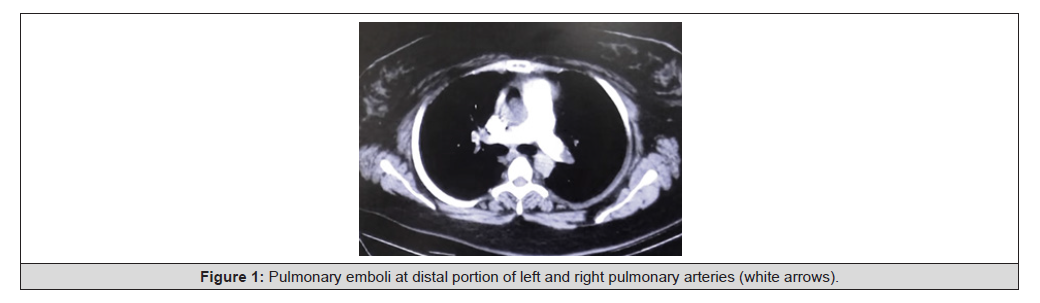
Figure 1:Pulmonary emboli at distal portion of left and right pulmonary arteries (white arrows).
At the same time, the platelet counts slightly decreased to 10000/μl and 8000 on days 8 and 9 respectively. After hematology service consultation she received 10 units of random donor platelet, single dose 600 mg Rituximab, and single dose 600 mg IV 500 mg single dose intravenous Methylprednisolone, and 75 mg oral prednisolone daily was prescribed later. Platelet count slightly increased to 27000/μl and half dose unfractionated heparin (500 units/h) was initiated.
Dyspnea improved gradually. A third course of IVIg was given on day 12th post-operation, and rituximab continued weekly. Rheumatologic consultation was performed, and hydroxychloroquine 400 mg in divided doses was also added. Overall, the patient’s condition improved, and the platelet count reached 61000/μl. Anticoagulation changed to oral anticoagulant apixaban (5 mg twice daily) and discharged on apixaban and prednisolone (75mg once daily). After two weeks with platelet count of 112000/μl, the IVC filter was retrieved successfully. Figure 2 shows retrieved IVC filter with thrombus particles trapped by the filter. Two months later, the platelet count reached 214000/μl.

Figure 2:Retrieved IVC filter with thrombus particles.
Discussion
ITP was initially considered a hemorrhagic disease, but paradoxically, the risk of thrombosis is higher in ITP patients in comparison with the general population [3]. A meta-analysis of five large population-based studies established that there are a two-fold increased risk of Venous Thromboembolism (VTE) and a trend towards an increased risk of Anti Thrombin (AT) in ITP as compared with the general population [4]. The cause of this prothrombotic tendency in patients with ITP remains unknown. [5] Possible causes include Hyperactive immature platelets [6], platelet microparticles [5], and dysfunction in complement activation [7].
In this article, we report a case with PTE and severe ITP together with a literature review of therapeutic approach in these cases. According to current guidelines, corticosteroids, intravenous immunoglobulin (IVIG), and anti-RhD immune globulin are typical first line and rescue treatments to increase platelet count and reduce risk of bleeding. Second-line therapy options are currently represented by the thrombopoietin receptor agonists (Entomophagy, Romiplostim), rituximab, and splenectomy [8,9]. In ITP patients with severe thrombocytopenia and thrombotic events, first line treatments should be initiated as soon as possible to increase platelet count to provide the possibility of anticoagulant treatment [8].
The patient in our case had several risk factors for thrombosis, including obesity, being in postpartum period [10], recent cesarian section surgery [11] and administration of TPO-ra [12] and IVIG [13]. Although findings in a meta-analysis published on 2023 concluded that ITP patients treated with TPO-ra had a nonsignificant higher risk of overall, arterial, and venous thrombotic events [14].
Antithrombotic therapy in ITP patients is challenging, and no well-stablished guidelines exist to aid clinical decision-making. In a study published in 2018, Pishko et al. compared the minimum platelet count recommendations between ITP specialists and general hematologist-oncologists for anticoagulants (AC) for VTE, the responses were from at least 10 × 109/L for both groups up to at least 70 × 109/L (ITP specialists) or 100 × 109/L (general hematologist- oncologists). Among ITP specialists, the modal response was at: 30 × 109/L for AC in VTE without a bleeding history [15]. Al-Samkari, on the other hand, argued that anticoagulant therapy should continue in ITP patients unless the disease is refractory to all treatments and a minimum platelet count (e.g., ≥ 20 × 109/L) cannot be achieved [16]. Our patient had a <20x109/L since based on most studies this is below acceptable threshold for AC therapy, we considered Inferior Vena Cava (IVC) filter placement for the patient as it is considered as efficient and safe treatment while AC therapy is contraindicated [17,18]. Absolute indication for IVC filter placement is patients with documented VTE or at high risk of clinically significant PE and have a contraindication to or complication or failure of anticoagulation therapy. In some patients with contraindications to or complications of anticoagulation, the period during which anticoagulant therapy cannot be used may be temporary or transient. Optional (retrievable) vena cava filters can be considered in these situations [19].
IVC filter placement is generally considered safe with the reported mortality rate contributed to IVC filter insertion is 0.12% [20]. However, IVC filter placement is associated with several perioperative and delayed complications. Perioperative complications include access site bleeding, thrombosis, infection, Arterio Venous Fistula (AVF), filter tilt, and incomplete opening. Delayed complications include filter migration, fracture, thrombosis, pulmonary embolism, vessel and/or organ perforation and device embolization. [21,22] In 2010, The Food and Drug Administration (FDA) issued an initial communication recommending filter removal as soon as protection from PE was no longer needed. Morales et al. have developed a quantitative model weighing the risks and benefits of filter removal. The authors concluded that filter removal was favored between 29 and 54 days [23]. Our patient responded to the mentioned ITP regimen and we observed platelets count increase, (up to 27x109/L) so we started AC therapy. Heparin has several potentially advantageous attributes. These include: 1-Rapid onset and offset of action, allowing for more flexibility in dose titration or discontinuation when needed (eg, for select surgical procedures or bleeding) 2-Ability to monitor using the activated partial thromboplastin time (aPTT), anti-factor Xa activity, or Activated Clotting Time (ACT), which are widely available.
On the other hand, Low Molecular Weight (LMW) heparins have a number of advantages over unfractionated heparin: Greater bioavailability, longer duration of the anticoagulant effect, permitting administration only once or twice daily, better correlation between dose and anticoagulant response, permitting administration of a fixed dose without laboratory monitoring, Lower risk of Heparin- Induced Thrombocytopenia (HIT) [24].
Choosing between UFH and LMWH is challenging since UFH has the advantage of better therapeutic level monitoring and ability to fully and rapidly reverse using protamine sulfate, on the other hand the risk of complications such as HIT in our patient with administration of UFH makes LMWH a considerable choice.
The Intercontinental Cooperative ITP Study Group, for ITP patients with low platelet counts and thrombosis suggests continuous Un Fractionated Heparin (UFH) at half-therapeutic dose for a few days while increasing the platelet count then increase to therapeutic levels and later switch to LMWH or warfarin. With counts >30×109/L, start with half-therapeutic dose LMWH, >50×109/L with full dose LMWH. Consider giving LMWH for the duration instead of switching to vitamin K antagonists [25].
Non‐Vitamin K Antagonist Oral Anticoagulants (NOACs) are an exciting new class of drugs that, as a whole, provide at least as good protection from thrombosis as their condition-specific comparator (vitamin K antagonist and/or LMWH), and have better safety profiles. They have several advantages over traditional drugs, such as lack of the need for routine blood tests and a reduced frequency of hemorrhage [26]. A major advantage of the NOACs is that they act directly on coagulation factors (thrombin and factor Xa) and so have far more predictable pharmacokinetics. This contrasts with warfarin, which acts on the liver to reduce the synthesis (and thus plasma levels) of several coagulation factors. The ideal anti- coagulant would, in addition to a better safety profile, have minimum interaction with other drugs, high bioavailability, predictable anticoagulant effect to obviate monitoring, and have an antidote. Although neither warfarin nor NOACs have all these features, NOACs are certainly preferable, and antidotes are in development.
There are no experiences with the new oral inhibitors (dabigatran, rivaroxaban) for prophylaxis or treatment of thromboembolism in ITP patients. In conclusion platelet count is essential in management of thrombocytopenic ITP patients with thromboembolism. IVC filter implantation is suggested in platelet counts below 20000/ μl to 30000/μl according to different recommendations. Half dose anticoagulation is initiated at platelet counts between this level and 50000/μl and full dose anticoagulation seems to be safe in platelet counts more than 50000/μl. Also, standard treatment to increase platelet counts should be considered in ITP patients in order to eliminate the contraindication of anticoagulation.
Acknowledgements
None.
Conflict of Interest
All authors have no conflicts of interest to declare.
Notes on patient consent
An informed written consent was taken from the patient.
References
- Neunert C, Terrell DR, Arnold DM, Buchanan G, Cines DB, et al. (2019) American Society of Hematology 2019 guidelines for immune thrombocytopenia. Blood Adv 3(23): 3829-3866.
- Tana M, Tana C, Rizzo G, Ricci F, Porreca E, et al. (2021) Risk factors and current management of venous thromboembolism in patients with primary immune thrombocytopenic purpura. Eur J Intern Med 86: 121-123.
- Tărniceriu CC, Hurjui LL, Florea ID, Hurjui I, Gradinaru I, et al. (2022) Immune Thrombocytopenic Purpura as a Hemorrhagic Versus Thrombotic Disease: An Updated Insight into Pathophysiological Mechanisms. Medicina 58(2): 211.
- Kraaijpoel N, Tritschler T, Guillo E, Girard P, Le Gal G, et al. (2019) Definitions, adjudication, and reporting of pulmonary embolism–related death in clinical studies: A systematic review. Journal of Thrombosis and Haemostasis 17(10): 1590-1607.
- Han X, Li C, Zhang S, Hou X, Chen Z, et al. (2020) Why thromboembolism occurs in some patients with thrombocytopenia and treatment strategies. Thromb Res 196: 500-509.
- Rand ML, Dean JA (1998) Platelet function in autoimmune (idiopathic) thrombocytopenic purpura. Acta Paediatr Suppl 424: 57-60.
- Luo S, Hu D, Wang M, Zipfel PF, Hu Y, et al. (2020) Complement in Hemolysis- and Thrombosis- Related Diseases. Front Immunol 11: 1212.
- Song F, Al Samkari H (2021) Management of adult patients with immune thrombocytopenia (Itp): A review on current guidance and experience from clinical practice. J Blood Med 12: 653-664.
- Tepper NK, Boulet SL, Whiteman MK, Monsour M, Marchbanks PA, et al. (2014) Postpartum venous thromboembolism: incidence and risk factors. Obstetrics and gynecology 123(5): 987-996.
- Blondon M, Casini A, Hoppe KK, Boehlen F, Righini M, et al. (2016) Risks of Venous Thromboembolism After Cesarean Sections: A Meta-Analysis. Chest 150(3): 572-596.
- Ho P, Khan S, Crompton D, Hayes L (2015) Extensive cerebral venous sinus thrombosis after romiplostim treatment for immune thrombocytopenia (ITP) despite severe thrombocytopenia. Intern Med J 45(6): 682-683.
- Lee YJ, Jae US, Lee J, Kim K, Won SK, et al. (2007) A case of deep vein thrombosis and pulmonary thromboembolism after intravenous immunoglobulin therapy. J Korean Med Sci 22(4): 758-761.
- Dong Y, Xia Z, Zhou J, Hu Y, Yue M, et al. (2023) Risk of thrombotic events in immune thrombocytopenia patients treated with thrombopoietic agents: a systematic review and meta-analysis. Thromb J 21(1): 69.
- Pishko AM, Misgav M, Cuker A, Cines DB, George JN, et al. (2018) Management of Antithrombotic Therapy in Adults with Immune Thrombocytopenia (ITP): A Survey of ITP Specialists and General Hematologist-Oncologists. J Thromb Thrombolysis 46(1): 24.
- Al-Samkari H, Kuter DJ (2019) Optimal use of thrombopoietin receptor agonists in immune thrombocytopenia. Ther Adv Hematol 10: 1-13.
- Mingot Castellano ME, Canaro Hirnyk M, Sánchez González B, Álvarez Román MT, Bárez García A, et al. (2023) Recommendations for the Clinical Approach to Immune Thrombocytopenia: Spanish ITP Working Group (GEPTI). J Clin Med 12(20): 6422.
- Bikdeli B, Chatterjee S, Desai NR, Kirtane AJ, Desai MM, et al. (2017) Inferior Vena Cava Filters to Prevent Pulmonary Embolism: Systematic Review and Meta-Analysis. J Am Coll Cardiol 70(13): 1587-1597.
- Kaufman JA, Kinney TB, Streiff MB, Sing RF, Proctor MC, et al. (2006) Guidelines for the use of retrievable and convertible vena cava filters: report from the Society of Interventional Radiology multidisciplinary consensus conference. J Vasc Interv Radiol 17(3): 449-459.
- Kinney TB (2003) Update on inferior vena cava filters. J Vasc Interv Radiol 14(4): 425-440.
- Ni H, Win LL (2013) Retrievable Inferior Vena Cava Filters for Venous Thromboembolism. ISRN Radiol 2013: 1-8.
- Li X, Haddadin I, McLennan G, Farivar B, Staub D, et al. (2020) Inferior vena cava filter - comprehensive overview of current indications, techniques, complications and retrieval rates. Vasa 49(6): 449-462.
- Morales JP, Li X, Irony TZ, Ibrahim NG, Moynahan M, et al. (2013) Decision analysis of retrievable inferior vena cava filters in patients without pulmonary embolism. J Vasc Surg Venous Lymphat Disord 1(4): 376-384.
- Hirsh J, Levine MN (1992) Low Molecular Weight Heparin. Blood 79(1): 1-17.
- Grainger JD, Bolton Maggs PHB, Godeau B, Bussel J, Donato H, et al. (2010) Diagnosis and management of chronic ITP: comments from an ICIS expert group. Ann Hematol Suppl 1: 11-17
- Schulman S (2014) New oral anticoagulant agents - general features and outcomes in subsets of patients. Thromb Haemost 111(4): 575-582.
- Blann AD, Lip GYH (2016) Non-vitamin K antagonist oral anticoagulants (NOACs) for the management of venous thromboembolism. Heart 102(12): 975-983.




 We use cookies to ensure you get the best experience on our website.