
Mini Review 
 Creative Commons, CC-BY
Choledochoduodenostomy is an Effective Alternative Surgical Technique for the Common Bile Duct Injury and Liver Transplantation: Literature Review
*Corresponding author:Atta Nawabi MD, MBA, MPH, FACS, FICS, Professor of Surgery Division of HPB, and Transplant, Department of Surgery, 3901 Rainbow Boulevard Kansas City, KS 66160, USA.
Received:August 18, 2025; Published:August 22, 2025
DOI: 10.34297/AJBSR.2025.28.003662
Abstract
Biliary reconstruction is one of the final steps in liver transplantation. The most common approach is duct-to-duct anastomosis (DD), also known as choledochocholedochostomy. However, in patients with deviations from normal anatomy or physiology, as in patients with Primary Sclerosing Cholangitis (PSC), this approach may not be feasible. Choledochoduodenostomy (CDD), roux- en- Y choledochojejunostomy (CJS), and roux-en-y hepaticojejunostomy (RY) can serve as an alternative approach. RY CJS are more commonly applied due to risks associated with CDD. Although the complications in CDD are often equivocal to CJS and RY. CDD offers the benefit of being closer to normal anatomy and allowing easier access to the biliary system if there is a need for future ERCP. For biliary reconstruction in liver transplant patients with altered anatomy, as in PSC, CDD should be implemented in suitable candidates.
Hypothesis
The goal of this project is to determine the effectiveness of choledochoduodenostomy at the time of liver transplant for those who are not a candidate for choledochocholedochostomy.
Introduction
Primary Sclerosing Cholangitis (PSC), the inflammation and fibrosis of the intrahepatic and extrahepatic bile ducts, commonly presents without symptoms. Symptomatic patients present with right upper quadrant pain, pruritus, weight loss, jaundice, and commonly occur in those with inflammatory bowel disease. PSC can progress to cirrhosis and end stage liver disease [1]. The median survival until liver transplant or death is 21.3 years with the only definitive treatment being liver transplant. Median disease duration until liver transplant is 8.1 years [2]. Even with liver transplantation there is a risk of recurrence of PSC [3]. However, patients with PSC have one of the greatest survival rates compared to all patients who undergo liver transplant [4].
Liver transplantation is one of the primary treatments for end-stage liver disease, acute liver failure, and both benign and malignant conditions such as hepatocellular carcinoma [5]. Biliary complications accounts for 31% of all complications due to liver transplant, making biliary reconstruction one of the biggest challenges to overcome [6,7]. The most common type of biliary reconstruction is duct-to-duct anastomosis (DD) also known as choledochocholedochostomy. It connects the bile duct of the recipient to that of the donor, maintaining a normal anatomy [8-10] DD becomes challenging in cases where there is mismatch of duct size between donor and recipient, extensive recipient surgical history, or adhesions. In PSC particularly, normal anatomy can be disrupted, and increased risks of cholangiocarcinoma, stricture, and anastomotic leak have led to preference for RY approach in OLT for PSC [11-13]. Choledochoduodenostomy (CDD), Choledochojejunostomy (CJS), and Roux-en-y hepaticojejunostomy (RY) may serve as alternatives [14]. Roux-en-Y hepaticojejunostomy RY connects the donor hepatic ducts to the recipient jejunum. Choledochojejunostomy (CJS) connects the donor common bile duct to the recipient jejunum. An additional approach is Choledochoduodenostomy (CDD), performed by connecting the donor common bile duct and recipient duodenum (Figure 1) [15]. Similar to DD, this results in closer to normal anatomy but is less favored compared to CJS and RY due to complications, most notably sump syndrome and cholangitis.
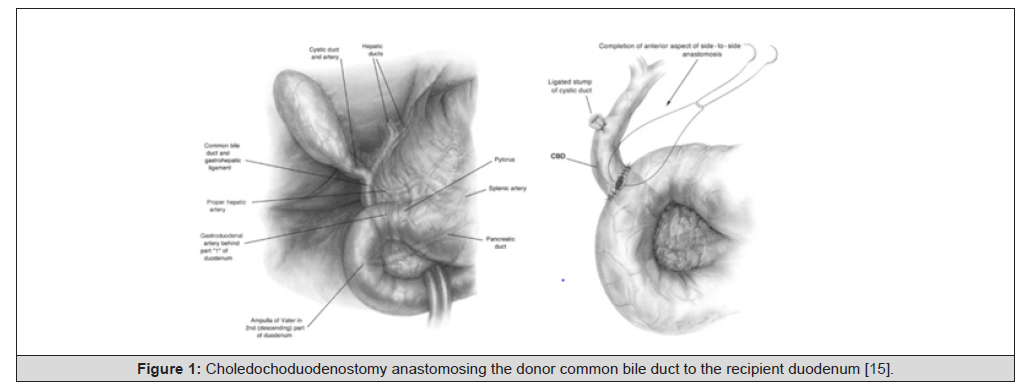
Figure 1:Choledochoduodenostomy anastomosing the donor common bile duct to the recipient duodenum [15].
In individuals with contraindications to DD for biliary reconstruction in liver transplant. CJS and RY have traditionally been viewed as primary alternatives. In this study, we hope to further investigate the benefits of CDD.
On the Space Fp of Proton’s Wave Functions
In patients with undergoing OLT for PSC or who have other contraindications for DD, CJS and RY are often favored over CDD for bile reconstruction because of associated rare complications of sump syndrome and cholangitis [16,17].
Sump syndrome is a rare, feared phenomenon where the remnant common bile duct collects stones, food particles, or bile and serves as a foothold for bacteria [24]. Rates of sump syndrome in patients who have undergone CDD are reported from 0-9.6% [18,25]. Although traditionally associated with CDD, it has been reported as a complication of both RY and CDD [16,24,26].
The biliary reconstruction in CDD is closer to normal anatomy compared to RY, which provides a variety of benefits. CDD results in easier laparoscopic access if future biliary duct exploration is required [9,23] While rates of ERCP or PTC are similar between biliary anastomosis types, intervention was required in one-third to nearly half of recipients [18]. Altered anatomy, short intestines, and adhesions can make ERCP challenging in patients with Roux en Y anatomy. Many alternative approaches exist, with preferred options notably including laparoscopic assisted ERCP which is resource intensive, requiring an operating room, and subjecting the patient to another intraabdominal surgery [27]. ERCP following CDD can be performed in the traditional fashion.
In addition to allowing easier endoscopic access to the biliary system, preserving small bowel anatomy with CDD allows the small bowel to continue normal physiologic function. Rerouting of the small bowel with RY can result in numerous nutritional deficiencies, as well as hypersecretion, peptic ulcers, and gastrointestinal haemorrhages [28]. This also allows for an operation that is arguably less technically challenging, requiring fewer anastomoses compared to RY. Operating time for CDD is decreased compared to RY [22,28]. Mean blood loss has been shown to be decreased in CDD compared to RY [22,28]. Additionally, length of hospital stay has been shown to be decreased in patients undergoing CDD compared to RY or CDJ [22,29].
Conclusion
Among individuals undergoing orthotopic liver transplant and unsuitable for choledochocholedochostomy, choledochoduodenostomy should be considered as it does not have increased rates of complication, better approximates native anatomy, and reduces the technical challenge of potential interventions in the future compared to roux en y or choledochojejunostomy
Acknowledgments
None.
Conflicts of Interest
None.
References
- Williamson KD, Chapman RW (2014) Primary sclerosing cholangitis. Dig Dis 32(4): 438-445.
- Boonstra K, Weersma RK, Van Erpecum KJ, Erik A Rauws, B W Marcel Spanier, et al. (2013) Population-based epidemiology, malignancy risk, and outcome of primary sclerosing cholangitis. Hepatology. 58(6): 2045-2055.
- Jadaun SS, Mehtani R, Hasnain A, Sushant Bhatia, Vikash Moond, et al. (2023) Good outcomes of living donor liver transplant in primary sclerosing cholangitis: an experience from North India. Hepatol Int 17(2): 499-506.
- Singal AK, Guturu P, Hmoud B, Kuo YF, Salameh H, et al. (2013) Evolving frequency and outcomes of liver transplantation based on etiology of liver disease. Transplantation 95(5): 755-760.
- Farkas S, Hackl C, Schlitt HJ (2014) Overview of the indications and contraindications for liver transplantation. Cold Spring Harb Perspect Med 4(5): a015602.
- Shimoda M, Saab S, Morrisey M, R M Ghobrial, D G Farmer, et al. (2001) A cost-effectiveness analysis of biliary anastomosis with or without T-tube after orthotopic liver transplantation. Am J Transplant 1(2): 157-161.
- Karakaya MF, Erdem Er, Onur Kirimker, Mesut Gümüşsoy, Emin Bodakçi, et al. (2023) Management of Biliary Complications in Liver Transplant Recipients with Duct-To-Duct Anastomosis: A Single-Center Experience. Turk J Gastroenterol 34(2): 177-181.
- Nissen NN, Klein AS (2009) Choledocho-Choledochostomy in Deceased Donor Liver Transplantation. Journal of Gastrointestinal Surgery 13(4): 810-813.
- Feith MP, Klompmaker IJ, Maring JK, P M Peeters, A P van den Berg, et al. (1997) Biliary reconstruction during liver transplantation in patients with primary sclerosing cholangitis. Transplant Proc 29(1-2): 560-561.
- Ishiko T, Egawa H, Kasahara M, Taro Nakamura, Fumitaka Oike, et al. (2002) Duct-to-duct biliary reconstruction in living donor liver transplantation utilizing right lobe graft. Ann Surg 236(2): 235-240.
- Landaverde C, Sato A, Tabibian J, Durazo F, Busuttil R (2009) De-novo cholangiocarcinoma in native common bile duct remnant following OLT for primary sclerosing cholangitis. Annals of Hepatology 8(4): 379-383.
- Abu Elmagd KM, Selby R, Iwatsuki S, J Fung, A Tzakis, et al. (1993) Cholangiocarcinoma and sclerosing cholangitis: clinical characteristics and effect on survival after liver transplantation. Transplant Proc 25(1 Pt 2): 1124-1125.
- Welsh FKS, Wigmore SJ (2004) ROUX-EN-Y Choledochojejunostomy is the method of choice for biliary reconstruction in liver transplantation for primary sclerosing cholangitis. Transplantation 77(4): 602-604.
- Miller C, Diago Uso T (2013) The liver transplant operation. Clin Liver Dis (Hoboken) 2(4): 192-196.
- Aldrete JS (2000) Choledochoduodenostomy. Operative Techniques in General Surgery 2(4): 304-310.
- Robbins G, Brilliant J, Huang Y, Rubin J, Goldberg E, et al. (2021) Sump syndrome of the remnant common bile duct following a living donor liver transplant. J Community Hosp Intern Med Perspect 11(5): 667-669.
- Schmitz V, Neumann UP, Puhl G, Tran ZV, Neuhaus P, et al. (2006) Surgical Complications and Long-Term Outcome of Different Biliary Reconstructions in Liver Transplantation for Primary Sclerosing Cholangitis-Choledochoduodenostomy versus Choledochojejunostomy. Am J Transplant 6(2): 379-385.
- Jonica ER, Han S, Burton JR, Pomposelli JJ, Shah RJ (2022) Choledochoduodenostomy is associated with fewer post-transplant biliary complications compared to Roux-en-Y in primary sclerosing cholangitis patients. Clin Transplant 36(5): e14597.
- Truong R, Moore HB, Sauaia A, Kam I, Pshak T, et al. (2022) Choledochoduodenostomy continues to be a safe alternative for biliary reconstruction in deceased-donor liver transplantation. Am J Surg 224(6): 1398-1402.
- Schreuder AM, Franken LC, Van Dieren S, Besselink MG, Busch OR, et al. (2021) Choledochoduodenostomy versus hepaticojejunostomy – a matched case–control analysis. HPB (Oxford) 23(4): 560-565.
- Blankensteijn JD, Terpstra OT (1990) Early and Late Results Following Choledochoduodenostomy and Choledochojejunostomy. HPB Surgery 2(3): 151-158.
- DiFronzo LA, Egrari S, O Connell TX (1998) Choledochoduodenostomy for Palliation in Unresectable Pancreatic Cancer. Arch Surg 133(8): 820-825.
- Bennet W, Zimmerman MA, Campsen J, Mandell MS, Bak T, et al. (2009) Choledochoduodenostomy is a safe alternative to Roux-en-Y choledochojejunostomy for biliary reconstruction in liver transplantation. World J Surg 33(5): 1022-1025.
- Abraham H, Thomas S, Srivastava A (2017) Sump syndrome: a rare long-term complication of choledochoduodenostomy. Case Rep Gastroenterol 11(2): 428-433.
- Suliman MS, Singh MM, Zaheer K, Malik SU, Abu Hashyeh A (2019) Is It Really SUMP Syndrome? A Case Report. Cureus 11(10): e5837.
- Kim H, Triplett D, Kauffman S, Beck G (2020) Hepatic Abscess: A Rare Presentation of Sump Syndrome After Choledochojejunostomy. ACG Case Rep J 7(8): e00447.
- Khara HS, Parvataneni S, Park S, Choi J, Kothari TH, et al. (2021) Review of ERCP Techniques in Roux-en-Y Gastric Bypass Patients: Highlight on the Novel EUS-Directed Transgastric ERCP (EGDE) Technique. Current Gastroenterology Reports 23(7): 10.
- Meinke WB, Twomey PL, Guernsey JM, Frey CF, Farias LR, et al. (1983) Gastrointestinal bleeding after operation for pancreatic cancer. Am J Surg 146(1): 57-60.
- Potts JR 3rd, Broughan TA, Hermann RE (1990) Palliative operations for pancreatic carcinoma. Am J Surg 159(1):72-77.




 We use cookies to ensure you get the best experience on our website.