
Mini Review 
 Creative Commons, CC-BY
A Comparative Study on the Balance Systems of Great Apes, Humans, Elephants, Whales, and Giraffes from the Perspectives of Elementally Limited Intelligence and the Ultimate Goal of “Indestructibility”
*Corresponding author:Liu Zhaoyang, Yang Yang International Plaza, Block A, ShaanXi province, Xi’an city, China.
Received: September 30, 2025; Published: October 06, 2025
DOI: 10.34297/AJBSR.2025.28.003718
Abstract
The balance system is a core physiological mechanism that enables animals to adapt to multi-dimensional movement environments. Its structure and function have evolved not only under constraints such as the organism’s morphological characteristics (e.g., body size and center of gravity distribution), ecological needs (e.g., habitat complexity), and the information processing capacity of the nervous system, but also embody the material world’s fundamental pursuit of “stable existence.” From the stable electron configurations of atomic structures to the regular lattice arrangements of crystals, and further to the dynamic equilibrium maintenance of living organisms, “indestructibility” (referring to an ultimate state of extreme stability and resistance to disruption) can be regarded as one of the ultimate goals of material world evolution. Based on the theoretical framework of “elementally limited intelligence” (where organisms achieve optimal functional output through a finite combination of sensory inputs and neural computational resources) and the philosophical concept of “indestructibility” (defined in a biological context as the optimization of structure and function to attain an extreme state of stability through structural reinforcement and functional enhancement), this paper compares the balance systems of five representative terrestrial/aquatic animal species-great apes, humans, elephants, whales, and giraffes-focusing on their components (vestibular organs, proprioception, visual input), neural regulatory mechanisms, and behavioral adaptations. The study finds that the evolution of balance systems across species is essentially a compromise strategy under the constraints of limited resources, striving toward “indestructibility.” From the distributed proprioceptive feedback of high-center-of-gravity terrestrial animals (e.g., giraffes achieving “localized indestructibility” through ultra-dense proprioceptors) to the hydrodynamic assistance in low-resistance aquatic environments (e.g., whales reducing balance-maintenance energy costs via buoyancy) and the flexibility-prioritized multimodal integration of primates (e.g., great apes and humans enhancing anti- imbalance resilience through redundant sensory integration), all reflect organisms’ adaptive exploration of “ultimate stability” within the bounds of limited intelligence.
Introduction
In the evolutionary spectrum of the material world, “stable existence” is the foundational goal of all life and non-life systems. The balance system, as a core mechanism for animals to counteract gravitational disturbances, environmental perturbations, and movement-induced impacts, serves not only immediate survival needs (e.g., avoiding falls, maintaining foraging/predator-avoidance efficiency) but also embodies a deeper pursuit of “indestructibility” in the material world. The theory of “elementally limited intelligence” posits that the adaptive evolution of organisms occurs within constraints of energy consumption, neural computational costs, and environmental demands. Organisms achieve optimal functional output for specific tasks (e.g., rapid turning, static standing) by combining finite sensory elements (e.g., the number of semicircular canals in the vestibular system, the density of proprioceptors) and neural processing capabilities (e.g., the number of neurons in the cerebellum). The concept of “indestructibility,” philosophically, refers to an ultimate state of extreme stability and resistance to disruption; in a biological context, it can be operationalized as the optimization of structural (e.g., skeletal/muscular mechanical strength), functional (e.g., sensory feedback sensitivity), and strategic (e.g., energy allocation prioritization) dimensions to achieve a state of “extreme anti-imbalance resilience.” Thus, the evolution of the balance system is, in essence, an adaptive epic of “incrementally approaching indestructibility under the constraints of limited intelligence.”
Background and Related Studies
Comparative research on animal balance systems has a long tradition, with many studies emphasizing the scaling rules and ecological adaptations of sensory and motor control systems. At the structural level, the semicircular canals of the vestibular system show strong allometric relationships with body size and locomotor agility. [2] Cox, et al., (2010) demonstrated that canal size and shape correlate with the frequency and amplitude of head movements across mammals, [7] while Spoor, et al., (2007) highlighted the specific association between semicircular canal morphology and locomotor patterns in primates. These findings provide a quantitative foundation for understanding how vestibular systems adapt to species-specific demands. Proprioceptive feedback also displays cross-species scaling properties. [1] Banks, et al., (2006) conducted an allometric analysis of muscle spindle counts across mammals, showing that spindle number is constrained by both body size and functional requirements. More recently, [8] Sun, et al., (2024) extended this approach by analyzing spindle density and distribution across a wider range of species, linking proprioceptive investment to ecological and behavioral demands. Such studies directly support the idea that sensory resource allocation follows evolutionary trade-offs under limited neural and energetic capacities. In cetaceans, the vestibular system presents a striking example of structural simplification and specialization. [9] Thean, et al., (2016) reported that inner ear development in whales is adapted to aquatic conditions, with reduced semicircular canal complexity but preserved otolith sensitivity to linear acceleration. This confirms that buoyant environments alleviate gravitational balance demands, shifting the system toward localized proprioceptive and hydrodynamic control.
In humans and other primates, balance relies heavily on multimodal integration. Beyond vestibular and proprioceptive contributions, cutaneous receptors in the plantar surface provide critical postural information. [10] Viseux, et al., (2019) demonstrated that plantar mechanoreceptors significantly enhance stability during quiet standing, [4] while Frigon, et al., (2021) reviewed how somatosensory feedback-encompassing proprioceptive, cutaneous, and joint receptors-contributes to locomotor control in mammals. These findings resonate with the present study’s framework of “elementally limited intelligence,” in which multiple sensory channels are integrated to maximize anti-imbalance resilience under computational and energetic constraints. Together, these comparative insights demonstrate that balance system evolution cannot be understood solely in terms of morphology or ecology. Rather, they exemplify a universal adaptive pattern: species allocate limited sensory and neural resources differently to approach functional stability, thereby providing empirical grounding for the present paper’s conceptual framework of “limited intelligence” and “indestructibility.”
Theoretical Connections Among the Balance System, the Goal of “Indestructibility,” and Limited Intelligence
The essence of the balance system lies in coordinating skeletal muscle movements through multimodal sensory inputs (vestibular sense, proprioception, vision) and real-time Central Nervous System (CNS) computations to maintain the body’s center of gravity within the support base. In a biological context, “indestructibility” can be concretely defined as: achieving extreme stability and resistance to disruption through synergistic optimization of structure (e.g., mechanical strength of bones/muscles), function (e.g., sensitivity of sensory feedback), and strategy (e.g., priority allocation of energy resources). The theoretical connections between the two are manifested in:
Structural Dimension
The morphology and density of core balance system components (e.g., inner ear vestibular organs, joint proprioceptors) directly influence resistance to perturbations. For example, joints with high-density muscle spindles can more precisely sense minute displacements, akin to “microstructural reinforcement.”
Functional Dimension
The integration efficiency of multimodal senses determines an organism’s ability to counteract complex disruptions (e.g., wind, water currents, swaying branches). For instance, the synergy of vision and vestibular input can compensate for the failure of a single sensory channel, resembling “redundant design for damage resistance.”
Strategic Dimension
The allocation priority of limited neural resources (e.g., preferentially reinforcing high-risk areas like the giraffe’s neck) reflects an organism’s tendency to protect “critical vulnerabilities,” similar to “targeted reinforcement for survival wisdom.” Therefore, the evolutionary history of the balance system is, fundamentally, an adaptive chronicle of “incrementally approaching the state of indestructibility within the constraints of limited intelligence.”
Balance System Characteristics and “Indestructibility”- Approaching Strategies of Five Animal Groups
Great Apes (e.g., Chimpanzees): “Distributed Anti-Imbalance” in Arboreal 3D Spaces
Great apes inhabit forest canopies, frequently engaging in climbing, brachiation (arm-swinging), and leaping. Their balance challenges arise from dynamic 3D movements and irregular changes in support points. Their balance system achieves “indestructibility” through “distributed multimodal integration”:
Vestibular System: Semicircular canals are slightly thicker than in humans (accommodating more vigorous rotational acceleration), and otolith organs exhibit higher sensitivity to linear acceleration (responding to instantaneous impacts during branch jumping), resembling “dynamic stress-induced structural reinforcement.”
Proprioception: The upper limbs (especially shoulder and wrist joints) have significantly higher muscle spindle density than in humans (due to reliance on arm pulling during brachiation), and plantar tactile receptors (e.g., Meissner’s corpuscles) are dense (assisting grip adjustments), forming “localized high-sensitivity in key movement joints.”
Visual Input: Well-developed binocular stereoscopic vision (for judging branch distances), but with lower reliance on vision during rapid movement (prioritizing real-time feedback from proprioception and vestibular input) to avoid systemic collapse from single-sensory failure.
“Indestructibility” Logic: Redundant integration of multimodal signals (e.g., combining vestibular angular acceleration and upper-limb proprioceptive feedback) reduces the risk of single- channel failure, akin to a “distributed network’s node-failure resistance.” Even if part of the sensory system is impaired, other channels maintain basic balance, achieving cumulative “localized indestructibility.”
Humans: Static-Dynamic Balance Trade-offs and Critical Protection in Bipedalism
Human bipedalism elevates the center of gravity (located at the second sacral vertebra, ~40% higher than in quadrupeds) and reduces the support base (only two feet). Balance challenges concentrate on static standing (resisting sway) and dynamic walking (shifting the center of gravity during gait cycles). The balance system achieves “indestructibility” through “key-area reinforcement and functional trade-offs”:
Proprioception: The lower limbs (especially ankle and knee joints) have the highest muscle spindle and Golgi tendon organ density (maintaining foot pressure center stability), and plantar skin (especially the heel and metatarsal regions) is densely innervated with tactile receptors (providing ground hardness and slope information), forming “reinforcement of critical support-base feedback.”
Visual Input: Vision plays a more critical role in human balance than in other animals (humans exhibit a 300% increase in postural sway with eyes closed), but the CNS suppresses visual-vestibular conflicts (e.g., ignoring moving backgrounds during walking), reflecting “dynamic adjustment of multimodal priorities.”
“Indestructibility” Logic: Sacrificing some dynamic flexibility (e.g., stability during rapid turns is weaker than in great apes) to gain static efficiency (cerebellar Purkinje cells optimize gait patterns through learning). The lower limbs and plantar regionshigh- risk areas-are “locally reinforced with high-density feedback,” similar to “strengthening load-bearing walls in architecture,” enhancing the stability of core survival capabilities at the cost of some performance.
Elephants: “Ultra-Sensitive Proprioceptive Feedback” for Massive Low-Center-of-Gravity Bodies
Adult African elephants weigh 5-7 tons, with their center of gravity at ~1.5 meters above the ground (higher than the ground but lower than giraffes). Their balance challenges stem from the inertia of their massive bodies (minor movements cause significant center of gravity shifts) and the rigid structure of their four-legged support (lacking flexible cushioning). The balance system achieves “indestructibility” through “ultra-sensitive feedback and structural adaptation”:
Vestibular System: Semicircular canals scale proportionally with body size but exhibit relatively low sensitivity to angular acceleration (as elephants rarely perform rapid head rotations or jumps), reflecting “simplified structure for low-dynamic demands.”
Proprioception: The limb joints (especially knees and wrists) have extremely high proprioceptor density (muscle spindle density is 2-3 times higher than in humans per square millimeter), and the thick fat pads on the soles contain abundant pressure receptors (real-time feedback on ground reaction force distribution), forming a “hyper-sensitive monitoring network for massive support points.”
Visual Input: Vision is primarily used for navigation, not balance (elephants can walk steadily with eyes closed), as they rely on robust proprioceptive feedback, resembling “resource divestment from non-critical functions.”
“Indestructibility” Logic: Ultra-sensitive proprioceptive feedback compensates for the limitations of vestibular and visual systems- joint receptors convert minor pressure changes into neural signals, triggering spinal reflex arcs to adjust muscle tension (bypassing complex cerebellar computations). This achieves precise regulation of the massive center of gravity with minimal computational cost, similar to a “mechanical self-adaptive shock absorber,” balancing energy efficiency and stability.
Whales (e.g., Humpback Whales): “External Compensation and Fluid Synergy” in Aquatic Buoyant Environments
Whales live in weightless aquatic environments where buoyancy offsets most body weight, but their balance challenges arise from high-speed swimming (up to 20km/h) and the need for directional control during turns, as well as pressure changes during deep dives (affecting inner ear fluid density). The balance system achieves “indestructibility” through “environmental synergy and localized simplification”:
Vestibular System: Semicircular canals are structurally simplified (no need to counteract gravity-induced tilting), but otolith organs retain sensitivity to linear acceleration (e.g., acceleration/ deceleration) to assist in regulating swimming speed, reflecting “streamlining of non-essential functions.”
Proprioception: The muscles of the tail fluke and dorsal fin are rich in proprioceptors (sensing fin movement angles and forces), but limb regression reduces traditional joint feedback, forming “precise feedback for propulsion-critical areas.”
Visual Input: Deep-diving whales rely minimally on vision (low light), while shallow-water species use vision for navigation, but balance primarily depends on hydrodynamics (e.g., feedback from tail fin movements), resembling a “natural stabilizer from the external environment.”
“Indestructibility” Logic: External environmental compensation reduces the burden on internal balance systems-water buoyancy and viscous drag naturally stabilize the body, requiring only fine-tuned tail muscle control (proprioceptive feedback) to adjust direction. This achieves motion stability in complex environments with minimal internal structure, similar to “passive protection leveraging natural forces.”
Giraffes: “Localized Ultra-Reinforcement” for Extremely High Centers of Gravity
Giraffes stand with a center of gravity at 2.5-3 meters above the ground (far higher than other terrestrial animals), with necks comprising over 50% of their body length. Their balance challenges concentrate on neck movements (e.g., lowering the head to drink, shifting the center of gravity forward) and sudden running. The balance system achieves “indestructibility” through “localized ultra- high-density feedback”:
Vestibular System: Horizontal semicircular canals are significantly longer than in other animals (sensing angular acceleration during neck rotation), and otolith organs are extremely sensitive to vertical gravitational changes (assisting head position micro-adjustments), resembling “precision perception reinforcement for high-risk movement axes.”
Proprioception: The neck muscles (especially those around the atlanto-occipital joint and cervical spinous processes) have ultra- high proprioceptor density (muscle spindle density is 5 times higher than in humans per gram of tissue), while leg muscles focus on supporting force adjustments, forming a “hyper-sensitive network for the ultra-high center of gravity support structure.”
Visual Input: Visual assists in judging ground distance when drinking (preventing falls) but is secondary to proprioceptive feedback in daily balance, reflecting “resource conservation in non-critical scenarios.”
“Indestructibility” Logic: Localized ultra-high-density feedback concentrates resources on protecting the most vulnerable area-the neck. Neck muscle proprioceptors convert minute displacements into instant neural signals, triggering coordinated contractions of back and leg muscles (e.g., rapid head retraction to restore balance), similar to “reinforced seismic structures at the top of a building,” ensuring overall survival capability through localized extreme stability.
Comparative Analysis and Coupling Patterns of “Limited Intelligence-Indestructibility”
The comparison of the five species reveals that the evolution of balance systems is a dynamic coupling of “limited intelligence” and the pursuit of “indestructibility”:
Priority Strategies for Resource Allocation
High-center-of-gravity animals (e.g., giraffes, elephants) prioritize reinforcing proprioception (directly monitoring the center of gravity), concentrating limited neural resources on “critical vulnerability points” (e.g., neck, limb joints), resembling “armor reinforcement for key areas.” Low-center-of-gravity or buoyant-environment animals (e.g., whales) rely on external physical properties (e.g., water buoyancy) to reduce internal system burdens, reflecting “leveraging external forces for survival.”
Redundancy vs. Simplification of Functional Modules
Primates (great apes, humans) retain multimodal integration (redundant vision, vestibular, and proprioceptive inputs) to enhance anti-imbalance resilience in complex environments (resembling “multiple insurance mechanisms”). Specialized species (e.g., whales) simplify non-essential functions (e.g., reducing semicircular canal complexity) to lower computational costs and depend on environmental synergy (resembling “lightweight design”).
Synergistic Evolution of Structure and Function
Elephants and giraffes achieve “micro-level precise regulation” through ultra-dense proprioceptors (high density per square millimeter/ gram of tissue), resembling “fine-tuning mechanisms in precision instruments.” Whales achieve “macro-level natural stability” through hydrodynamic assistance (external environmental compensation), resembling “passive protection leveraging natural laws.” These strategies collectively demonstrate organisms’ adaptive exploration of the “ultimate stability” goal under limited intelligence-no species achieves absolute indestructibility (due to absolute energy and resource constraints), but all species adopt unique finite-resource allocation solutions to approach the local optima of this ultimate state within their specific ecological niches. Cross-Species Balance System Comparison Summary (Table 1).
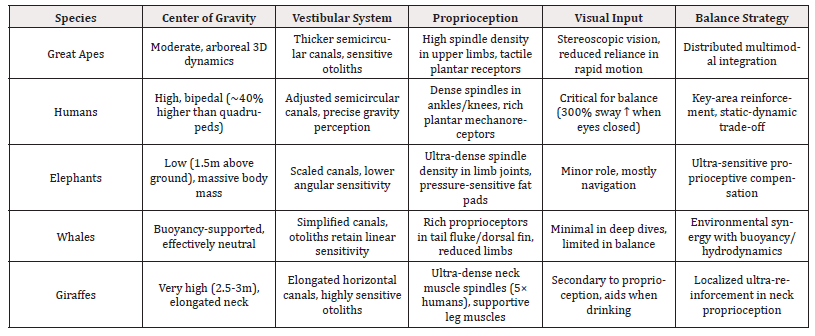
Table 1:Presents a comparative summary of balance system characteristics across the five species analyzed in this study.
This table summarizes the key characteristics of balance systems across different species, including center of gravity positioning, vestibular system adaptations, proprioception mechanisms, visual input utilization, and overall balance strategies.
Conclusion
Based on the dual frameworks of “elementally limited intelligence” and “indestructibility,” this paper reveals the evolutionary logic of the balance systems of great apes, humans, elephants, whales, and giraffes. Their structural and functional differences are not merely outcomes of ecological adaptation but also adaptive strategies striving toward “ultimate stability” within the constraints of limited resources. From the reinforced proprioceptive feedback of high-center-of-gravity terrestrial animals (localized indestructibility) to the hydrodynamic assistance of aquatic environments (external compensation) and the multimodal redundancy of primates (functional stacking), all species achieve their own “local optima” in the pursuit of indestructibility through unique combinations of limited intelligence. Future research could further integrate bionics (e.g., designing “key-node reinforcement” in robotic balance systems) and evolutionary physiology (e.g., quantifying the “anti-imbalance limits” of different species) to deepen understanding of these coupling patterns.
Conflict of Interest
None.
Acknowledgments
During the preparation of this manuscript, I utilized Tencent Hunyuan’s large language model “Yuanbao” and the free version of GPT-5 to optimize the text, including grammar correction, sentence structure adjustment, and terminology standardization, as well as to design Table 1. Parts of the content were assisted by artificial intelligence.
References
- Banks, RW (2006) An allometric analysis of the number of muscle spindles in mammalian skeletal muscles. J Anat 208(6): 753-768.
- Cox PG, Nathan J (2010) Semicircular canals and agility: the influence of size and shape measures. J Anat 216(1): 37-47.
- Fitzpatrick R, et al. (2006) Balance control in mammals: a comparative perspective. J Neurophysiol.
- Frigon A (2021) Control of mammalian locomotion by somatosensory feedback. Compr Physiol 12(1): 2877-2947.
- Hogan N, et al. (1990) Sensory contributions to balance in primates. Experimental Brain Research.
- Li Y, et al. (2015) Morphological and functional evolution of the mammalian vestibular system. Zool Res.
- Spoor F, Garland T, Krovitz G, Ryan TM, Silcox MT, et al. (2007) The primate semicircular canal system and locomotion. Proc Natl Acad Sci 104(26): 10808-10812.
- Sun Y, Wang X, Chen L (2024) Quantity and distribution of muscle spindles in animal skeletal muscles: An updated comparative review. Frontiers in Zoology 21(12): 115-129.
- Thean T, Wilson LA B, Racicot RA, Ekdale EG (2016) Ontogeny and phylogeny of the inner ear morphology in cetaceans. J Anat 229(6): 857-869.
- Viseux F, Lemaire A, Barbier F, Villeneuve P, Charpentier P (2019) How can the stimulation of plantar cutaneous receptors contribute to postural control? Frontiers in Human Neuroscience 13: 335.




 We use cookies to ensure you get the best experience on our website.