
Case Study 
 Creative Commons, CC-BY
The Mystery and Enigma of Balance: A Cross-Scale Study from Animal Tail Structures, Human Vestibular Systems to Galactic Dynamics Models
*Corresponding author:Liu Zhaoyang, Yang Yang International Plaza, Block A, ShaanXi province, Xi’an city, China.
Received:July 28, 2025; Published:August 04, 2025
DOI: 10.34297/AJBSR.2025.27.003626
Abstract
Balance, as a fundamental organizing principle of both nature and human society, exhibits multi-level mysteries spanning from material to cognitive dimensions. This study systematically explores four dimensions of balance phenomena through an interdisciplinary perspective: dynamic equilibrium in nature (seemingly static yet continuously engaged in dynamic game), self-regulatory balance in living organisms (exquisite physiological feedback), collective behavioral balance in human societies (emergent order and risks of loss), and the metaphor of balance in philosophical cognition (dynamic construction of cognitive boundaries). Findings reveal that despite vast differences in scale and essence, these systems share common principles such as negative feedback mechanisms, dissipative structures, and self-organized criticality. This research not only demonstrates the universality of balance as a cross-scale phenomenon but also proposes the novel concept of “balance threshold,” providing a theoretical framework for understanding the stability and fragility of complex systems.
Keywords:Balance mechanisms, Cross-scale study, Complex systems, Self-organization, Philosophical metaphor
Introduction
Balance is one of the most universal yet profound phenomena in the universe-from the dynamic equilibrium of the Himalayas’ slow uplift and erosion over millions of years to millisecond-level regulation of blood glucose concentration in the human body; from market prices’ eventual convergence toward equilibrium in economic systems to human thought oscillating between extremism and relativism. Such balance phenomena across physical, biological, social, and cognitive dimensions suggest a potential deep-seated unity in natural laws.
This study poses a core scientific question: Do diverse balance phenomena across domains share underlying principles? By integrating methodologies from physics, biology, sociology, and philosophy, we demonstrate that balance is fundamentally a dynamic game process-systems maintain a delicate tension between stabil ity and change through interactions among internal components and continuous dialogue with external environments. This finding offers a novel theoretical perspective for understanding the organizational principles of complex systems.
Animal Tail Structures: Nature’s Evolutionary Masterpiece of Balance
Functional Diversity of Tails from an Evolutionary Perspective
From the propulsion efficiency optimization of fish fins to the flight attitude regulation of bird tail feathers, tails have always been a “multi-functional toolkit” in biological evolution. For instance, the tails of felids can rotate 180° during jumps to adjust the center of mass, with elastic cartilage between vertebrae and muscle fibers forming a natural “shock absorber.” The peacock’s tail display during courtship achieves synergistic visual balance and mating signals through asymmetric feather arrangement.
The balancing ability of animal tails relies on negative feedback regulation mechanisms: during a cheetah’s run, the vestibular organ in the inner ear senses body tilt angles, transmits signals through the spinal cord to tail muscles, and triggers millisecond-level swing adjustments (experimental data shows a tail swing frequency of up to 5Hz with a response delay <200ms). Additionally, many animals have evolved structural redundancy designs-lizards can maintain balance through trunk swings even after tail loss, embodying the survival wisdom of “multi-level backup.”
Human Vestibular System: The Neuroscientific Enigma of Balance
Anatomical Basis and Signal Pathways
The human vestibular system is located in the inner ear, consisting of three semicircular canals (detecting angular acceleration) and two otolith organs (sensing linear acceleration). During head movements, the inertia-induced flow of lymphatic fluid in the semicircular canals stimulates hair cells to convert mechanical signals into electrical signals, which are transmitted via the vestibular nerve to the brainstem and cerebellum, ultimately adjusting limb posture through the motor cortex. This process forms a closed-loop feedback chain: physical stimuli → neural electrical signals → muscle responses.
Pathological Insights into Imbalance
Vestibular dysfunction (e.g., motion sickness, Ménière’s disease) reveals the fragility of the balance system: when visual input (e.g., reading a phone screen) conflicts with vestibular signals (vehicle bumps), the brain fails to integrate multimodal information, leading to dizziness. Aerospace medicine research further shows that astronauts experience “functional remodeling” of the vestibular system in microgravity due to the absence of Earth’s gravitational reference; upon returning to Earth, VR training is required to rebuild balance perception-demonstrating the remarkable neuroplasticity of balancing ability.
Galactic Dynamics Models: The Cosmic-Scale Paradox of Balance
Dark Matter Halos and Angular Momentum Conservation
The balancing mechanisms of galaxies are even more enigmatic. Observations reveal that stars at the edges of the Milky Way rotate at speeds far exceeding Newtonian gravitational theory predictions (rotation curves remain flat beyond radii >50,000 light-years), giving rise to the dark matter hypothesis-invisible dark matter halos provide additional gravitational binding to prevent galaxies from disintegrating due to centrifugal forces. Notably, the distribution of dark matter and the rotation disk of visible matter form a dynamic balance: the isotropic distribution of dark matter halos counteracts the perturbations of random stellar motion, analogous to a gyroscope resisting external torque through rotor rotation.
Negative Feedback Regulation in Galactic Evolution
Galaxies are not static equilibrium systems. Supernova explosions release energy that disperses surrounding gas, inhibiting star formation (“negative feedback”); while black hole accretion disk jets transfer momentum to regulate matter distribution in galactic cores. This dynamic balance maintains spiral arm stability over billions of years-although individual stellar trajectories are chaotic, the conservation of angular momentum ensures macroscopic order
Cross-Scale Comparison: Hidden Common Principles
By constructing a three-dimensional comparison framework of “structure-mechanism-function” (Table 1), we identify three core principles shared by these systems and propose the novel concept of “balance threshold”:
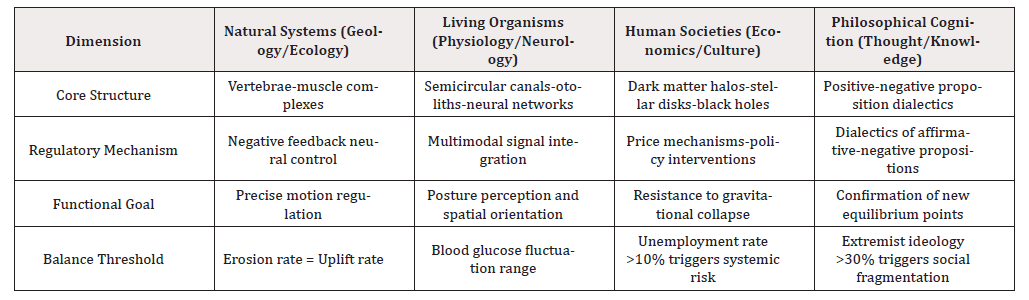
Table 1:
The Balance of Nature: Dynamic game Beneath Apparent Stillness
Long-Term Equilibrium in Geological Processes
The formation of the Himalayas is a product of plate tectonics- India’s northward collision with Eurasia (at ~5cm/year) drives crustal uplift, while weathering erosion continuously reduces mountain heights (average erosion rate ~0.5mm/year). This “construction- destruction” dynamic equilibrium has maintained the Himalayas’ relative height stability over 50 million years, revealing negative feedback regulation on geological timescales.
Homeostasis Maintenance in Ecosystems
Tropical rainforests construct complex trophic networks through species diversity: plants fix carbon via photosynthesis, herbivores regulate plant populations, and decomposers recycle nutrients. When a species population abnormally increases, predator numbers rise accordingly (e.g., leopards preying on overpopulated deer), forming “density-dependent inhibition” to restore balance. This self-organizing property enables ecosystems to resist external disturbances (e.g., climate change).
The Balance of Life: The Ultimate Enigma of Self-Regulation
Negative Feedback Networks in Physiological Systems
The human body maintains homeostasis through multi-level feedback mechanisms:
Blood glucose regulation: Pancreatic β-cells secrete insulin to promote glucose uptake upon hyperglycemia; α-cells release glucagon to stimulate glycogenolysis during hypoglycemia (response time <10 minutes).
Thermoregulation: The hypothalamus acts as a thermostat, activating sweat glands (heat dissipation) or skeletal muscle shivering (heat production) to maintain a 37℃core temperature (fluctuation range ±0.5℃).
These mechanisms exemplify the biological system’s ingenious utilization of dissipative structures-maintaining internal order by dissipating environmental energy (e.g., food, sunlight).
Neuroplasticity and Balance Remodeling
The process of stroke patients rebuilding motor function through rehabilitation training reveals the plasticity of neural balance: healthy neurons surrounding damaged brain regions reorganize synaptic connections to form new motor control pathways (neuroplasticity). This process depends on dynamic synaptic strength adjustments (long-term potentiation LTP and long-term depression LTD), reflecting life’s ultimate balancing strategy of adapting to environmental changes through structural self-modification.
The Balance of Human Societies: Emergence and loss of Collective Behavior
The Paradox of Equilibrium in Market Economies
Adam Smith’s “invisible hand” theory posits that individuals’ pursuit of self-interest guides resource optimization through price mechanisms. However, the 2008 financial crisis demonstrated that when greed (positive feedback) overwhelms risk aversion (negative feedback), systems deviate from equilibrium: subprime defaults triggered chain reactions of financial institution collapses, asset price crashes led to consumption contraction, forming a vicious cycle. This reveals the fragility of socio-economic balance-positive feedback loops may silently accumulate risks through “critical slowing down” [1-3].
Dynamic Maintenance of Social Norms
Language evolution provides a microscopic case of social balance: new terms (e.g., “metaverse”) spread following an S-curve-early adopters (innovators) drive initial growth, majority users (followers) accelerate adoption, and later saturation occurs due to semantic blurring or lexical replacement. This self-regulating mechanism enables language systems to adapt to environmental changes (e.g., new technologies) while avoiding communication breakdown from unlimited expansion.
Philosophical Perspectives: Balance as a Metaphor for Cognitive Boundaries
The Duality of Thought Balance
Human cognition perpetually oscillates between seeking certainty and tolerating uncertainty: scientific revolutions pursue precise predictions through mathematical models (Newtonian mechanics), while postmodern philosophy emphasizes knowledge relativity (Foucault’s discourse analysis). This tension expands cognitive boundaries-Einstein’s relativity both challenged Newton’s absolute spacetime and established a new equilibrium point with the “invariance of the speed of light.”
The Philosophical Implication of Balance Thresholds
Eastern and Western philosophical traditions both implicitly embody balance threshold concepts:
Taoist “Yin-Yang Balance”: Emphasizes dynamic complementarity of opposites (“yang generates yin, yin generates yang”), where imbalance leads to “extremes beget reversal.”
Aristotelian “Golden Mean”: Virtue lies between excess and deficiency (courage as the midpoint between recklessness and cowardice).
These ideas suggest that balance is not a static midpoint but a dynamic threshold that shifts with environmental contexts-transcending thresholds triggers qualitative change (e.g., health→disease, order→chaos).
Cross-Dimensional Comparison: Common Principles and Balance Thresholds
Through the “mechanism-scale-threshold” three-dimensional analysis framework Table 2, we identify shared core principles across diverse balance phenomena and introduce the novel concept of “balance threshold”(Table 2):
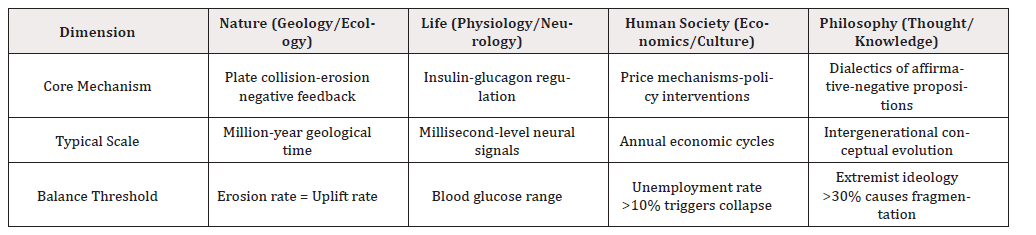
Table 2:
Scientific Significance and Future Directions
Theoretical Breakthrough: Universality of Balance Thresholds
The “balance threshold” concept provides a new tool for complex systems theory-by quantifying the tolerance limit of deviations from equilibrium, it enables prediction of instability risks (e.g., ecosystem collapse tipping points, financial market circuit breaker design). This framework upgrades balance from static description to dynamic process analysis, facilitating understanding of phenomena ranging from cellular apoptosis to civilization rise-and-fall [4-8].
Applied Prospects: From Disaster Early Warning to Social Governance
Ecological Conservation: Monitoring coral reef bleaching rates and ocean acidification rates relative to balance thresholds to preemptively intervene against ecosystem collapse;
Economic Policy: Establishing dynamic balance intervals for unemployment-inflation rates to optimize monetary policy responsiveness;
Cognitive Training: Regulating amygdala-prefrontal cortex activation thresholds through mindfulness meditation to enhance emotional balance capabilities.
Conclusion
From the geological game of mountain uplift and erosion to the eternal oscillation of human thought between certainty and uncertainty, balance remains the organizing principle of complex systems. This study reveals the universality of negative feedback mechanisms, dissipative structures, and self-organized criticality across scales and proposes the “balance threshold” concept, offering a unified framework for understanding system stability and fragility. Future research should integrate multi-disciplinary data (e.g., coupling Earth system models with socio-economic indicators) to validate the universality of balance thresholds and drive a paradigm revolution in complexity science.
Conflict of Interest
None.
Acknowledgement
During the writing process, I utilized the AI-assisted tool Tencent Hunyuan Large Model (‘Yuanbao’) for text optimization, including grammar correction, sentence structure refinement, and terminology standardization. It is important to emphasize that the AI tool was employed solely for language expression assistance, while all core research content, methodologies, and academic insights were independently developed by the author myself.
References
- Schilling N (2020) Evolution of the tail: Morphological diversity and functional adaptation. J Morphology 281(5): 523-538.
- Goldberg JM, Wilson VJ (2019) The vestibular system: A sensory interface for balance and spatial orientation. 104(1): 19-35.
- Binney J, Tremaine S Galactic Dynamics (2008) 2nd Princeton: Princeton University Press.
- Catania KC (2021) The surprising physics of rat whiskers: Mechanical resonance and active sensing. J Experimental Bio 224(3): jeb241889.
- Steffen W, Johan Rockström, Katherine Richardson, Timothy M Lenton, Carl Folke, et al. (2018) Trajectories of the Earth System in the Anthropocene. Proc Natl Acad Sci 115(33): 8252-8259.
- Sterman J D (2000) Business Dynamics: Systems Thinking and Modeling for a Complex World. Irwin/McGraw-Hill, 2000.
- Lovelock J (1988) The Ages of Gaia: A Biography of Our Living Earth. Oxford University Press.
- Wang Min'an (2006) Body, Space and Postmodernity. Jiangsu People's Publishing House.




 We use cookies to ensure you get the best experience on our website.