
Research Article 
 Creative Commons, CC-BY
Diagnostics of the Functional State of Firefighters Under Stress Loads Using Biofeedback Technology
*Corresponding author: Olga Jafarova, Biofeedback Computer Systems Laboratory, Institute of Molecular Biology and Biophysics, Federal Research Centre of Fundamental and Translational Medicine, Russia.
Received: April 19, 2025; Published: April 28, 2025
DOI: 10.34297/AJBSR.2025.26.003488
Abstract
The article presents the results of a comprehensive psychophysiological study of the features of the functional states of firefighters under stress loads. Functional state diagnostic protocol was developed using the technology of biofeedback on psychophysiological characteristics (HR, GSR), reflecting the activity of the cardiovascular system under simulated stress conditions. A classification of functional states of participants based on the dynamics of the most reliable and informative parameters of emotional reactivity is proposed. It was shown that the emotional response to the proposed stress factors hindered the psycho-emotional recovery of the participants and increased the stress load on the body.
Keywords: Functional states, Psycho-physiological characteristics, Biofeedback technology, Emotional reactivity profile, Stress
Abbreviations: FS: Functional States, HR: Heart Rate, GSR: Galvanic Skin Response, AMP1-AMP6: Amplitude of Spontaneous Galvanic Skin Reactions.
Introduction
The increase in the number of man-made accidents, emergencies, armed conflicts necessitate ensuring the reliability of human resources associated with the prevention, solution or elimination of the consequences of such incidents. A decrease in emotional stability in people of dangerous professions under the influence of stressors can lead to a change in the functional state of the body, and, as a result, to a state of psychophysiological disadaptation. In this regard, it is relevant to develop programs to support emergency response specialists at all stages of work in order to increase professional reliability and reduce the risk of making mistakes in situations where it is necessary to make the only right decisions in conditions of time constraints. The concept of Functional States (FS) is the central concept of the psychophysiology of stress loads. The study of psychophysiological mechanisms responsible for the functional states of the human body is of great applied importance. Within the framework of a comprehensive approach, FS are referred to as a system of psychophysiological manifestations that accompany various aspects of human activity. This definition of FS was due to the emergence of the possibility of multiple registration of physiological signals (EKG, EEG, EMG, GSR, respiratory indicators, etc.), however, the study of the features of a person’s response to the action of various stimuli is a relevant, but not fully resolved problem today. Thus, at present, the issues of searching for and developing objective methods for diagnosing the functional states of emergency response specialists and creating effective individual correction programs on their basis are especially acute [1-3].
Materials and Methods
Study Participants
91 students of the Novosibirsk Regional Firefighter Training Centre of EMERCOM of Russia (age of 20-43 years, M = 29,54).
Research Protocol
The protocol for diagnosing the functional state of the participants is represented by the game biofeedback training “Honey Bear”, which reflects the activity of the cardiovascular system under conditions of stress simulation.
Multiparametric combined game training “Honey Bear” (“Sladkoyezhka”, a sweet tooth) is a type of applied biofeedback technology, it diagnoses the functional and psych emotional state of people based on the targeted control of Heart Rate (HR) and Galvanic Skin Response (GSR) of participants during training sessions [4]. The BFB training is conducted using the “BOS-PULSE” software and hardware system for processing electrophysiological and psychophysiological information and biofeedback (produced by LLC ‘COMSIB’, Russia) (Figure 1). The plot of the combined game training “Honey Bear”. The training presents a game scenario in which the main character, a bear cub, must climb a tree, reach the honey located in a hollow, and eat it. The honey in the hollow is guarded by bees. They fly near the bear cub and carry a small door to close the hollow. If the bear cub manages to outrun the bees, it gets to eat the honey. If the bees outrun the bear cub, they hang the door on the hollow, and the bear cub does not get the honey.

Figure 1: Screenshots of the “Honey Bear” game application.
The speed of the bear cub decreases as the level of emotional tension in the participant increases, which is expressed in an increase in HR and the number of spontaneous reactions in the Skin Conductance Level (SCL) signal, it is considered as one form of GSR. Accordingly, the calmer the participant, the faster the bear cub can climb the tree, and the greater its chances of outrunning the bees. If the participant avoids developing stress reactions, the obstacles decrease, and the bear cub has a better chance of reaching the honey first. The goal of the training is to simultaneously lower the HR and prevent sharp increases in skin conductance. The training is considered effective if during the session there are no spontaneous reactions exceeding the individual GSR threshold, and the number (frequency) of reactions decreases from trial to trial. The duration of a session is 6 trials (20-25 minutes total), during which the following physiological parameters are recorded: duration of cardio intervals (RR, ms), Skin Conductance Level (SCL, μS), reaction frequency (RF, 1/min), and session rating (win/loss for each trial). For each trial, the average values of the parameters are calculated (RR1-RR6, SCL1-SCL6, RF1-RF6), as well as the Amplitudes of Spontaneous GSR-s (AMP1-AMP6, μS). The students completed “Honey Bear” training in the computer class of the Novosibirsk Regional Firefighter Training Centre of EMERCOM of Russia, where the “BOS-PULSE” system had been installed. The devices “BI-03K” or “BI-02M” (manufactured by LLC ‘COMSIB’, Russia) were used; it recorded EKG and SCL; parameters RR and GSR were calculated by software “Honey Bear”.
Results and Discussion
Based on the report algorithm of the game application “Honey Bear”, the following parameters were visualized and evaluated: the number, intensity and duration of spontaneous reactions to stress according to the parameters of GSR. The analysis of the data made it possible to diagnose the psychophysiological states of the participants on the basis of emotional reactivity to stress. The most sensitive parameters of the GSR for assessing the individual level of emotional reactivity to stress turned out to be the averaged values of the amplitude of spontaneous Galvanic Skin Reactions (AMP1- AMP6). Expert analysis of the amplitude characteristics of the GSR during the training made it possible to classify the participants of the study into four categories according to the observed dynamics of the indicator in six attempts: a decrease in the values of AMP1- AMP6 (N=60), stable values of AMP1-AMP6 (N=16), an increase in the values of AMP1-AMP6 (N=10) and participants with minimal or equal to zero (no reactions detected) values of AMP1-AMP6 (N = 5). A classification of the functional states of participants based on an expert assessment of the identified profiles of emotional reactivity is proposed below Table 1.
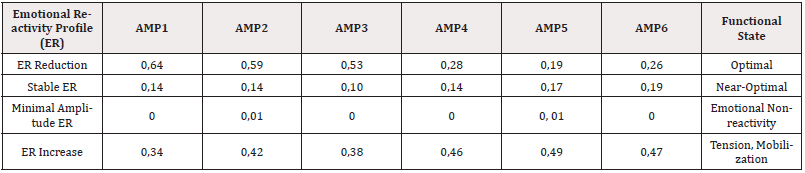
Table 1: Types of individual profiles of emotional reactivity and functional states of participants according to the amplitude of spontaneous galvanic skin reactions dynamics in 6 trials of biofeedback session “Honey Bear”.
Most of the participants (N=76, 83.5%) demonstrated profiles of optimal and near-optimal functional states with effective adaptive responses to stress: there was a decrease in psycho-emotional stress or a consistently low one. The are activity profile according to the GSR with minimum and equal to zero values of AMP1-AMP6 was determined in 5 participants (5.5%) - it reflects a high level of resistance (stability) of the nervous system and control of emotional experiences to stress load during training. Some of the participants (N=10, 11.0%) showed profiles of the growth and formation of emotional (adaptive) anxiety under the influence of a stress factor, which was the result of the activation of all body systems and indicates the insufficient effectiveness of defence mechanisms; it may functionally correspond [5] to the state of increased mobilization of psychological and energy resources.
Conclusion
The study of psychophysiological mechanisms regulating the functional states of the human body is an important area of scientific research with significant applied potential. As a result of a comprehensive psychophysiological study of the features of the functional states of emergency response specialists under stress, a protocol for diagnosing the functional state was developed using the technology of biofeedback on psychophysiological indicators (HR, GSR). A classification of functional states is proposed on the basis of the identified profiles of emotional reactivity. It was shown that the emotional response to stressors presented in testing made it difficult for participants to recover emotionally and increased the stress load on the body. The applied value of the obtained results lies in the fact that understanding the mechanisms that control the functional state will allow us to develop methods that contribute to improving psychological conditions, reducing stress levels and increasing resistance to adverse factors. Properly selected diagnostic methods, complex algorithms for data analysis, convenient formats for presenting results and high-quality feedback are able to identify the features of the functional states of firefighters in order to timely offer corrective procedures that preserve, first of all, the physical and mental health of specialists, as well as contribute to their professional growth and increase in career duration. Thus, the study of the characteristics of the SCL and GSR provides very valuable information about the human condition, especially in cases where there are changes in the level of psycho emotional tension. In this case, it is essential to take into account the individual peculiarities and dynamic characteristics of the observed changes.
Acknowledgements
The study was supported by project FGMU 2025-0004.
Conflict of Interest
Authors declare no conflict of interest exist.
References
- Psychology of Occupational Health: A Textbook / Nikiforova. SPb.: Rech’, 2006. 480s.
- Baevsky RM, Syrkin AL (2004) Assessment of the adaptive capabilities of the body and the problem of restorative medicine. Bulletin of Rehabilitation Medicine № pp. 18-22.
- Polevshchikov MM, et al. (2010) Determination of the onset of fatigue of a person when performing physical activity by psychophysiological methods. Bulletin of Rehabilitation Medicine № pp. 22-24.
- Jafarova O, Mazhirina K, Sokhadze E, Shtark M (2020) Self-regulation Strategies and Heart Rate Biofeedback Training // Appl Psychophysiol Biofeedback Jun 45(2): 87-98.
- Mazhirina KG, Danilenko EN, Dzhafarova OA, Nazarov KS, Mitin IN (2023) Psychophysiological mechanisms of the stress response as a source of athletic success. Human. Sport. Medicine 23(1): 165-172.




 We use cookies to ensure you get the best experience on our website.