
Research Article 
 Creative Commons, CC-BY
Unravelling Imposter (IP) Syndrome: Exploring Relationship with Family Dynamics, Academic Background, Self-Appraisal, Social Media and Building Predictive Models
*Corresponding author: Shubhangi Sanjay Moharekar, Department of Biotechnology, New Arts Commerce and Science College, Ahmednagar, India.
Received: January 11, 2025; Published: January 21, 2025
DOI: 10.34297/AJBSR.2025.25.003333
Abstract
Imposter syndrome is a psychological cognition renowned for self-doubt and prolonged fear of inadequacy. The previous research has demonstrated that imposter syndrome is associated with stress, anxiety specially in college students. This study analysed 102 individuals. The various factors like expectations and pressure from oneself or others, parent’s disagreement, sibling’s comparison, media influence, academic struggles, remarks from teachers or mentors, comparison in academic environment, ability judgement from oneself or others, anxiety and stress are contributing to the development of the Imposter syndrome characteristics checked by chi-square test of independence. Supervised machine techniques are applied to model the data based on these variables, KNN algorithm giving the highest accuracy (80.64%) in predicting impostor syndrome.
Keywords: Imposter syndrome, Family dynamics, Academic background, Self- appraisal, Stress, Anxiety, Media influence
Introduction
Imposter syndrome is a psychological condition in which individuals, despite their successful accomplishments, perceive themselves as inadequate or fraudulent. It was first identified by psychologists Dr Suzanne Imes and Dr Pauline Clance in 1978. Initially observed among high-achieving women but later detected the commonness among gender, occupation. Individuals with Imposter syndrome considered getting success by mistake, luck or external factors. Other traits are recurrent doubt about one’s own abilities, fear of failure, perfectionism, difficulty to accept the praise or accomplishments.
The previous research established that the commonness of Imposter syndrome widely varied between 9% to 82% [1]. Women reported significantly higher rate of Imposter syndrome than men and age is negatively associated with imposter feelings also anxiety and depression are the psychological issues coexist with Imposter syndrome [1]. Individuals with high Imposter syndrome scores less in self-acceptance and well-being. It is significant positive correlation with Imposter syndrome and perfectionism and negatively correlated with self-efficacy and happiness in both males and females [2]. High achieving people are sicker to Imposter syndrome [3]. There is weak negative correlation between Imposter syndrome and parental bonding, perceived social support indicating the minimum effect of these factors on imposter feelings [3].
While existing research gives the relationship between Imposter syndrome and perfectionism, self- efficacy, happiness, achievement motivation, parental bonding, perceived social support. In previous research, it is not specified that the is there any relationship between Imposter syndrome and Self-appraisal (expectations and pressure from oneself or others, ability judgement from oneself or others), Family dynamics (parent’s disagreement, sibling’s comparison), Academic background (academic struggles, remarks from teachers or mentors, comparison in academic environment), media influence, anxiety and stress [1-6].
The aim of our study is to determine whether a relationship exists between Imposter syndrome and expectations and pressure from oneself or others, parent’s disagreement, sibling’s comparison, media influence, academic struggles, remarks from teachers or mentors, comparison in academic environment, ability judgement from oneself or others and stress. Also, we model the data with respect to these variables.
Participants
The 102 participants’ responses are collected using online questionnaire where 58 are females and 43 are males. The majority of participants are aged between 20-30.
Research Methodology
Questionnaire Design
1) Imposter Phenomenon (IP): The Clance Imposter Phenomenon Scale (CIPS) (Cronbach’s α=0.92) [7] consist of 20 items having 5-ponit Likert scale used to check whether person possess imposter characteristics or not. Then for the analysis, the scores are coded in following way:
Between 41-60: Moderate IP characteristics coded as 0
Between 61- 80: Frequent IP characteristics coded as 1
Above 81: Intense IP characteristics coded as 2
2) Stress: Perceived Stress Scale (PSS-10) (Cronbach’s α=0.85) [8] consist of 10 items, rated 5-point Likert scale ranging from 0(never) to 4(very often)
Between 14-26: Moderate stress coded as 0
Between 27-40: High stress coded as 1
3) Generalized Anxiety Disorder Questionnaire (GAD-7) (Cronbach’s α=0.895) [9] consist of 7 items, rated 4-point Likert Scale ranging from 0(not at all) to 3(Nearly every day)
Between 10-14: Moderate anxiety coded as 0
Greater than 15: Severe anxiety coded as 1
4) The questions based on parents’ disagreement, media influence, siblings’ comparison ability judgement, academic struggles, remarks from teachers or mentors, comparison in academic environment, expectations and pressure from oneself or others are included collecting answers in Yes (1) or No (0).
Overview of the Variables
Parents Disagreement: Parents’ disagreement is an important family dynamic. Continuous disagreeing of parents on decisions of children can lead to develop self-doubt in child’s mind. Siblings Comparison: Constantly comparing with siblings by the parents or society contribute to doubt their own abilities and fear of failure.
Academic Struggles: This includes difficulty in coursework, in research, or balancing responsibilities, one may think that they are not capable for handling such a thing fostering underestimating oneself, low self-efficacy and perfectionism ultimately develop imposter characters.
Comparison in Academic Environment: Students compared their progress to their peers, which can lead to belief their achievements are due to luck or any other external factor. When students measure their worth or capabilities based on marks, grades, awards or recognition results in occurrence of perfectionism, fear of failure.
Remarks from Teachers or Mentors: When teachers or mentors are giving overly critical, dismissive feedbacks or remarks, increases the self-doubt. Harsh or ambiguous comments lead to low self-esteem or low self-efficacy.
Media Influence: Media plays significant role in creating perspective of success and achievement. The portray of social or academic life in media especially on social platforms, often set the definition of success or achievement. Individuals may think that they are not capable to get those standards, or way behind from others. This can bring low self-esteem, self-doubt or perfection.
Expectation and Pressure from Oneself or by Others: When unrealistic and excessive expectations can lead to imposition. This happened when individuals feel pressured to conform to the expectations of others, often due to fear of rejection, guilt or societal standards. This results in low self-efficacy, low self-esteem and perfectionism and fear of being exposed as a fraud.
Ability Judgement: Due to constant ability judgement by oneself or by others, one may believe that the success is due to luck or external factors or by accident. Individuals constantly doubting their abilities and tries to be perfectionists, consequently develop the imposter characteristics.
Stress: When you are stressed, one might start doubting their abilities. You’re feel like you are not good enough or going to be exposed as a fraud. Stress also consequences the constant fear of failure or perfectness in work. Thus, it contributes to imposter characteristics.
Procedure
The dataset is obtained by the online survey conducted through google forms. The survey consisting of 20 questions on imposter phenomenon, 10 questions on stress, 7 questions on anxiety and 11 questions on variables which are to be studied. Furthermore, using received responses the scores are calculated and interpreted for the further analysis.
Data Analysis
The analysis was conducted in R software (v 4.4.1), Python and Excel to study the variables.
Results and Discussions
Chi-square Test of Independence: The chi-square test is used to check is there is any association between Imposter syndrome and various variables viz parent’s disagreement, stress, anxiety, media influence, sibling’s comparison ability judgement, academic struggles, remarks from teachers or mentors, comparison in academic environment, expectations and pressure from oneself or others (Table 1).
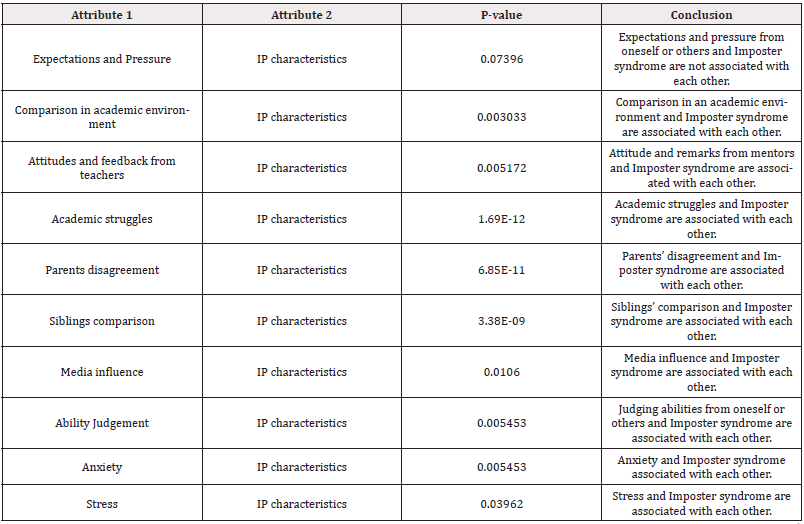
Table 1:

Table 2:
Modelling of the Data Using Machine Learning Techniques: Various supervised machine learning techniques are used to model the data and aim is to find out the more accurate model that can be used for the further prediction. The train- test ratio kept same while applying any of the ML technique. The KNN algorithm gives more accuracy (80.64%) than other ML techniques (Table 2).
Results and Discussion
Our results sheds light on the strong relationship between academic life, home environment and media influence on persuading Imposter syndrome. In our analysis, we observed in self-appraisal factors like, expectations and pressure from oneself or others and Imposter syndrome are not associated with each other which means that expectations and pressure does not responsible for IP characteristics, whereas Judging abilities from oneself were affected on Imposter syndrome.
In academic background, variables like comparison in an academic environment, attitude and remarks from mentors and academic struggles were associated with Imposter syndrome which indicate that, Imposter syndrome was affected by academic background in both male and female. Students often face competitive environment around them that may lead to non-specific response of the body i.e. stress and then ultimately anxiety among students. Stress is having immense impact on the lifestyle and is associated with adverse health issues [8]. Stress, anxiety and social media mostly influenced the Imposter syndrome. It is well known that social media has negative or inverse impact on mental well-being by exacerbating the user’s anxiety symptoms [10].
Family dynamics variables like Parent’s disagreement, Siblings comparison and Imposter syndrome are associated with each other. Its shows that Family dynamics were responsible for Imposter syndrome. Clance and Imes (1995) reported that family background plays major role in building imposterish feelings that affect mental health and imposter phenomenon starts to form [5]. The Imposter Phenomenon upsurges in social contexts because it often involves comparisons to others, internalized social standards, and expectations that shape how individuals see themselves [11-14]. To overcome this phenomenon, a shift in mindset is required emphasizing self-compassion, the recognition of one’s accomplishments, and a more realistic understanding of the challenges inherent in any success.
Conclusion
In our survey analysis we observe that Imposter syndrome is common in all individual’s male as well females. Our study found that variables like academic background factors, Family dynamic factors, Stress, anxiety and social media were influencing the Imposter syndrome. Whereas, self-appraisal factors like expectation and pressure plays minor role in Imposter syndrome. This study may contribute to the social work to overcome the imposter syndrome. We fitted six machine learning models for our data by using trained and test ratio (70:30). In this we observe that, K-nearest Neighbourhood algorithm gives the highest accuracy i.e. (80.64%). So, we suggest that this model give better result for prediction.
Limitations
In our study number of female responders are more than number of males. Mostly questionnaire was filled by students of age group (20-30), we were not considered occupation and socioeconomic factors and also at what extent they were responsible for Imposter syndrome in our study.
Acknowledgement
None.
Conflict of Interest
None.
References
- Bravata DM, Watts SA, Keefer AL, Madhusudhan DK, Taylor KT, et al. (2020) Prevalence, Predictors, and Treatment of Impostor Syndrome: A Systematic Review. J Gen Intern Med 35(4): 1252-1275.
- Pákozdy C, Askew J, Dyer J, Gately P, Martin L, et al. (2024) The Imposter Phenomenon and Its Relationship with Self-Efficacy, Perfectionism, and Happiness in University Students. Current Psychology 43: 5153-5162.
- Varsha K and Singh M (2024) Understanding Imposter Syndrome: A Correlational Analysis of Achievement Motivation, Parental Bonding, And Perceived Social Support. Educational Administration: Theory and Practice 30(4): 9074 -9080.
- Shaju RE, Dirisala M, Najjar MA, Kandasamy I, Kandasamy V, et al. (2023) Using Neutrosophic Trait Measures to Analyze Imposter syndrome in College Students after COVID-19 Pandemic with Machine Learning. Neutrosophic Sets and Systems 60: 317-334.
- Clance PR and Imes SA (1978) Impostor Phenomenon in High-Achieving Women: Dynamics and therapeutic innervations. PSYCHOTHERAPY: THEORY, RESEARCH AND PRACTICE 15: 241-274.
- Spitzer RL, Kroenke K, Janet BW, Williams JMW, Löwe B, et al. (2006) A Brief Measure for Assessing Generalized Anxiety Disorder: The GAD-7. Arch Intern Med 166(10): 1092-1097.
- Sabine M Chrisman SM, Pieper WA, Clance PR, Holland CL, Glickauf Hughes C, et al. (1995) Validation of the Clance Imposter Phenomenon Scale. Journal of Personality Assessment 65(3): 456-467.
- Berardi A, Ruotolo I, Sellitto G, Panuccio F, Polimeni A, et al. (2021) Criterion validity and reliability of perceived stress scale (PSS) in a student population during covid-19 pandemic. 18th International Conference on Cognition and Exploratory Learning in Digital Age (CELDA 2021): 71-78.
- Shinawatra P, Kasirawat C, Khunanon P, Boonchan S, Sangla S, et al. (2023) Exploring Factors Affecting Impostor Syndrome among Undergraduate Clinical Medical Students at Chiang Mai University, Thailand: A Cross-Sectional Study. Behav Sci (Basel) 13(12): 976.
- Rowan SA (2023) The Effects of Social Media on Mental Health and Career Planning. Honors Theses. 886.
- Clance PR, Dingman D, Reviere SL, Stober DR (1995) Imposter Phenomenon in an Interpersonal/Social Context: Origins and Treatment. Women & Therapy 16(4): 79-96.
- Rosenstein A, Raghu A, Porter L (2020) Identifying the Prevalence of the Impostor Phenomenon Among Computer Science Students. IGCSE ’20, March 11–14, 2020, Portland, OR USA: 30-36.
- Clance PR (1985) Clance imposter phenomenon Scale PsycTest dataset.
- Cohen S, Kamarck Tand Mermelstein R (1983) A Global Measure of perceived stress. Journal of Health and Social Behavior 24(4): 385-396.




 We use cookies to ensure you get the best experience on our website.