
Mini Review 
 Creative Commons, CC-BY
The Impact of the Digital Era on Human Behavior: Measurements and Classification of the Way Affecting Images, Information, and Maps in The Daily Life
*Corresponding author: Efthymios Spyridon Georgiou, Company Efthymios Georgiou, Stathogianni 4, 11741, Athens, Greece.
Received: December 09, 2024; Published: December 17, 2024
DOI: 10.34297/AJBSR.2024.25.003299
Abstract
Nowadays, technology changes the society. The democratic world needs more democratic solutions to go forward. The manuscript’s purpose is to present that the topic of cartography has gradually increased. Visualizing the data in spatial, number, and symbol form describes phenomena that are not seen with human eyes in a better and more understanding way. In previous decades, the design of maps was based on paper, and now, the digital era has transformed the kinds and various types of maps. For instance, the raster datasets increase the image resolution quality and spatial accuracy. The number of pixels and the various colors improve the raster form. The raster data is exported to tiff, jpeg, png, etc. Also, human behavior and thinking receive more understanding of the information. The digital environment is more attractive, innovative, creative, intelligent, and sociable in the eyes of the G.I.S users. The various G.I.S software users depend on age, gender, profession, and education level. These topics affect the way of thinking and the usefulness of the G.I.S software. To summarize, traditional map design transforms into new digital methods and techniques. The manuscript’s results include different approaches and perspectives on understanding the science of G.I.S. The message for the home is that the digital era is an opportunity for development. It is significant to carefully approach new technologies, personal security, a sense of freedom, and economic development.
Introduction
The current paper aims to study human behavior relative to images, information, and maps. In recent years, technology has spread. The article’s purpose is to examine personal perspectives, digital skills, and critical thinking regarding the use of digital products. The central questions of the research are:
i. What are people’s critical views on new technologies?
ii. How did the persons receive the messages and information?
iii. What are the memories of the old technological tools?
iv. Which are the most used geography applications in daily life?
v. If the technological change improves their lives?
The study’s techniques are the questionnaire and the statistical analysis. The export results are significant because they summarize some opinions and views about technological change. The participants are from all over the world, and this target group creates a spherical approach to the theme. The answers recognize the lines between the benefits of technological tools, the points of interest, and the threats of high–hour use.
The Paper’s Maps
In previous decades, the paper’s maps are the primary tool for visualizing geography. For many years, geomorphology (mountains, lakes, rivers), land use, towns, roads, and green areas have been present in an paper way. For instance, the more famous maps are the travel maps. Most maps are used to recognize roads and directions from a place. The first paper’s map was from the Babylonian Map of the World, produced between the late 8th and 6th centuries BCE, and depicts the oldest known map of the ancient world. Acquired by the British Museum in 1882 and translated in 1889. [1] Technical specialists in the history of maps, trained as cartographers, seldom step beyond the workshop door and into the outside world. Context is simplistically portrayed as “general historical background.” [2] The map is also one of the oldest, most potent, and constant of geographic ideas. Maps express facts or concepts that derive much of their significance from spatial relationships [3]. The design maps in the paper in a creative progress. The pragmatic design creates a sense of satisfaction and knowledge of the place “where you live”. It is an excellent example of the classification of the multiple levels: Lexical, Functional, and Cognitive, which helps us better understand the function of maps [4].
Digital Maps
The commonplace result from outline preparation is geographic data that can be utilized in spatial and spatiotemporal examinations in a Geographic Data Framework environment, which benefits various investigative areas within the spatial, social, natural, and well-being sciences. [5] As of now, a few plan standards are accessible for making computerized 3D maps, numerous of them coming from classical 2D outline plans. However, modern planning techniques and standards are still required for computerized and intuitive 3D and 4D base maps for urban situations. [6] Spatial behaviour defines the way in which we navigate our world. Our daily actions are governed by a need to cognitively process space as we move from place to place [7].
Technological change is an excellent opportunity for knowledge. The various pieces of information are not sources of knowledge. Filtering the web leads to the extraction of accurate conclusions and results. Maps are a source of knowledge. The creator and editor of digital products play an important role in their validity and reliability. The answer to the question “who” communicates the digital map or information and “what” role and place in global governance is basically in the authenticity of the product. In other words, it is the very ownership and signature of the digital map maker.
Methodology
The research methodology is based on the statistical indexes of the official website of the European Commission https://ec.europa. eu/eurostat and the shared questionnaire. In the questionnaire, people from the United State of America, Germany, Egypt, and Greece participated. The methodology is summarized in the following Table.
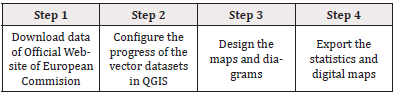
Table:
The participants reply the questions relative to the impact of technological change.
i. Do they remember the paper’s maps?
ii. Which are the most famous maps that they use?
iii. How is the transformation to high-resolution images and white-black TV in your eyes?
iv. What is the significance of big data and information in your lives?
v. Does the digital era improve your lives?
A questionnaire is simply a ‘tool’ for collecting and recording information about a particular issue of interest. [8] The empirical study of energy demand briefly described the questionnaire method for deriving cognitive maps or signed digraphs.[9] A logical, systematic, and structured approach must support questionnaire design and development [10].
Results
Statistics of Eurostat
The author generates the primary data table from the official European database: https://ec.europa.eu/eurostat/web/main/ data/database. The official Eurostat website is a smart, innovative, understandable, useful digital tool and library.
Table 1 shows the level of internet access in households. The index has increased over the last twenty years in 27 countries of the European Union. The change percentage is +18,55 to 2023 from 2012. In the following years, the internet access in households will be catholic in the total number of houses.

Table 1:
Table 2 shows the individuals frequently using the Internet in 27 European Union countries. The percentage of users has increased over the last few years, changing by 29,57%. The increase is very high. Every year, the percentage increases by 2,68 %.

Table 2: Demographic Characteristics in Baseline.
Table 3 shows individuals with basic or above basic overall digital skills. Almost half of the population of the 27 states has digital skills.

Table 3:
Answers of the Questionnaire
Question 1: Do they remember the paper’s maps?
In this question the most of answers are the travel maps. The highest percentage is the travel maps. The second answer is the atlas. The travel maps have spread in decades of ‘80 and ‘90. Also, many persons remember the atlas as classic memory from the secondary level of education.
Question 2: How do we rethink technological change?
In question 2, the answers are relative to the following:
i. Opportunity to speak and communicate (60%),
ii. Easy to move in the town and the trips (20%),
iii. Improve my education level (20%)
The digital era is an excellent opportunity to speak and get to know people. Designing new applications is crucial in creating friendships, flirting, exchanging ideas, and sharing personal views.
Question 3: Do you remember the white-black TV? What has stayed in your mind for the years?
The answer is that the youngest people do not have clear memories. Many people remember children’s entertainment shows, such as the construction of white–and–black TVs as big boxes. Also, at a young age, most people don’t watch TV programs. They spend hours surfing the Internet and social media.
Question 4: Which geography application do you use weekly?
Most of the questions are about GPS, the most famous application. There are many answers, such as Google Maps, Jungle, City- Mapper, etc.
Question 5: Our years there are big data and unlimited information. How is this phenomenon for you?
The participants seemed very interested in this question. There were various answers: “necessary,” “overwhelming,” “much information is not true,” and “do not trust many articles.”. Many participants approached this question critically. “It is changing the way we make decisions and how we think about education and learning.” They recognized the line between the truth and the wrong. It is changing the way we make decisions and how we think about education and learning
Question 6: Do you believe that digital maps and applications are better for your life?
Most people gave a positive answer. The digital age has improved people’s lives.
The questions measure and classify the impact of technological change and the behavior of the persons. The design of the questionnaire is a dynamic progress with Google Forms. The participants’ replies were sent via email. The perspectives of the participants, especially those of the youngest age, present high interest; the digital era is a reality. The topics of the manuscript approach some sides of modern reality. The future needs to become better for humanity. Democratic societies need more democratic solutions to the obstacles. The new indexes and mathematics results help in this direction because they visualize reality and create measurement number sizes.
Discussion
The digital age changed daily habits, communication, democratic solutions, the sense of time and space, reduced distances, and the course of history. For example, a news item from Athens is transmitted to the United States of America in hours and minutes. Many times, the news is broadcast simultaneously. This involves discussing the effects on business and revenue models, the consequences of new digital channels and media, and the increasing prevalence of data. [11] Waves of e-government are rising through public organizations and administrations worldwide, and more governments are using information and communication technology, especially Internet or web-based networking services between government agencies and citizens, businesses, employees, and other nongovernmental agencies [12].
In recent years, young people have stopped watching hours of television. Previous generations saw people on the screen, and they seemed big and magnified. Today, young people watch sports games and mainly entertainment shows. They prefer to surf the Internet. Children must also develop critical thinking; any can separate the true from the false, the trustworthy from the non-trustworthy, and the authentic from the inauthentic. Separating lines have been cultivated between them in their perception.
The social and economic implications of the Digital Era are huge and will increase as technological functionality becomes more knowledge-based, our everyday lives and understanding of ourselves become more linked to it, and it takes on a ‘life’ of its own. [13] Some of these practices are voluntarily undertaken by people interested in improving their health and fitness, but many others are employed in the interests of organizations and agencies [14].
References
- Baugh, L Sue (2024) Babylonian Map of the World. Encyclopedia Britannica.
- Harley J B (2002) The new nature of maps: essays in the history of cartography (No. 2002). JHU Press.
- Hanson S (Ed.) (1997) Ten geographic ideas that changed the world. Rutgers University Press.
- MacEachren A M (2004) How maps work: representation, visualization, and design. Guilford Press.
- Chiang Y Y, Leyk S, Knoblock C A (2014) A survey of digital map processing techniques. ACM Computing Surveys (CSUR) 47(1): 1-44.
- Atzl C, Mittlböck M, Knoth L (2022) Design decisions for multidimensional digital and interactive basemaps of urban environments. Cartography and Geographic Information Science 49(3): 220-236.
- Field K, OBrien J, Beale L (2011) Paper maps or GPS? Exploring differences in way finding behaviour and spatial knowledge acquisition. In 25th International Cartographic Conference, Paris, France.
- Patel H R, Joseph J M (2016) Questionnaire designing process: A review. Journal of Clinical Trials 6(2): 2-7.
- Roberts F S (1976) The questionnaire method. Structure of decision: The cognitive maps of political elites. pp. 333-342.
- Rattray J, Jones M C (2007) Essential elements of questionnaire design and development. J Clin Nurs 16(2): 234-243.
- Leeflang PS, Verhoef P C, Dahlström P, Freundt T (2014) Challenges and solutions for marketing in a digital era. European management journal 32(1): 1-12.
- Fang Z (2002) E-government in digital era: concept, practice, and development. International journal of the Computer, the Internet and management 10(2): 1-22.
- Shepherd J (2004) What is the digital era?. In Social and economic transformation in the digital era (pp. 1-18). IGI global.
- Lupton D (2014) Health promotion in the digital era: a critical commentary. Health promot Int 30(1): 174-183.




 We use cookies to ensure you get the best experience on our website.