
Review Article 
 Creative Commons, CC-BY
Non-Zero-Sum Games Among Professional Fishermen from The Northern Pantanal
*Corresponding author: André L Ribeiro Lacerda, Department of Sociology and Political Science, UFMT, Cuiabá/MT campus, Brazil, E-mail: ribeirolacerda66@gmail.com
Received: December 10, 2024; Published: December 19, 2024
DOI: 10.34297/AJBSR.2024.25.003305
Abstract
For professional fishermen in the northern Pantanal, certain social situations challenge the solitary nature of fishing, potentially transforming into non-zero-sum games when involving other participants who perceive the situation in a similar way. From the Darwinian conflict perspective, data collected from 471 structured interviews from four colonies of professional fishermen in the northern Pantanal (Barão de Melgaço, Leverger, Poconé and Cáceres) support two hypotheses: H1 argues that the Leverger fishermen will tend to fish more alone than the fishermen of the other colonies, and H2 argues that the fisherwomen will tend to fish less alone than the fishermen and, therefore, they will hold more zero sum games. New questions and hypotheses to be investigated are suggested based on problems found in the data.
Keywords: Fishermen, Pantanal, Game theory, Cooperation
Initial Considerations
In the 1920s, sociologists Robert Park and Ernest Burgess, in their seminal work Introduction to the Science of Sociology, extensively explored activities, acts, and operations involving social interactions. They termed these ‘social processes’, defining them as repetitive interactional patterns of behavior commonly observed in social life [14].
The main social processes they identified were cooperation, competition, and conflict. All these processes would occur at the individual and group levels [8,14].
Park and Burgess (1921) referred to the complete mechanisms that establish social structures as competitive cooperation. Cooperation as a social process can be found among the smallest possible groups, such as a dyad (two friends), or in a much larger complex organization, such as the WHO - World Health Organization [8].
Collaborating - working together - requires overcoming obstacles that frequently hinder its realization. These difficulties are present in what have been called collective action problems. All so cial species face problems of collective action, characterized as the various opportunities for cooperation that can produce benefits but can be prevented by profiteers and other forms of selfishness and also by failure to coordinate [15-19].
In the 1960s, economist Mancur Olson presented some paradoxes around the concept of collective action. According to him, the interests of individuals do not always coincide with the interests of the groups to which they belong, which generates paradoxes in the construction of collective acts. That is, even if all individuals in a group are centered on their own interests and they win if, as a group, they act to achieve their common goals, they will still not act voluntarily to promote these common and group interests [13].
Empirical studies on the formal theory of collective action have experienced enormous growth in recent decades [4-6,12,19]. Compared to other vertebrates, humans appear to be remarkably good at solving collective action problems [19].
At the social level, individuals often encounter social situations that may be classified as collective action paradoxes. In the most varied of situations, individuals assess whether the collective interests at stake match their individual interests. Robert Wright, an evolutionary psychologist, proposed that social interactions have a game-like structure, in terms of game theory. In other words, in their social interactions individuals make decisions as if they were in a game.
Game theory gained prominence in 1944 with the publication of Von Newmann and Morgenstern’s Game Theory and Economic Behavior. According to this theory, the fundamental aspect of any game is the presence of at least two players whereby each player, at the end of each game, gets a ‘payoff’ which is the sum of their gains or losses. Game strategies consist of lists of optimal choices for each player, anticipating the possible situations he will face. Games can be classified into two types: zero-sum games and non-zero-sum games.
Zero-sum games are those in which the sum of the players’ payoffs is zero; that is, one player can only win if the other loses, as occurs, for example, in poker or chess.
On the other hand, non-zero-sum games are scenarios where one individual’s gain does not necessarily result in another’s loss. For instance, exchange transactions are non-zero-sum games: I provide something you desire in exchange for money or another item of interest. Wright says that social interactions between human beings can be viewed as zero-sum and non-zero-sum games. According to him, social life is full of non-zero-sum calculations. According to evolutionary psychology, these unconscious calculations are part of human nature [25].
The concept of reciprocal altruism expresses this type of calculation [25]. It posits that people exhibit altruistic behavior with the expectation of receiving similar treatment in return. In essence, it is a form of mutual assistance where an individual who helps another later receives help from the same person [23-25]. Reciprocal altruism is one of the bases of social cooperation in groups. It is found in all human societies and is an important basis for socialization in many other species [7].
The central idea is that through reciprocal altruism, natural selection has incorporated into human nature a series of impulses whose practical objective is to provide advantageous exchanges [25].
In the intricate relationship between zero-sum games and nonzero- sum games that constitute everyday life, it can be argued that zero-sum games presuppose competitive individuals while nonzero- sum games presuppose cooperative individuals. However, Wright (2000) cautions against making this distinction. Cooperating can have a deceptive meaning. For example, the division of labor provides us with misleading situations. Suppose an individual from Cuiabá, Mato Grosso, buys a loaf of cornbread grown and processed in São Paulo. In that case, this action can be exemplified as a social exchange in the sense of Cosmides & Tooby (1992) [3] or as cooperative behavior. Still, neither the individual consumer nor the company producing the cornbread chose to cooperate. For this reason, Wright (2000) prefers the term “non-zero sum” rather than cooperating, which he finds vague.
Zero-sum and non-zero-sum games between members of small groups are common in non-human societies [19,23] and human societies [8,19,23]. But let’s think about the diversity of groups formed in societies and the potential social situations for forming social groups that are not realized. Like Axelrod (1986) [1], we can ask under what conditions do non-zero-sum games emerge? Or, in what social situations do collective actions take place?
A fishing colony is a social structure in that it is structured around the occupational status of a fisherman. It is a simple social structure if it is related to the types of social structures - the number of different kinds of statuses, the number of people in each social status, and the nature of the link between the statuses. It can also be considered a simple organizational structure, compared to organizations that have larger and more formal structures, composed of a diversity of social statuses, differences in authority, and, at lower levels, a greater number of occupants of all statuses [20-22].
Organizations are built to respond to and satisfy human needs. In the case of fishing colonies, they constitute organizational structures whose objective is to collect fish. To collect fish, fishermen establish zero-sum and non-zero-sum exchange relationships with other fishermen or with other social actors.
Amateur and professional fishing are fundamental economic activities in the northern Pantanal, which is located in the State of Mato Grosso. The Mato Grosso municipalities of Cáceres, Poconé, Barão de Melgaço, and Santo Antônio do Leverger (Leverger) have fishing colonies that are an important source of income for approximately 3000 professional fishermen. In addition to professional fishing, amateur fishing drives hotel services, inns, and boat hotels in the four municipalities.
This was the reality in 2017. In 2024, with the institution of the Zero Quota Law policy for some fish (Law No. 12,197/2023), there was a prohibition of the transport, storage, and commercialization of the following species for 5 years: Cachara, Caparari, Dourado, Jaú, Matrinchã, Pintado/Surubin, Piraíba, Piraputanga, Pirara, Trairão and Peacock Bass. This law greatly impacted on the socioeconomic situation of some municipalities whose residents got their livelihoods from fishing. For instance, in Leverger, the town’s main avenue, once bustling with fishermen selling their catch during late afternoons and weekends, is now deserted. Several small-scale merchants interviewed expressed their frustration with the Zero Transportation Law.
At the plenary of professional fishermen of the Midwest, an event sponsored by the Ministry of Fisheries in Campo Grande in September 2024 which set up the First National Plan for Artisanal Fishing in Brazil, the president of the Fishing Federation of Mato Grosso reported that many fishermen in Cáceres/MT were having problems surviving with the Zero Quota Law and that there were cases of depression and suicide attempts among fishermen. Fishing colonies can be described as autonomous organizational structures. Generally, these colonies do not operate as cooperatives, as fishermen retain full control over their earnings. The colony’s commitment is restricted to paying a monthly fee of a single amount to all fishermen, regardless of how much each fisherman catches.
When registered as a professional fisherman, a task that is usually performed by the colony and in the colony, the fisherman can harvest up to 125 kg of fish per week, whilst respecting other restrictions such as the minimum standards (size) for the different fish and also restrictions in relation to the types of artifacts that are prohibited in fishing such as nets, cast nets and some types of traps. Another key restriction stipulates that for four months each year (October to January), fishing is prohibited except for subsistence purposes, as this is the spawning season when schools of fish migrate upstream to reproduce.
Professional fishermen can, therefore, be seen as social actors playing roles in an occupational status, as human society is understood as a network of social statuses [11,22] (BIERSTEDT, 1957).
It can be said, for the professional fishermen of the northern Pantanal, that certain situations represent challenges for fishing as a solitary activity par excellence, as they themselves define it, and can, therefore, be transformed into social situations with the potential for non-zero-sum games, insofar as it involves other participants who also see that situation in the same way. Fishermen tend to view full-river fishing, night fishing, and fishing in which they have to move to fish away from home as situations that require the help of other fishermen, i.e., these moments convert into potential social situations for non-zero-sum games.
To exercise their occupational status, the Leverger fisherman, if they do not have their own fishing boat, usually when they have a property on the riverbank, can go to places where he can access a river, most likely the Cuiabá River. According to the game theory of exchange, people tend to implicitly or explicitly calculate the “investments made versus the benefits received in their interpersonal relationships” [25] (BLAU, 1994) and perceive these relationships according to three possible exchange patterns: (a) reciprocity, situations in which equal amounts of resources are invested and received in return; (b) excess of reciprocity, in which the resources received exceed those invested; and (c) in which the resources invested exceed what was received (COLLET AND AVELIS, 2011). A basic tenet of social exchange theory is that individuals form and maintain a relationship as long as the benefits of that relationship exceed those available elsewhere.
Darwinian conflict theory (SANDERSON, 2000) is compatible with the use we make here of game theory and exchange theory [25] (Blau, 1994). In this sense, it is possible to say that fishermen make choices and establish exchange relations to make their occupation viable. For example, fishing is influenced by the seasons. In the rainy (flood) season, you fish one way; in the dry season, you fish another; during the day, one type of fishing strategy is used whilst at night, another is used. Fishing alone is dangerous in the rainy (flood) season and at night, so having company is a good strategy. It can be said that fishermen make rational choices related to the meanings they give to their objectives and not in relation to the goals themselves (SANDERSON, 2001).
The professional fisherman, in general, has to decide on a series of social situations in which, if he chooses to fish with someone, it involves calculations underlying an exchange relationship as game theory suggests. Game theory provides a framework for illustrating social exchange processes, whether at individual level or in their entirety, such as partnering for fishing and sharing the resulting catch. For this to happen, the exchange process must deal with what Wright (2000) calls the consensual minimum for nonzero- sum games.
It can be said that, if fishing with a partner, the professional fisherman has to manage a set of consensual decisions that are, in the language of game theory, zero-sum games and non-zero-sum games. Zero-sum games are those in which the sum of players’ payoffs is zero; one player can only win if the other loses. In non-zerosum games, the sum of the payoffs is non-zero. In zero-sum games, if I win, you lose. If you have few fish and I catch a lot, you will probably not have been successful. While in non-zero-sum games, if John catches more than Peter but Peter has been able to get some good bait for joint fishing and, in the end, they share the proceeds of their catches, then both win.
It is possible to speak of the set of decisions in which there must be consensus for fishing to be cooperative or viable as a social exchange process. A baseline consensus for non-zero sum games can be outlined as follows: (1) agreement on the departure time for fishing; (2) agreement on the fishing location; (3) consensus on whether to remain at the current fishing spot; (4) agreement on fishing dynamics - such as maintaining silence, bringing alcohol beverages, using prohibited fishing tools, paddling and balancing the canoe; (5) consensus on how the catch will be divided.
The set of consensual decisions constitutes a non-zero-sum game that contains zero-sum games. A compromise may be necessary regarding the fishing schedule but if the partner agrees on your suggested fishing location, you may lose in one aspect but gain in another. Thus, zero-sum game interactions occur within the broader framework of a non-zero-sum game.
Social situations should be understood as moments of social interaction in which meaning is constructed by the participants, as conceptualized by social psychologists [18]. A social situation is what its participants believe it to be. For the fishermen of the northern Pantanal, fishing at night, fishing during the flood, and moving to fish far from home, when they will have to camp for a few days, are all hazardous. How do they deal with these situations considered to be hazardous? The general hypothesis suggests fishermen will develop non-zero-sum games to cope.
A first hypothesis (H1) stipulates that, of the four colonies, Santo Antônio do Leverger is the only one where professional fishermen can exercise their occupation without the need for large displacements. Due to Leverger’s geography, the individual can move on foot or by bicycle in order to fish. Of course, more specialized fishermen will travel great distances to look for more highly prized fish. Moreover, in general, it is expected that in Leverger one fishes more alone than in Barão de Melgaço, Poconé, and Cáceres because the greater the need to fish far away, the greater the need for non-zero sum games, that is, to fish with other people, to the extent that this requires sharing resources for the trip and having company in the camps erected on the river banks. And the general idea is that non-zero-sum games involve higher costs for professional fishermen. If he can do something on his own, he will. If he can go fishing alone, he will not need to deal with maintaining the minimum consensus that is required for zero-sum games when fishing together with someone else.
Although the number of professional fishermen in the northern Pantanal is increasing, it can be said, according to the Darwinian perspective of conflict, that professional fishermen will tend not to fish alone because by the very nature of fishing, being a hazardous activity when practiced in rivers, they will seek partnerships to develop their activities. According to Sanderson (2001), all societies have division of labor, meaning they all allocate societal tasks according to gender. That is to say, societies consider certain tasks “masculine” and others “feminine”. Things have changed. Greater participation of women in the labor market has led to them performing tasks previously restricted to the male universe. However, this does not invalidate the prediction of the Darwinian conflict perspective (Sanderson, 2001).
The fundamental hypothesis is that women will tend to avoid tasks and roles that involve dangers and risks, require a lot of strength, and tasks that require long periods away from home. And why would this be a standard in the human species? According to Sanderson (2001), this is related to the woman’s responsibility to care for children. Especially taking care of babies. Sociologists and economists require this pattern to explain why women with young children tend to develop self-employment, for example [9].
This theoretical foundation allows us to justify hypothesis H2. It stipulates that fisherwomen will tend not to fish alone, unlike fishermen in general.
As Wright (2000) suggests, it is important to make it clear that a non-zero-sum scenario does not inherently involve cooperation. A non-zero sum scenario offers potentials that may or may not be exploited depending on the players’ behavior. On the other hand, when a non-zero sum occurs, it creates more potential for non-zero sums.
Methodology
Four hundred and seventy-one (471) structured interviews were conducted with professional fishermen from Leverger, Barão de Melgaço, Poconé, and Cáceres in the northern Pantanal:
1) Leverger - a colony with about 440 member fishermen - 87 structured interviews were conducted between April/May 2016 and December 2017;
2) Cáceres, two colonies, one with 800 member fishermen and the other (APEC) with about 100. 118 interviews were conducted between August and September 2016;
3) In Barão de Melgaço, that had a colony of about 1200 member fishermen, 154 structured interviews were conducted between October and December 2016;
4) Between April and June 2017, 92 fishermen were interviewed in Poconé, a colony with about 500 members.
Of the situations that professional fishermen identify as challenges for individual fishing: (a) fishing during the rainy (flood) season, (b) fishing at night, (c) fishing in distant places, only the last issue was directly addressed. However, the questionnaire asked: (1) with whom they fish; (2) who are their fishing companions; (3) if the place where they fish is far from or close to home; (4) if any member of their family is associated with any fishermen colony. These data allowed the formulation of two hypotheses presented above.
The questionnaire was divided into three sections. The first section, containing nine questions, focused on general aspects of fishing, such as whether respondents used to fish more or less than in the past, their preferred fish species, and the type of fish they catch most frequently.
In a second block of 23 questions, they were asked about their conditions as fishermen, their time of membership in the colony, whether they fish with someone else or alone, what fishing strategies they use, whether they fish far or close to whom they sell their fish, and what they do during the spawning season, a period in which fishing is prohibited for four months a year.
Finally, in the third and last block with 11 questions, the questionnaire explored the sociodemographic dimension. The respondents were asked about their age, marital status, education and whether any member of their family is a member of a colony.
The sample was designed according to cluster sampling [10]. The fishermen were interviewed in the fishing colonies, in different fishing locations and in their homes. For example, in Poconé, fishermen were interviewed in Porto Jofre, a fishing community more than 140 kilometers from the city and in different neighborhoods, such as Cruz Preta, where several fishermen live.
Results
The data were organized according to the hypotheses. For H1, the idea is that fishermen tend to play non-zero-sum games to face situations that they define as hazardous. Although they like to fish alone, there are situations in which fishermen have to seek companions to face situations that they cannot control. (Table 1, Graph 1)

Table 1: How fishermen in the northern Pantanal fish (in percentage), N= 471.
Note*: Source: Data collected by the author (2017).

Graph 1: How fishermen in the northern Pantanal fish (in percentage).
H1 posits that fishermen in Leverger are more likely to fish alone because their geographical area allows them to access nearby fishing spots on foot or by bicycle, as some of them commonly do. Therefore, it is expected that in Leverger one fishes more alone than in Barão de Melgaço, Poconé, and Cáceres because the greater the need to fish far away, the greater the need for non-zero-sum games, that is, to fish with other people.
H2 suggests that, in general, fisherwomen are less likely to fish alone compared to their male counterparts, consistent with the Darwinian conflict perspective (2001). The data by gender for each colony can be seen here. (Tables 2-5, Graphs 2-5)

Table 2: How the fishermen of Santo A. Leverger/MT fish by gender (in percentage), N=87.
Note*: Source: Data collected by the author (2017).

Table 3: How the fishermen of Barão de Melgaço/MT fish by gender (in percentage), N=154.
Note*: Source: Data collected by the author (2017).

Table 4: How the fishermen of Cáceres/MT fish by gender (in percentage), N=118.
Note*: Source: Data collected by the author (2016).

Table 5: How the fishermen of Poconé/MT fish by gender (in percentage), N=92.
Note*: Source: Data collected by the author (2016).
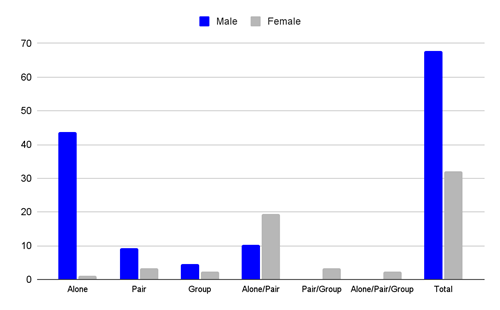
Graph 2: How the fishermen of Santo A. Leverger/MT fish by gender (in percentage).
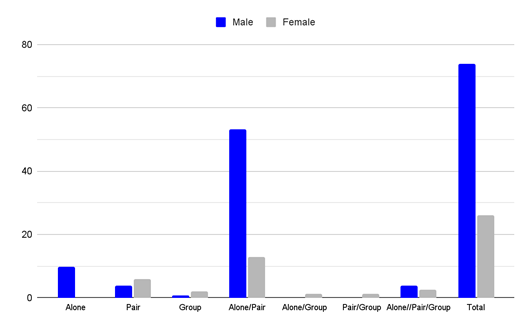
Graph 3: How the fishermen of Santo A. Leverger/MT fish by gender (in percentage).
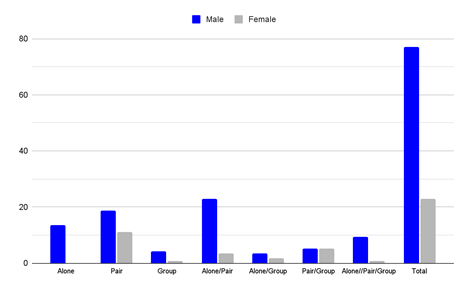
Graph 4: How the fishermen of Cáceres/MT fish by gender (in percentage).

Graph 5: How the fishermen of Poconé/MT fish by gender (in percentage).
Discussion of Results
The data on solitary fishing in Leverger stand out significantly when compared to the other colonies, as shown in Tables 6 and 7. Notably, the proportion of fishermen who fish alone and/or in pairs is only lower than those who just fish alone in Leverger (44.82% to 29.88%). In all the other fishing colonies, the proportion of those fishing alone and in pairs is higher than those who just fish alone. In Barão de Melgaço, the option of fishing alone and in pairs is 4.70 times greater (63.2% to 13.48%) than fishing alone. (Tables 6,7)

Table 6: Colony size by proportion of solitary fishing.
Note*: Source: prepared by the author.

Table 7: Comparison test between Leverger and the other colonies.
Note*: Source: prepared by the author. Significance 1%.

Table 8: Variation in number of colony members between 2016 and 2024.
Note*: prepared by the author.
The data indicate that in Leverger there are fewer non-zerosum games. The colony doesn´t operate as it used to. Fishermen used to sell fish there but they don’t anymore, and the now colony only works to solve bureaucratic problems for the fishermen, unlike other the colonies that have been operating normally. (Table 8) When making a comparison between the number of fishermen between 2016 and 2024, according to the colonies, there is a discrepancy between the number reported by the colonies and the real number of those who live solely from fishing. The colonies are guided by the General Register of Fishing Activity (RGP), registration includes any individual seeking to have a fishing guide. It is likely that the real number of professional fish in Leveger is overestimated. In Cáceres there were two colonies, apec (100) and Z2 (800) and now there are three, apec (200), Z2 (380) and appa (70). But the number of fishermen has decreased.
With regard to H2, the data are not significant for Poconé as shown in Tables 8 and 9. Here, it is necessary to make a caveat. In the first colony we interviewed, Leverger, the data on who the fishermen fished with encountered data collection issues. Some of the interviewers did not record the data. However, the statements of those interviewed is consistent with those of the women from the other colonies, i.e. when they say that they fish alone, on the riverbanks near their houses or on “rafts” (a floating wooden structure anchored or tied to the riverbank which is also close to their homes, as many of women from Leverger do). The only fisherwoman in Poconé who said she fished alone, fished on the riverbank next to her house. The family, she said, has a house in the Pantanal and they go there to fish, a common scenario among several fishermen in Poconé, as attested by the interviews. (Tables 9,10)

Table 9: Who men and women fish within the colonies.
Note*: Source: prepared by the author.

Table 10: Test comparison of differences between gender per colony.
Note*: Source: prepared by the author.
When they fish alone, they fish on the riverbank or on rafts near their homes. When fishing far from home, they often partner with friends, relatives, children, or husbands. In pairs, they typically fish alongside their husbands who are also professional fishermen.
Fishermen are even more restrictive when it comes to cooperative practices. If fisherwomen fish with friends, fishermen may fish with friends from the colony but, in general, the proportion is much lower than among women. They tend to fish primarily with their wives or their children.
Final Considerations
Professional fishing is a vital economic activity in the northern Pantanal. However, it has faced significant challenges in recent years. Fires that devastated large parts of the Pantanal, coupled with legislation banning fishing and the transport of several fish species, have severely constrained fishing as a livelihood. Examining non-zero-sum games provides insights into the fisherman’s social foundations and highlights the economic potential of exploring new strategies, including alternative economic activities.
Colonies are different in terms of organizations of social statuses. The study did not explore this dimension. As enforcement of the restrictions has been very strict, the fishermen are very wary, making it difficult for researchers to interact with them. But a reasonable hypothesis is that there are differences between the colonies regarding the number of non-zero-sum games and that the greater this number, the greater the importance of the colony for the fishermen and the community where it is inserted. The Leverger fishermen’s colony is currently closed.
The presence of fisherwomen in the colonies has increased in recent years. The data show that they tend to play more non-zero- sum games than fishermen. The president of the fishermen’s of Mato Grosso is a woman. The increasing presence of women in professional fishing challenges the traditional perception of fishing as a solitary activity in the northern Pantanal.
It is known that the type of fishing arrangements, whether in groups or in pairs, does not necessarily imply non-zero-sum games as a whole. You can go with a group to a certain fishing spot, but fish alone. You can travel in pairs, go to a location, have the company of another, but the fishing produce is individual. And you can fish in pairs, sharing the produce and costs. In other words, we have different combinations of zero and non-zero-sum games. Investigating fishing by differentiating it by gender and type of arrangement can provide good results in terms of enriching the concept of non-zero sum and distinguishing it from the notion of cooperation.
References
- Axelrod R (1986) The Evolution of Cooperation. New York: Basic Books, Inc Publishers.
- Axerold R, Hamilton WD (1981) The evolution of cooperation, Science 211: 1390-1396.
- Cosmides L, Tooby J (1992) Cognitive adaptations for social exchange. The Adapted Mind, New York/Oxford: Oxford University Press.
- Fehr E, Leibbrandt A (2011) A field study on cooperativeness and impatience in the tragedy of the commons. Journal of Public Economics 95(9): 10.
- Kollock P (1998) Social dilemmas: the anatomy of cooperation. Annual Review of Sociology 24: 183-214.
- Heckathorn DD (1996) The dynamics and dilemmas of collective action. American Sociological Review 61(2): 250-277).
- Hopcroft R (2010) Sociology - a biosocial introduction. London/Boulder: Paradigm Publishers.
- Horton P, Hunt C (1980) Sociology, São Paulo: McGraw-Hill.
- Lacerda ALR, Souza PCde. A systematic review of the Relationship between Self-Employment and Women Heads of Household. Repad - Journal of Studies and Research in Administration 4(1): 2020.
- Levine DM (2008) Statistics: theory and applications. Rio de Janeiro: LTC.
- Martin JL (2009) Social Structures. Princeton: Princeton University Press.
- Oliver P (1993) Formal models of collective action. Annual Review of Sociology 19: 271-300.
- Olson M (1999) The Logic of Collective Action. São Paulo: EDUSP.
- Park RE, Burgess EW (1921) Introduction to the science of sociology. University of Chicago Press, Chicago.
- Penn DJ, Mysterud I (2007) Evolutionary Perspectives on Environmental Problems. New Brunswick/London: Aldine Transaction.
- Pfeiffer T, Claudia Rutte, Timothy Killingback, Michael Taborsky, Sebastian Bonhoeffer (2005). Evolution of cooperation by generalized reciprocity.Proc R Soc 272(1568): 1115-1120.
- Pinker S (2013) Os bons Anjos da Nossa Natureza. SP: Companhia das Letras.
- Reis H (2008) Reinvigorating the concept of situation in social psychology. Personality and Social Psychology Review 12(4): 311-329
- Smith EA (2003) Human Cooperation - Perspectives from Behavioral Ecology, in Hammerstein, P. (Editor), Genetic and Cultural Evolution of Cooperation, London: The Mit Press.
- Trivers R (1971) The evolution of reciprocal altruism,.Quarterly Review of Biology 46(1): 35-57.
- Tsebelis G (1998) Jogos Ocultos, SP: Edusp.
- Turner JH (2000) Sociology - Concepts and Applications. São Paulo: Makron Books.
- Voland E (1993) Elementos de Sociobiologia. Lisboa: Instituto Piaget.
- Von Neumann J, Morgenstern O (2004) Theory of Games and Economic Behavior, Princeton: Princeton University Press.
- Wrigt R (2000) Não Zero, RJ: Editora Campus.




 We use cookies to ensure you get the best experience on our website.