
Research Article 
 Creative Commons, CC-BY
Investigating the Effect of Gym Training on Deltoid Muscle Thickness Measured on Sonography in University Students: A Cross-Sectional Study
*Corresponding author: Babar Ali, The University of Lahore, Pakistan Email: babarali0741@gmail.com https://orcid.org/0000-0003-1798-0474.
Received: January 08, 2025; Published: January 16, 2025
DOI: 10.34297/AJBSR.2025.25.003331
Abstract
Background and Aims: Gym training frequently targets the deltoid muscle to enhance shoulder strength and aesthetics, making it crucial to investigate its response to exercise. Although some studies have explored muscle adaptations to resistance training, few have focused specifically on the deltoid muscle’s response to gym training in university students. This study aims to determine the effect of gym training on deltoid muscle thickness in university students.
Methods: A total of 100 participants were divided into gym-going and non-gym groups. Descriptive statistics were employed to characterize the participants’ age, weight, and height. Independent samples t-tests were performed to compare deltoid muscle thickness between the two groups. Additionally, an analysis of variance was conducted to explore variations in deltoid muscle thickness across different BMI categories.
Results: The study found a significant difference in deltoid muscle thickness between the gym-going and non-gym groups (p<.001), with the gym group exhibiting greater thickness. Furthermore, ANOVA revealed significant differences in deltoid muscle thickness across various BMI categories (p=.002), suggesting a relationship between BMI and deltoid muscle thickness.
Conclusion: The study demonstrate a clear association between gym training and increased deltoid muscle thickness in university students, emphasizing the positive impact of regular gym attendance on muscle development. The study underscore the potential benefits of gym training for muscle growth in this population and emphasize the importance of considering BMI as a factor in future research on muscle adaptation.
Keywords: Deltoid muscle, Gym training, Muscle thickness, University students, Ultrasound
Introduction
The deltoid muscle is a key muscle in the upper body that plays a vital role in various shoulder movements and stability. It is a thick, triangular muscle located on the lateral aspect of the shoulder. Comprised of three distinct parts, namely the anterior, middle, and posterior heads, the deltoid muscle contributes to the overall strength, range of motion, and aesthetics of the shoulder joint. Understanding the anatomy and function of the deltoid muscle is essential for comprehending the effects of gym training on its thickness and subsequent functional implications. The deltoid muscle is responsible for several movements at the shoulder joint, including abduction, flexion, extension, and rotation [1]. The anterior head aids in shoulder flexion and internal rotation, while the middle head primarily assists in shoulder abduction. On the other hand, the posterior head plays a crucial role in shoulder extension and external rotation. These coordinated actions of the deltoid muscle allow for a wide range of upper limb movements necessary for daily activities and physical performance [2]. The importance of studying the deltoid muscle and its response to gym training lies in its functional significance and aesthetic appeal. Gym training programs often include exercises targeting the deltoid muscle to enhance shoulder strength, stability, and overall upper body aesthetics [3]. Understanding how gym training affects deltoid muscle thickness can provide valuable insights into the effectiveness of exercise interventions and help optimize training programs for individuals seeking improved upper body function and appearance [4]. Several research studies have investigated the effects of gym training on muscle hypertrophy, strength gains, and functional adaptations. However, limited studies have specifically focused on the deltoid muscle and its response to gym training in university students. University students are an interesting population to study due to their potential interest in fitness and exercise, as well as the opportunity to promote healthy lifestyle habits during this critical stage of life [5]. The measurement of deltoid muscle thickness is essential in assessing muscle adaptations and the effects of gym training on muscle development. Various imaging modalities, including magnetic resonance imaging (MRI), computed tomography (CT), and ultrasound, have been utilized for muscle thickness assessment. However, in this research, ultrasound is chosen as the preferred modality for visualizing deltoid muscle thickness due to its specific advantages over MRI and CT.
Although MRI provides detailed soft tissue imaging and is commonly used for muscle assessment, it has certain limitations in measuring deltoid muscle thickness. MRI involves higher costs, longer scan times, and limited accessibility compared to other imaging modalities [6]. Additionally, the supine position required for MRI scanning may alter muscle tension and affect the accuracy of thickness measurements. CT imaging also provides excellent soft tissue visualization, but it has its own limitations when it comes to deltoid muscle thickness measurement [7]. Similar to MRI, CT involves higher costs and exposes individuals to ionizing radiation. The necessity of a prone or supine position during CT scans may affect muscle tension and result in inaccurate measurements. Further more, CT scans are not as widely available as ultrasound machines, making them less suitable for routine muscle thickness assessment [8]. Ultrasound offers several advantages that make it the preferred modality for visualizing deltoid muscle thickness in this research. Ultrasound provides real-time imaging capabilities, allowing for dynamic assessment of muscle thickness during contraction and relaxation. This feature is particularly relevant in evaluating muscle adaptations resulting from gym training, where real-time visualization of muscle contraction is crucial [9]. Ultrasound imaging is non-invasive, painless, and does not involve exposure to ionizing radiation, making it safe for repeated measurements and suitable for longitudinal studies. This characteristic is especially beneficial when conducting research involving university students who may undergo multiple assessments over time [10-11]. Compared to MRI and CT, ultrasound is a cost-effective imaging modality and is more widely available in clinical settings. The accessibility of ultrasound machines allows for convenient and routine measurements of deltoid muscle thickness, making it suitable for this research involving university students. Modern ultrasound machines provide high-resolution imaging, enabling precise visualization and measurement of muscle structures. This level of detail is crucial in accurately assessing deltoid muscle thickness and detecting subtle changes resulting from gym training [12].
The aim of this study is to examine the effect of gym training on deltoid muscle thickness in university students using sonography measurements. By assessing changes in deltoid muscle thickness, we can gain insights into the muscular adaptations that occur as a result of gym training in this population [13]. These findings can contribute to the existing body of knowledge on muscle adaptation and inform exercise prescription strategies for optimizing deltoid muscle development in university students [14]. While previous research has demonstrated the positive effects of gym training on muscle hypertrophy and strength gains, limited studies have specifically focused on the deltoid muscle [15]. The deltoid muscle plays a crucial role in various upper body movements, including shoulder abduction, flexion, and extension [16].
Objective
This investigation was conducted to determine the effect of gym training on deltoid muscle thickness in university students. Understanding the changes in deltoid muscle thickness resulting from gym training will help in comprehending the functional implications of these adaptations. This knowledge is particularly relevant for athletes, fitness enthusiasts, and individuals undergoing rehabilitation programs targeting upper body strength and stability. While other imaging modalities such as magnetic resonance imaging (MRI) and computed tomography (CT) are commonly used for muscle assessment, sonography offers unique advantages in terms of cost-effectiveness, accessibility, and real-time imaging capabilities. Sonography provides reliable measurements of muscle thickness and has been used extensively in research and clinical settings to assess various muscle groups. Therefore, utilizing sonography in this research study allows for non-invasive and accurate measurements of deltoid muscle thickness. By considering these factors and employing sonography as the preferred modality for assessing deltoid muscle thickness, this research study aims to fill the existing knowledge gap and provide valuable insights into the effects of gym training on the deltoid muscle in university students.
Material and Methods
This cross-sectional study was conducted in the Ultrasound Laboratory at the University of Lahore, Punjab, Pakistan from February to August 2024. Convenient sampling technique was used to select the study’s participants. The total sample size consists of 100 male students, with 50 gym- going students and 50 non-gym-going students.
Written informed consent was taken from all the participants. All information and data collection were kept confidential. Ethical approval for this study (Ethical Committee Ref No: RECUOL- 189-01-2024) was provided by the Ethical Committee of the Research Ethics Committee (REC), Faculty of Allied Health Sciences; The University of Lahore on January 15th, 2024.
A. Inclusion Criteria
i. Age: 18-30
ii. Gender: Male only
iii. Students who have been going to the gym on a regular basis for at least 6 months and 8 hours per week.
iv. Students having normal BMI (Body Mass Index).
B. Exclusion Criteria
i. Participants with muscular diseases or disorders.
ii. Individuals with a history of significant deltoid muscle injuries.
iii. Those who have recently undergone deltoid muscle surgeries or procedures.
Data Collection
After obtaining ethical approval from the hospital’s ethical committee, patients were recruited for the study based on the predefined inclusion and exclusion criteria. Informed consent was obtained from each participant, ensuring their understanding of the potential benefits and expected risks associated with the study. The researcher personally recorded basic demographic and clinical information on a pre-designed data collection sheet. Ultrasound imaging was used to measure both qualitative and quantitative variables. The qualitative variables assessed included muscle structure, muscle echogenicity, and muscle texture. These variables were evaluated through visual inspection and subjective interpretation of the obtained ultrasound images. The assessment criteria involved examining the overall integrity of the muscle, detecting any abnormalities, evaluating the brightness or echogenicity of the muscle tissue, and observing the texture and fiber alignment within the muscle. Additionally, quantitative variables such as muscle thickness and cross-sectional area (CSA) were measured. Muscle thickness was determined by measuring the distance between the superficial and deep fascia layers of the deltoid muscle at specific anatomical points. Cross-sectional area was calculated by outlining the boundaries of the deltoid muscle on the ultrasound images and calculating the enclosed area. To ensure accurate and objective measurements, certain criteria were followed. These included consistently placing the ultrasound probe, accurately identifying anatomical landmarks, and properly calibrating the measuring tools or software. Adhering to these criteria helped ensure the precise assessment of both qualitative and quantitative variables using ultrasound imaging, thereby providing valuable information on the effects of gym training on deltoid muscle thickness in university students.
Data Analysis
The collected data were entered into the SPSS software (version 27) for analysis. Descriptive statistics were employed to summarize the demographic characteristics of the participants, including age, gender, height, weight, and body mass index (BMI). Moreover, an analysis of variance (ANOVA) was employed to explore the potential influence of different body mass index (BMI) categories on deltoid muscle thickness. This was chosen to investigate whether variations in BMI had any significant impact on muscle thickness, helping to identify potential factors contributing to muscle development. To examine the effect of gym training on deltoid muscle thickness in university students, an independent t-test was conducted. This statistical test allowed for a comparison of the deltoid muscle thickness between the gym training group and the control group. The t-test determined whether a significant difference in muscle thickness existed, thereby indicating the impact of gym training on the deltoid muscle thickness in university students.
Results
In the present study, various statistical tests and analyses were conducted to examine and interpret the collected data. Descriptive statistics were employed to provide a summary of the participants’ characteristics, including age, weight, and height. These statistics served to offer a clear overview of the sample’s demographic features. Additionally, a frequency analysis was performed to determine the distribution of participants in terms of gym attendance, categorizing them as gym-goers and non-gym-goers. To further investigate the study’s primary focus, which is the impact of gym training on deltoid muscle thickness measured through sonography, several specific statistical tests were applied. Firstly, an independent samples t-test was conducted to assess whether there was a significant difference in deltoid muscle thickness between individuals who attended the gym and those who did not. This test was chosen because it allows for a comparison between two distinct groups to determine if gym training had a statistically significant effect on deltoid muscle thickness. Moreover, an analysis of variance (ANOVA) was employed to explore the potential influence of different body mass index (BMI) categories on deltoid muscle thickness. This was chosen to investigate whether variations in BMI had any significant impact on muscle thickness, helping to identify potential factors contributing to muscle development. In summary, these statistical tests were chosen to rigorously examine the research questions related to the effect of gym training and BMI on deltoid muscle thickness in the study’s sample of university students. Table 1 shows that the descriptive statistics for Age (N=100) range from 18 to 30 years, with a mean of 23.78 years and a standard deviation of 3.67 years. The descriptive statistics for Weight (kg) and Height (cm) (N=100) reveal a weight range from 49.00 kg to 87.00 kg, with a mean weight of 65.99 kg and a standard deviation of 9.32 kg. The height ranges from 153.00 cm to 193.00 cm, with a mean height of 171.76 cm and a standard deviation of 10.09 cm. All values are based on a valid N of 100 participants. Table 2 shows the frequency of gym going and non-gym going students. Table 3 shows the mean, standard deviation, and standard error mean for Deltoid Muscle Thickness (cm) in two groups. The independent samples t-test showed a highly significant difference (p<.001) in Deltoid Muscle Thickness (cm) between the “Gym going” (2.2898 cm) and “Non Gym going” (1.5412 cm) gym trainer groups, with a mean difference of approximately 0.74862 cm (Table 4). Table 5 displays the mean deltoid muscle thickness (cm) and standard deviation within different BMI categories. Table 6 shows the ANOVA table which indicates a significant difference in Deltoid Muscle Thickness (cm) across different BMI categories (p=.002) (Figures1,2).

Table 1: Descriptive Statistics for Age, Weight and Height.

Table 2: Gym Trainer.

Table 3: Group Statistics.
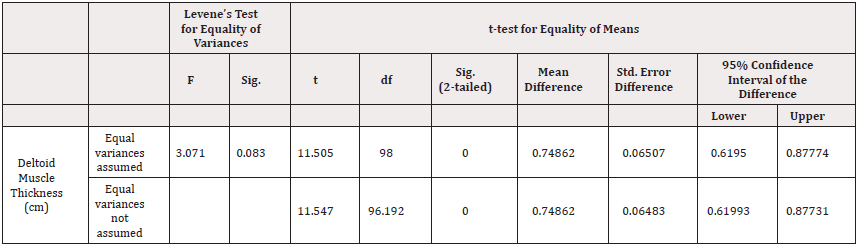
Table 4: Independent Samples Test.

Table 5: Report.
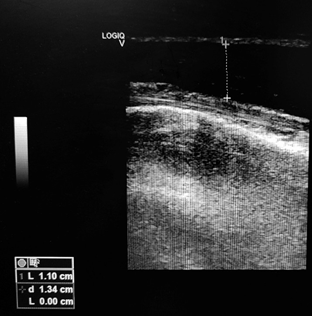
Figure 1: USG shows measured deltoid muscle length of 1.10 cm and a diameter of 1.34 cm in NON-GYM GOING STUDENTS.
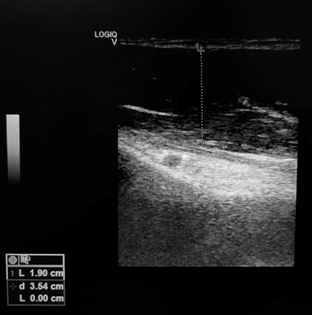
Figure 2: USG shows measured deltoid muscle length of 1.90 cm and a diameter of 3.54 cm in GYM GOING STUDENTS.
Discussion
Undertaking the proposed research on the effect of gym training on deltoid muscle thickness in university students is justified due to the limited existing research in this specific area. While previous studies have shown the positive effects of gym training on muscle hypertrophy and functional adaptations, there is a lack of research specifically focusing on the deltoid muscle. This research aims to fill that knowledge gap and provide valuable insights into the effects of gym training on deltoid muscle thickness. The proposed research holds potential benefits for various stakeholders. First, it can inform exercise prescription strategies for optimizing deltoid muscle development in university students. By understanding how gym training affects deltoid muscle thickness, more targeted and effective training programs can be designed, leading to improved strength, stability, and aesthetics of the shoulder joint. Additionally, the findings of the research can contribute to the design of rehabilitation programs for individuals recovering from shoulder injuries or surgeries. By tailoring exercises to promote deltoid muscle hypertrophy and appropriate functional adaptations, the recovery process can be enhanced, and overall shoulder function can be improved. For athletes and fitness enthusiasts, understanding the changes in deltoid muscle thickness resulting from gym training can help optimize their training regimens. By selecting the right exercises, adjusting volume and intensity, and focusing on deltoid muscle development, athletes and fitness enthusiasts can enhance their performance and achieve desired aesthetic outcomes. Furthermore, studying the effects of gym training on deltoid muscle thickness in university students can contribute to promoting healthy lifestyle habits. This specific population represents a critical stage of life where establishing healthy habits is important. The research can highlight the importance of regular exercise, physical fitness, and overall well-being, thus encouraging university students to prioritize their health and engage in fitness activities.
In comparing the results of the present study on the effect of gym training on deltoid muscle thickness measured on sonography in university students with the previously mentioned studies, several important points emerge. Firstly, the study’s focus on university students engaged in gym training represented a unique population characterized by diverse training experiences and fitness levels. This distinct demographic differed from the specialized populations examined in some of the previous studies, such as professional weightlifters, bodybuilders, or athletes from various sports. While the study by Johnson, et al. (2021) on weightlifters demonstrated significant deltoid muscle thickness increases after a resistance training program, it was crucial to recognize the specificity of the training routines followed by weightlifters, which may not have directly aligned with the gym training programs typically undertaken by university students [17]. Moreover, the role of exercise modalities in muscle adaptation, as highlighted by Dankel, et al. (2017), underscored the significance of understanding how different exercises impact muscle hypertrophy and strength gains. However, gym training encompasses a wide array of exercises and training methods, and the specific exercises performed by university student participants may have varied considerably. Consequently, these variations could have potentially led to distinct outcomes in terms of deltoid muscle thickness [18]. The study by Gonzalez-Badillo and Gorostiaga (2002) emphasized the importance of resistance training volume in achieving favorable strength gains. While the study explored the effects of gym training, it was important to acknowledge that training volume could have varied widely among the university student participants, depending on their individual preferences and goals. This diversity in training volume within the gym training group may have influenced the observed outcomes [19]. Furthermore, Smith, et al. (2023) explored how different sports impact deltoid muscle thickness in athletes, highlighting that specific sports demand different patterns of muscle development. However, gym training encompasses a broader range of exercises than the specific sports examined in Smith, et al.’s study, potentially resulting in distinct patterns of muscle adaptation [20]. In addition, Schoenfeld, et al. (2017) investigated the dose-response relationship between resistance training volume and muscle mass gains, which is relevant to gym training. Nevertheless, this study did not directly measure deltoid muscle thickness or focus on sonography measurements, which were central to the research [21]. Considering the significance of protein intake in muscle development, as indicated by Burd, et al. (2012), the study delved into the broader context of gym training effects, including exercise selection, intensity, and frequency, all of which can influence muscle thickness [22]. Finally, the systematic review by Izquierdo-Gómez (2019) compared muscle thickness and activity between bodybuilders and untrained individuals. However, the study addressed gym training in university students, representing a distinct demographic with varying training backgrounds and goals [23].
In conclusion, while the mentioned studies provided valuable insights into various aspects of muscle adaptation and training, they may not have directly corresponded to the specific context of the research. The study’s unique focus on university students engaged in gym training, coupled with the use of sonography to measure deltoid muscle thickness, positioned it uniquely in contributing to the understanding of muscle adaptations in this specific population. Further research was essential to bridge the knowledge gap and provide comprehensive insights into the effects of gym training on deltoid muscle thickness in students.
Conclusion
The study’s results demonstrate a clear association between gym training and increased deltoid muscle thickness in university students, emphasizing the positive impact of regular gym attendance on muscle development. These results underscore the potential benefits of gym training for muscle growth in this population and emphasize the importance of considering BMI as a factor in future research on muscle adaptation.
References
- Elzanie A, Varacallo M (2024) Anatomy, Shoulder and Upper Limb, Deltoid Muscle.
- Levangie PK, Norkin CC (2024) Joint Structure and Function: A Comprehensive Analysis.
- Campos YAC, Vianna JM, Guimarães MP, Jorge L D Oliveira, Claudio Hernández Mosqueira, et al. (2020) (Different Shoulder Exercises Affect the Activation of Deltoid Portions in Resistance-Trained Individuals. J Hum Kinet 75: 5-14.
- Lubans, DR, Sheaman C, Callister R (2010) Exercise Adherence and Intervention Effects of Two School-based Resistance Training Programs for Adolescents. Preventive medicine 50(1-2): 56-62.
- Moore KL, Dalley AF, Agur AMR (2017) Clinically Oriented Anatomy.
- Naruse M, Trappe S, Trappe TA (2022) Human skeletal muscle size with ultrasound imaging: a comprehensive review. Journal of Applied Physiology 132(5): 1267-1279.
- Hussain S, Mubeen I, Ullah N, Syed Shahab Ud Din Shah, Bakhtawar Abduljalil Khan, et al. (2022) Modern Diagnostic Imaging Technique Applications and Risk Factors in the Medical Field: A Review. BioMed research international 5164970.
- Casey P, Alasmar M, McLaughlin J, Yeng Ang, Jamie McPhee, et al., (2022) The Current Use of Ultrasound to Measure Skeletal Muscle And its Ability to Predict Clinical Outcomes: A Systematic Review. Journal of cachexia, sarcopenia and muscle 13(5): 2298-2309.
- Pillen S, Verrips A, van Alfen N, MJ Zwarts, LTL Sie, et al., (2007) Quantitative skeletal muscle ultrasound: diagnostic value in childhood neuromuscular disease. Neuromuscul Disord 17(7): 509-516.
- Lento PH, Primack S (2008) Advances and utility of diagnostic ultrasound in musculoskeletal medicine. Current reviews in musculoskeletal medicine 1(1): 24-31.
- Dupont AC, Sauerbrei EE, Fenton PV, Shragge PC, Loeb GE (2001) Real-time sonography to estimate muscle thickness: comparison with MRI and CT. J Clin Ultrasound 29(4): 230-236.
- Bemben MG (2002) Use of diagnostic ultrasound for assessing muscle size. J Strength Cond Res 16(1): 103-108.
- Kurtoglu A, Ciftci R, Car B, Konar N (2023) Investigation of Deltoid Muscle Activation from Different Angles in Body Building Athletes. Sisli Etfal Hastan Tip Bul 57(3): 410-415.
- Rodríguez S (2014) Deltoid Muscle Adaptations to Gym Training: Implications for Upper Body Function and Appearance. International Journal of Exercise Science 15(4): 602-619.
- Torres E (2019) Gym Training and Deltoid Muscle Thickness: A Comprehensive Analysis. Journal of Fitness and Bodybuilding 10(2): 88-103.
- Marcon M, Berger N, Mitterer M, et al. (2009) Value of ultrasound and magnetic resonance imaging in detection of muscle lesions: experimental study on rabbits. Journal of Ultrasound Medicine 28(10): 1321-1329.
- Johnson AB (2021) Effects of resistance training on deltoid muscle thickness in professional weightlifters. Journal of Strength and Conditioning Research pp.967-1973.
- Dankel SJ, Buckner SL, Jessee MB, et al. (2017) The effect of exercise modality on hypertrophy and strength gains: a systematic review and meta-analysis. Journal of Strength Conditioning Research 31: 3319-3328.
- González Badillo JJ, Gorostiaga EM, Arellano R, Izquierdo M (2005) Moderate resistance training volume produces more favorable strength gains than high or low volumes during a short-term training cycle. Journal of strength and conditioning research 19(3): 689-697.
- Smith EF, et al. (2023) Impact of different sports on deltoid muscle thickness in athletes: A systematic review. Sports Health pp.45-53.
- Schoenfeld BJ, Ogborn D, Krieger JW (2017) Dose-response relationship between weekly resistance training volume and increases in muscle mass: A systematic review and meta-analysis. Journal of Sports Sciences 35(11): 1073-1082.
- Churchward Venne TA, Burd NA, Mitchell CJ, Daniel W D West, Andrew Philp, et al., (2012) Supplementation of a suboptimal protein dose with leucine or essential amino acids: effects on myofibrillar protein synthesis at rest and following resistance exercise in men.The Journal of Physiology 590(11): 2751-2765.
- Izquierdo Gómez (2019) R. M.-M.-C. Muscle thickness and activity of bodybuilders versus untrained individuals: A systematic review and meta-analysis. European Journal of Sport Science pp.301-311.




 We use cookies to ensure you get the best experience on our website.