
Case Report 
 Creative Commons, CC-BY
Clinical Case of Linear Morphea (Sabre Cut) Regenerative Strategy Utilizing a Combination of Facial Adipostructuring and PDO Threads
*Corresponding author: Gladys Velazco, building attached to the rector’s office of the Universidad de Los Andes Merida Venezuela, Colombia.
Received: February 13, 2025; Published: February 19, 2025
DOI: 10.34297/AJBSR.2025.25.003382
Abstract
Linear morphea (coup de sabre) is a rare variant of localized scleroderma characterized by progressive fibrosis of the skin and subcutaneous tissue, significantly affecting facial aesthetics and quality of life. This study presents the case of a 23-year-old patient diagnosed with linear morphea, who was treated using an innovative combination of Facial Adipostructuring and Polydioxanone (PDO) threads [1]. The therapeutic protocol involved three sessions conducted at 21-day intervals, aimed at restoring facial volume, restructuring subcutaneous tissue, and stimulating neocollagenesis. Post-treatment evaluation, which included anthropometric measurements, demonstrated an 80% reduction in the depth of facial depression, a 60% increase in dermal thickness in the affected area, and a notable enhancement in facial symmetry. Furthermore, the patient reported an increase in self-esteem and a reduction in anxiety concerning her physical appearance. This study underscores the potential of facial adipostructuring and PDO threads as a safe and effective therapeutic strategy for linear morphea, yielding promising outcomes in tissue regeneration and aesthetic enhancement.
Keywords: Morphea; Juvenile localized scleroderma; Autoimmune, adipostructuring, PDO
Introduction
Morphea, or localized scleroderma, is a chronic autoimmune disorder characterized by excessive fibrosis of the skin and underlying connective tissue [2-4]. This fibrosis results from a complex interplay of genetic, immunological, and environmental factors that lead to fibroblast activation, collagen overproduction, and extracellular matrix accumulation. Linear morphea, commonly referred to as “coup de sabre,” is a specific variant of the disease that presents as an atrophic, sclerotic band following a linear trajectory, often located on the forehead or scalp [5]. This form can result in significant facial deformities, alopecia, and a detrimental psychological impact on patients, particularly children and adolescents.
The pathophysiology of linear morphea is characterized by a chronic inflammatory response marked by the infiltration of T lymphocytes, macrophages, and mast cells within the affected dermis. These cells secrete proinflammatory cytokines, including Tumor Necrosis Factor Alpha (TNF-α) and Interferon Gamma (IFN-γ), which enhance collagen synthesis by fibroblasts. Furthermore, an upregulation of growth factors, particularly Transforming Growth Factor Beta (TGF-β), has been noted, facilitating fibrosis and the differentiation of myofibroblasts.
The management of linear morphea continues to pose challenges, with existing therapeutic options, including topical or intralesional corticosteroids, phototherapy, and systemic immunosuppressants, demonstrating limited efficacy and potential for considerable side effects [6]. In this regard, facial adipostructuring and the use of PDO threads present an innovative and promising therapeutic alternative (Figures 1,2).

Figure 1: 1a, 1b, 1c: Depressed underlying frontal region in the supra and superciliary areas adjacent to the facial midline prior to treatment. Figure 1b illustrates the response following the initial session of the protocol. Figure 1c displays the outcome achieved in the second session of the hybrid protocol.

Figure 2: In the illuminated region, a hypopigmented lesion is observed in an area obscured by adjacent hair. Alopecia is present in a 3 cm section that extends into the scalp. The underlying bone exhibits a depression, particularly in the supra- and superciliary regions, where the lesion originated, extending both upwards and downwards. The lesion is situated adjacent to and parallel with the midline, impacting a moderately large area in the left eyebrow region. The underlying depressed area is noted in the supraciliary region and towards the facial midline. Figures 2a, 2b, and 2c illustrate the progression of the protocol implemented in each session.
Case Report
A 23-year-old female patient presented at the age of 19 in 2021 with a pearly, shiny plaque lesion located in the left frontal region, arranged linearly and atrophic, matching the skin colour. The lesion exhibited persistence of the pearly plaque in its lower portion, accompanied by alopecia in three focal points of the affected scalp area. Following a clinical diagnosis of scleroderma coup de sabre, an immunological study was initiated to determine the appropriate treatment [7-9].
The patient’s medical history revealed no prior pathologies, no facial or bodily alterations, and no familial history of chronic or autoimmune diseases. She sought primary care due to a lesion in the frontal region that had been evolving for three months. Initially, she exhibited a depression in the left frontal area accompanied by hyperpigmentation measuring 2 to 3 cm in diameter, followed by the emergence of alopecia in three distinct areas.
In clinical laboratory analysis, no significant alterations were observed, with no evidence of abnormalities such as positive antinuclear antibodies, single-chain DNA antibodies, rheumatoid factor, anticentromere antibodies, or an accelerated erythrocyte sedimentation rate as indicators of any irregularity. A conclusive diagnostic test was conducted using Doppler ultrasound, which revealed a reduction in dermal and hypodermic echogenicity, as well as subcutaneous cellular tissue in the middle and lower thirds of the anterior frontal facial segment and scalp.
Ultrasound Indicators
Findings consistent with Morphea, exhibiting ultrasound indicators of activity in the central segment of the middle and lower thirds of the anterior frontal facial region, as well as in the scalp at the level of the central segments of the frontal, posterior parietal, and occipital regions (Figures 3,4).

Figure 3: 3a Outcome following three sessions in the frontal region treated in planes 3, 4, and 5 as indicated in Figure 3b. Figure 3b: n1 Superficial fat, n2 Fibers of the frontal muscle and deep fascia, n3 Skin, n4 Periosteum, n5 Bone tissue. Planimetric design on a cadaver utilizing the Adipostructuring technique and PDO threads. (Image courtesy of CLEMI Foundation).
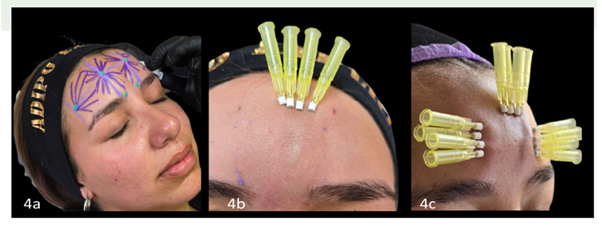
Figure 4: 4a. Facial paint utilized in panniculometry marking for adipostructuring of the frontal region. 4b: Linear and lateral design employing PDO threads in the frontal depressive and atrophic area. 4c: Application design featuring an interconnected mesh to achieve a supportive effect.
Discussion
This clinical case exemplifies the potential of facial adipostructuring and PDO threads as an innovative and effective therapeutic strategy for linear morphea. The integration of these techniques facilitated substantial volumetric correction, stimulated tissue regeneration, and enhanced skin quality in the affected region.
The results obtained align with prior studies that have established the effectiveness of facial adipostructuring in addressing skin atrophy and depressed scars. Autologous fat, abundant in mesenchymal stem cells, functions as a “biological filler” that not only rectifies volumetric deficiencies but also fosters tissue regeneration and neocollagenesis [10].
PDO threads enhance the process of facial adipostructuring by delivering a lifting effect, stimulating collagen synthesis, and fortifying the dermal structure. The integration of these techniques yields results that are both enduring and natural.
This clinical case offers initial evidence regarding the efficacy of facial adipostructuring and PDO threads in the treatment of linear morphea. This therapeutic combination presents a promising alternative to traditional treatments, yielding encouraging aesthetic and functional outcomes (Figure 5).

Figure 5a, 5b: Depressed underlying region in the supra- and superciliary zones adjacent to the frontal facial midline, observed before and after three sessions. Figure 5c, 5d: Depressed underlying region in the supra- and superciliary zones adjacent to the anteromedial facial midline, observed before and after a three- session protocol.
General Objective
To assess the efficacy and safety of facial adipostructuring using PDO threads in the treatment of linear morphea, focusing on its effects on tissue regeneration, correction of volumetric defects, and restoration of facial architecture.
Specific Objectives
a) Describe the clinical characteristics of the patient with linear morphea, encompassing the location, extent, and severity of the lesions.
b) To assess the volumetric effects of facial adipostructuring, one must measure the decrease in the depth of facial depressions through standardized photographs and anthropometric measurements.
c) Document the patient’s clinical progress, noting enhancements in facial symmetry, skin texture, and hair regeneration. To evaluate patient satisfaction regarding treatment outcomes through self-assessment scales and quality of life questionnaires.
Assessment
a) Clinical evaluation: Standardized photographs were captured prior to each session and during post-treatment assessments (1 month, 2 months, and 3 months). The evaluation focused on facial depression depth, facial symmetry, skin texture, and hair regeneration.
b) Satisfaction evaluation: A Visual Analogue Scale (VAS) was employed to evaluate patient satisfaction regarding treatment outcomes in terms of aesthetics and quality of life.
Informed consent was secured from the patient for the publication and dissemination of this clinical case, which includes the use of photographs illustrating the pre- and post-treatment conditions. The consent process adhered to the ethical principles of autonomy, confidentiality, and anonymity, ensuring that no personal information the amperage and torque cannula on the frontal panniculopathic system.
A 23 G - 40 mm cannula is employed to administer microdoses of 0.1 ml per designated vector in each frontal fatty compartment of the active ingredients constituting the panniculopathic restructuring system.
capable of identifying the patient was disclosed. The purpose of the report was thoroughly explained, emphasizing its role in the advancement and assessment of new therapeutic strategies for the treatment of linear morphea.
Methodology
We present the case of a 23-year-old patient diagnosed with linear morphea, confirmed through clinical evaluation, high-resolution ultrasound, and skin biopsy. The patient exhibited a linear atrophic lesion in the right frontal region, characterized by cutaneous depression, alopecia, and facial asymmetry. Informed consent was obtained from the patient for both the procedure and the publication of this clinical case.
The patient received three sessions of facial adipostructuring utilizing PDO threads, conducted at 21-day intervals (October 13, October 28, and December 17, 2024).
Facial adipostructuring: attaining gradual and uniform volumetric correction. In each session, frontal fat pads were redistributed, and the fibroconnective system was reinforced in ligamentous regions. Application of PDO Threads: Biostimulating PDO threads were utilized. A total of 80 threads were inserted in a mesh vector configuration, providing structural support to achieve a lifting effect, stimulate collagen production, and reinforce the dermal structure.
The Adipostructuring Technique (AST), defined as “the panniculopathic reorganization of the facial fat compartments based on their structure, physiology, and biomechanics, without extraction under any circumstances,” was executed in the upper frontal third with the application of Adipoestructure Mioface Harmony (AMH), registered with the Public Health Institute of Chile (ISP) 2601C.
One session per month for a duration of three months. Regular application of Aphrodite Polydioxanone (PDO) monofilament threads, ISP 2616/23. Cannular carving technique, executing movements with the amperage and torque cannula on the frontal panniculopathic system.
A 23 G - 40 mm cannula is employed to administer microdoses of 0.1ml per designated vector in each frontal fatty compartment of the active ingredients constituting the panniculopathic restructuring system.
Protocol
In the upper frontal region, the three frontal adipose tissues are rejuvenated, reducing the depressive and atrophic areas in the upper third. By repositioning and reinforcing the retaining ligaments, we close the interstitial spaces, resulting in an increase in soft tissue volume and thickness within the subcutaneous layer. This enhancement in resistance fosters bio stimulation within the fibroconnective tissue.
The activation of mechanoreceptors governing proprioceptive mechanisms to initiate the ligament reflex in the interfacing muscles facilitates the replacement and restructuring of tissue compromised by the pathology.
Initially, a change in skin colour occurred in the frontal region, leading to a lack of pigmentation, enhanced turgor, improved viscoelasticity, and the absence of a supra- and superciliary depressive area. Outcome of the treatment utilizing the adipoestructure kit in conjunction with steps 2 and 3, along with 30g x 38mm threads in the application of polydioxanone structural mesh, employing a technique developed without fillers and entirely biocompatible, ensuring safety during the procedure and for the patient. Achieving a natural balance devoid of rigidity and facial disproportions [11-14].
“Commence the initial session of Adipostructuring on 10/13/2024, followed by the second session on 10/28/2024 and the third session on 12/17/2024. Facial fat is a highly compartmentalized tissue, rather than a confluent mass delineated by vascularized boundaries [15,16]. The technique necessitates a comprehensive analysis of the affected area to be treated in the upper third of the face, specifically in the frontal region. With the adipostructuring technique, treatment initiates in the upper third, addressing both the adipose pannicles and the interceptal spaces. Three sessions are conducted, with a 21-day interval between each. Utilizing the adipostructure kit serves as an alternative to restore anatomical and cellular order, enhance the frontal and ligamentous panniculopathic condition, and achieve the reestablishment of biological balance, thereby amplifying the aesthetic and functional outcomes anticipated by patients.”
Conclusions
a) Results The treatment outcomes demonstrated a marked enhancement in the patient’s facial appearance.
b) Reduction in facial depression: A reduction of 80% in the depth official depression was observed, as assessed through standardized photographs and anthropometric measurements.
c) Enhanced facial symmetry: A significant enhancement in facial symmetry was noted, accompanied by a decrease in midline deviation.
d) Improvement in tone and tissue turgor in the affected area, becoming imperceptible after three sessions.
e) Hair regeneration: Fine hair growth has been noted in the region previously impacted by alopecia.
f) Patient satisfaction: The patient expressed a high level of satisfaction with the treatment outcomes.
Furthermore, she noted an enhancement in her self-esteem and a reduction in anxiety associated with her vulnerability regarding her physical appearance.
Conflicts of Interest
None.
Acknowledgements
None.
References
- Sánchez Carpintero I, Ruiz Rodriguez R (2019) Polydioxanone threads: A comprehensive literature review. J Cosmetic Dermatol 18(4): 1058-1063.
- Fett N, Werth VP (2011) Morphea Update: Part I. J Am Acad Dermatol 64(2): 217-228.
- Kim JY, Park KY (2019) Facial fat grafting: Current status and future prospects. J Korean Med Assoc 62(12): 636-644.
- Kreuter A (2019) Localized scleroderma. Dermatol Ther 32(2): e12890.
- Torok KS (2012) Pediatric scleroderma: systemic andlocalized forms. Pediatr Clin North Am 59(2): 381-405.
- Zulian F, et al. (2005) Consensus-driven recommendations for the management of juvenile localized scleroderma. Arthritis Care Res 52(2): 283-293.
- Weibel L, Planchon S, Wolkenstein P (2020) Localized scleroderma: Clinical spectrum, outcomes, and treatment. Best Practice Res Clin Rheumatol 34(1): 101534.
- Fett N (2021) Linear Scleroderma “In Sabre Strike.” Curr Treat Options Rheumatol 7(1): 105-117.
- Parodi A, Cozzani E (2022) Localized Scleroderma: A Review of Classification, Diagnosis, and Treatment. J Immunol Research: 1-14.
- Tremp M, Di Candia V, Amherd Hoekstra A, Mureau MAM (2020) A thorough review of the literature on autologous fat grafting for facial rejuvenation. Plastic Reconstruct Surger Global Open 8(12): e3353.
- Kim HJ, Kim MN, Chung JH (2020) The application of polydioxanone threads in aesthetic dermatology. J Cosmetic Dermatol 19(10): 2477-2488.
- VG Guevara (2020) Active ingredients utilized in the execution of the adipostructuring technique: Mechanism of action. Acta Bioclinica 10: 287-313.
- Tadini KA, Campos PM (2009) In vivo effects on skin of a formulation containing Dimethylaminoethanol (DMAE). Pharmaceuticals 64: 818-822.
- Cao Y, Qu HJ, Li P, Wang CB, Wang LX, et al. (2011) A single-dose administration of L-carnitine enhances antioxidant activities in healthy individuals. Tohoku J Exp Med 224(3): 209-213.
- Longo B, Lattarulo S, Porto A (2023) Facial Fat Grafting: A Comprehensive Review of Techniques, Applications, and Outcomes. Aesthetic Surger J 43(1): 101-112.
- Gentile P (2021) Fat grafting in aesthetic and reconstructive surgery. Facial Plastic Surger 37(5): 549-559.




 We use cookies to ensure you get the best experience on our website.