
Case Report 
 Creative Commons, CC-BY
Case Report: Old Total Ruptur Perineal
*Corresponding author: Trisha Alya Rahmi, General Practitioner in Woman and Children Bunda Hospital, Indonesia.
Received: August 20, 2024; Published: September 19, 2024
DOI: 10.34297/AJBSR.2024.24.003164
Abstract
Background: This manuscript presents a unique case report detailing a successful sphincteroplasty and perineorrhaphy caused by perineal laceration was not treated adequately and causes a total perineal defect
Case Presentation: A 36-year-old woman is the subject of this case report. She achieved successful sphincteroplasty and perineorrhaphy caused by old perineal rupture.
Conclusion: Perineal laceration is not treated thoroughly and can cause total perineal defect. In advanced conditions, perineal lacerations can cause anal incontinence. Anal incontinence is a condition in which the patient is unable to control flatus or stool, thus interfering with the quality of life.
Keywords: Old Total Perineal Ruptur, Sphincteroplasty, Perineorrhaphy
Introduction
A perineal laceration can occur at the time of delivery. The severity of the tear depends on the extension of the laceration to the anal sphincter. The injuries to the anal sphincter occur in 1-9% of all cases of vaginal delivery. Of these incidence rates, 0.03-0.2% were fourth-degree cases of vaginal injuries. The injuries to the perineum can be diagnosed at the time of delivery so that treatment can be done immediately. However, in some areas with incomplete health facilities, perineal laceration is not treated adequately and causes a total perineal defect. In advanced conditions, perineal lacerations can cause anal incontinence. Anal incontinence is a condition in which the patient is unable to control flatus or stool, thus interfering with the quality of life.1,2 In this case, a 36 years old woman who experienced hold back feces and hold back flatus since 10 years ago after vaginal delivery.
Case Illustration
A 36 year old women came to the Policlinic Urogynecology Dr. M. Djamil Hospital Padang on December 06th 2023, with chief complaints unable to hold back feces and holding back flatus since 10 years ago. According to the patient, the patient had experienced this complaint since giving birth to her first child with spontaneous labor and extensive birth wounds. The day after giving birth, the patient complained of feces coming out of the vagina, but the complaint disappeared after 1 month, but the complaint was that she could not hold back her bowel movements and the flatus remained. There are no complaints about urination. The patient is sexually active, there is no pain during intercourse and there is no post coital bleeding. The patient's birth history with vaginal delivery in 2013 with birth weight is 2950 gr, 2016 with birth weight is 2800 gr, 2019 with birth weight is 3100 gr and 2021 with birth weight is 2900 gr.
Vital sign in this patient was stable and the patient’s BMI is norm weight. There is no abnormality of general examination. On gynecological status examination, no abnormalities were found in the abdomen or genitalia. On inspection, the anterior and posterior vaginal mucosa was smooth, a skin bridge appeared on the perineum, and no perineal body was visible. The portio looks smooth and there are no lacerations. On rectal toucher examination, a defect in the anus in the 11-13 o'clock direction was palpable. The dove tail was positive and the pit rolling test was positive. Ultrasound found defects in the IAS and EAS in the 11-13 o'clock direction. The patient was diagnosed with fecal incontinence ec old total perineal rupture.
The patient underwent sphincteroplasty and perineorrhaphy under spinal anesthesia. The anus and vagina are directly connected, then a transverse incision is made at the border of the vagina and anal mucosa. A sharp dissection is performed between the vaginal mucosa so that it is mobile enough and separated from the anal mucosa. Identify the external anal sphincter and free it up to the ischio anal fat until mobile enough. The anal mucosa was sutured interrupted with PGA 3.0 with an intralumenal knot. The internal anal sphincter was stitched with a horizontal mattress using PGA 3.0 and the internal anal sphincter was stitched overlapping with PGA 2.0. The bulbocavernosus muscle was also sutured with 1 interrupted suture with PGA 2.0, then continued with perineorrhaphy with PGA 2.0. Bleeding during surgery was around 100 cc (Figures 1,2).
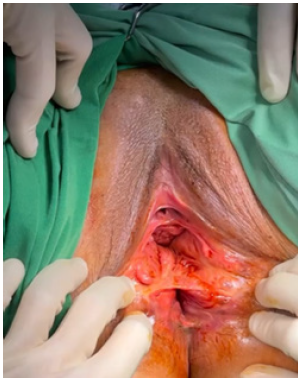
Figure 1: Old total perineal rupture.
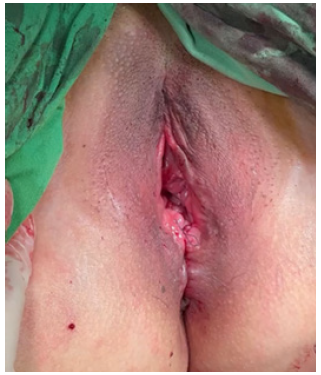
Figure 2: Post sphincteroplasty and perineorrhaphy.
Discussion
This patient came with chief complaints unable to hold back bowel movements and holding back flatus since 10 years ago. This patient had a history that one day after giving birth to her first child, the patient complained of feces coming out of the vagina, but the complaint disappeared on its own after 1 month later, but the complaint was that she could not hold back her bowel movements and the flatus remained. In this patient there were no complaints of sexual function and perineal pain.
The anal sphincter complex, the anorectal mucosa, and the perineal body are frequently injured by vaginal lacerations. Asian ethnicity, nullipara, birth weights greater than 4 kg, shoulder dystocia, occipito-posterior position, prolonged second stage of labor, use of instruments during delivery, and induction of labor are risk factors for perineal injury. These factors also appear to contribute to the development of perineal tears. The identification of the degree of laceration and primary repair are steps that are efficient, cost-effective and improve the quality of life. But occasionally, the medical professionals helping with birthing are unable to determine the extent of the damage, thus the treatment is inadequate [1,2].
Injuries to the obstetric anal sphincter happen in 0.6-4.2% of vaginal births. The chance of experiencing both short- and long-term fecal incontinence symptoms is increased in individuals with a history of sphincter injury. According to endoanal ultrasonographic studies (EAUS), 3-75% of women still have an external anal sphincter (EAS) dysfunction three years or more following primary sphincter repair. Women with a history of anal sphincter injuries frequently report worsening sexual function and bladder control, as well as perineal pain, in addition to the impairment resulting from fecal incontinence [2].
Endoanal ultrasonography can be used prior to surgery to evaluate the pudendal nerve injury and identify the type of anal sphincter lesion. Restoration of the internal and EAS structures is the goal of surgery. An effective repair may lead to the anal canal lengthening and function returning. Reconstructive surgery may be performed under epidural anesthesia. Furthermore, the anesthetic administered has the ability to relax the anal sphincter, allowing for tension-free anal sphincter fusion. Suturing can be done with delayed absorbable polymers such polyglactin 910 and polyglycolic acid. This substance does not dehisce or cause significant discomfort, necessitating the usage of analgesics [1,3].
A variety of surgical methods can be used to treat a perineal laceration. One can suture the IAS independently. This layer requires a very accurate re-approximation as well as the proper strength and integrity of the repair. This is as a result of IAS's significant contribution to continence maintenance. Compared to IAS, the EAS look will seem darker. End-to-end or overlapping plication of the injured muscle can be used to repair the EAS. The EAS capsule can be sutured using a figure-of-eight or interrupted method. Subsequently, the anal sphincter can be supported by suturing the perineal muscles. Sometimes, the end-to-end method does not produce the desired results [1,4].
Therefore, the obstetricians use overlapping repair to correct the defect and fecal incontinence with a better outcome. It is possible to suture skin, perineal muscles, and vaginal tissue using the continuous non-locking suturing technique. After the repair, a rectovaginal exam should be done to make sure everything was done correctly. It is possible for symptoms to improve three to six months after surgery [1].
Conclusions
In conclusion, perineal laceration is not treated thoroughly and can cause total perineal defect. In advanced conditions, perineal lacerations can cause anal incontinence. Anal incontinence is a condition in which the patient is unable to control flatus or stool, thus interfering with the quality of life.
References
- Djusad S, Kouwagam AD (2023) Repair of old total perineal rupture: a case series. J Surg Case Rep 2023(1): rjac628.
- Spinelli A, Laurenti V, Carrano FM, Gonzalez Díaz E, Borycka Kiciak K (2021) Diagnosis and Treatment of Obstetric Anal Sphincter Injuries: New Evidence and Perspectives. J Clin Med 10(15): 3261.
- R RK, Chigateri S, Kamat L, Divya D (2018) Surgical management of chronic fourth degree perineal tear: a single center experience. Int J Reprod Contracept Obstet Gynecol 7(12): 4919.
- Santoso BI, Chan N, Tanamas L (2019) Old Perineal Rupture - From Diagnosis to Reparation. Indonesian Journal of Obstetrics and Gynecology 7(3): 238-241.




 We use cookies to ensure you get the best experience on our website.